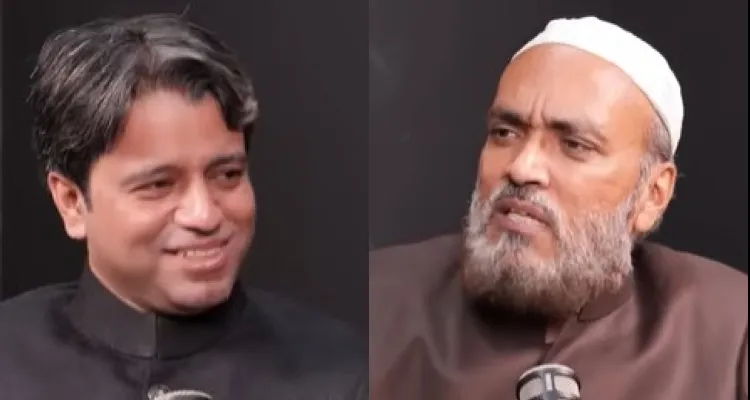
.webp "Saquib Salim and Prof Waris Mazhari, in Deen aur Duniya")
New Delhi
Dars Nizami, the multi-layer curriculum used in Islamic seminaries (madrasas) to train students to become scholars, imams, and muftis, has been a topic of debate for a long time. The question is whether the same curriculum is being taught in madrasas today that was compiled two or three centuries ago. Has there been no change in it despite the changing times? To find answers to these important questions, Saquib Salim of Awaz-the Voice spoke in detail with the renowned researcher and professor of the Department of Islamic Studies at Jamia Hamdard, Waris Mazhari, on his podcast Deen aur Duniya.
Here are the excerpts from the second part of the interview:
Then why did it become difficult to change the curriculum later?
Over time, a kind of sanctity came to be attached to the curriculum. Later generations came to think that since our great scholars had formulated this curriculum and through it great scholars were born, there was no need to change it. As a result, every reform proposal faced caution or opposition.
What is the main argument of those who oppose reforms in madrassas?
It is commonly argued that this curriculum has produced great scholars and intellectuals in the past. Therefore, there is no need to change it. Interestingly, many of the people who support this opinion on social media have not themselves studied in madrassas, but they also argue in favour of maintaining the current curriculum as it is. This thinking further complicates the debate on madrassa reforms.
Where do the ideas of those who oppose reforms in madrassas come from?
The fact is that many people who air their opinions on this subject are not familiar with the system of the madrasas. Unless one understands the entire academic tradition and background of the madrasas, it is difficult for one to form a balanced opinion. On the other hand, those who know the madrasas closely generally agree that the madrasas have played a fundamental role in Muslim society and continue to do so. Their opinion is not that the madrasas should be abolished, but that they should be made better and more effective in accordance with the requirements of the present era.
Is it right to always maintain the old curriculum?
Every era has its own requirements. The sciences of the times of Imam Ghazali, Ibn Taymiyyah, Ibn Rushd, Ibn Sina and Farabi cannot be taught in the same form today. When Darul Uloom Deoband was established in the 19th century, the world's educational system was also different. Today, science, technology, artificial intelligence and modern research have changed the world of knowledge. Therefore, changes in the curriculum are also necessary according to the times. However, the spirit and basic purpose of religious education should remain intact.
Is the purpose of madrasas to produce doctors and engineers?
No. The main objective of madrasas is to produce scholars who have a keen eye for the Quran, Hadith, Fiqh, Usul Fiqh and other religious sciences. It is not the main responsibility of madrasas to produce doctors, engineers or other professionals. However, it is essential that the religious scholars also have the ability to understand modern society.
Is there still a need for as many scholars today as there was in the past?
This is an important question. The religious education system was severely damaged during the British era, so it was the need of the hour to produce a large number of scholars to fill this gap. But after 1947, the situation changed. The number of madrassas increased rapidly and madrassas were established in almost every part of the country.
What is your opinion about dividing religious and contemporary education into separate compartments?
This division of religious and secular education is fundamentally incorrect. If a student pursues science, philosophy, medicine, engineering or other modern sciences with his religious identity and moral values, then this is also a religious service. Islam does not prohibit the pursuit of modern sciences, but teaches them to use them for useful purposes. Let me tell you that different models have been adopted in many Muslim countries. For example, in Indonesia, the Nahdatul Ulama also runs thousands of schools. There, religious institutions have not limited themselves to madrassas but have also established modern educational institutions.
Indian madrasas also establish schools and modern educational institutions?
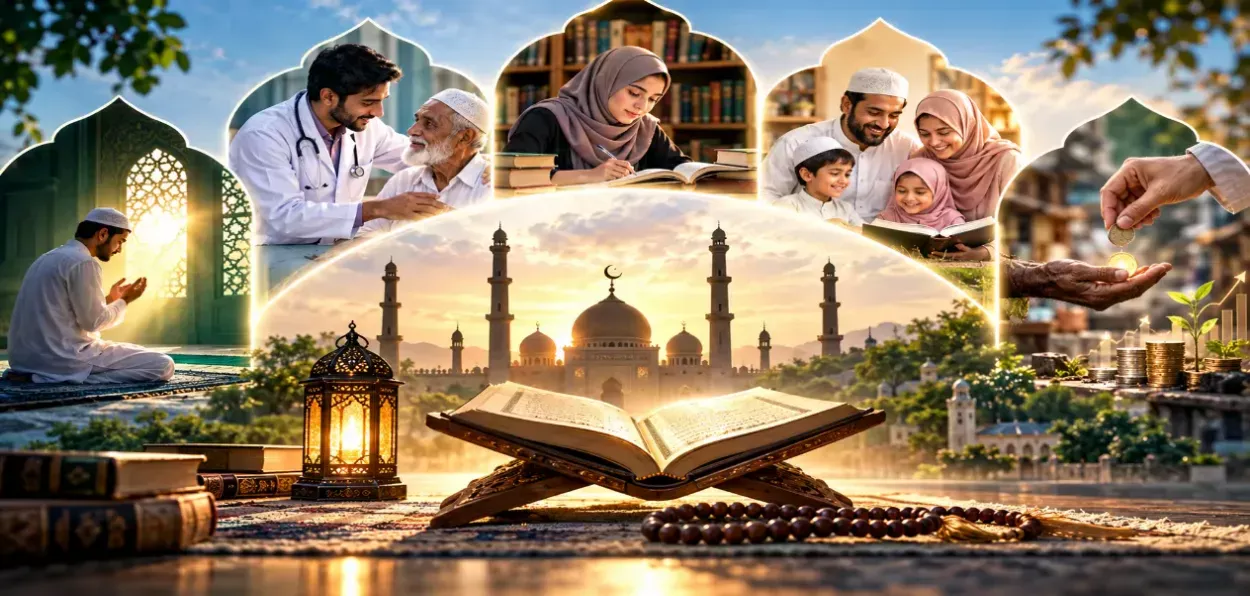
Of course you can. The real problem is the mindset. People generally believe that Zakat and donations should be given only to madrasas, whereas if religious institutions, while maintaining their religious identity, establish schools, colleges, hospitals and other public welfare institutions, this would be an equally important service. Look! Institutions like Shasthiyat-ul-Uloom in Gujarat have established engineering colleges and medical colleges. Such examples prove that madrasas can also successfully run modern educational institutions while maintaining their religious identity. If this model is promoted, the educational and social needs of the Muslim society can be met in a much better way.
Was vocational training also taught in madrassas in the past?
Historically, in some madrasas, bookbinding, tailoring, embroidery, shoemaking and other professional skills were also taught so that students would not only depend on Imamate or teaching but could also get a respectable job for themselves. Even today, there is a need for madrasas to introduce modern skill development programs so that graduates can benefit from their skills in various professional fields along with religious services. The founders of madrasas were aware that graduating students may face financial problems. That is why they included some skills in the curriculum. For example, bookbinding, tailoring, bookbinding and other professional skills were taught so that students could earn their living along with religious services.
What should replace these skills in today's era?
Times have changed today. The era of hand-written writing is over. Bookbinding is also no longer as necessary as it was before. Therefore, these old skills should be replaced with computer, coding, digital technology, skill development and other modern professional courses. The goal is the same, but its form should change according to the time.
Will including skill development in madrasas be a new thing?
No, this will not be anything new, but rather a continuation of the ancient tradition of madrassas. Even earlier, students were taught practical skills. Today, only these skills need to be changed according to modern requirements.
Was medical education also offered at Darul Uloom Deoband?
Yes. At one time, there was also a medical college affiliated to Darul Uloom Deoband that taught medicine to students. Later, this institution started running under a separate management and was no longer part of the central system of Darul Uloom.
Why has the concept of economic self-sufficiency weakened in madrassas?
Over time, the aspect of economic self-sufficiency and vocational training in the curriculum of madrasas weakened. However, during the Sultanate and Mughal eras, the curriculum was structured in such a way that the student was not limited to the mosque or madrasa but could also express his talents in different sectors of society and get a respectable job.
What is the condition of students graduating from madrassas today?
Today, most students, after graduating from madrassas, return to teaching in madrassas or taking up the responsibilities of imam and sermon in mosques. One reason for this is that the curriculum does not pay enough attention to modern professional skills.
Do subjects like medicine also need to be viewed in accordance with the new era?
Of course. Just as Unani medicine was important in the past, so is the era of modern medical science today. Under the same principle, madrasas should also consider incorporating modern skills and new sciences in an appropriate manner while maintaining their basic religious identity so that the graduates can adapt to the demands of a changing society.
Is there a need to pay attention to modern medicine and scientific studies in madrasas?
Times have changed. In the past, Unani medicine was important, but today is the era of modern medical science. MBBS, MD and other modern medical sciences have created new dimensions in the field of medicine. Therefore, it is necessary that students be provided with opportunities to advance in these fields. However, this does not mean that madrasas should abandon their basic purpose, but rather create new possibilities according to the changing circumstances.
How is the situation today different from that?
Today, many religious institutions are run on public donations and grants. In this case, if an administrator or scholar says something that the public does not like, he fears that the donations will decrease. In this way, sometimes financial dependence can also affect free academic expression. Whereas, I believe that if modern professional skills and economic self-sufficiency are promoted in madrasas, then the scholars will not be dependent only on donations or institutions for their livelihood. This will make them more independent and will also be able to perform religious services with more freedom and confidence. This is the tradition that is prominently seen in the early periods of Islamic history.
Why are scholars sometimes unable to speak openly about the mistakes of society?
This is a major issue. If a scholar or religious institution says something that is offensive to the public, there is a fear that the institution's financial support will be affected. Since many seminaries are run on public donations, sometimes administrators or scholars are unable to speak out about important social reforms. Lack of financial self-sufficiency can be a barrier to free expression of opinion.
In your opinion, how can a balance be established between religion and the world?
The Holy Quran teaches a balance between the two. We are taught to pray to Allah Almighty to grant us good in this world and good in the Hereafter. Similarly, the Quran also says not to forget our share in this world. That is, a person should not be careless about the responsibilities of this world while only thinking about the Hereafter.
What is the relationship between this world and the hereafter in the light of the Hadith?
In the Hadith, the world has been described as the field of the Hereafter. This means that the deeds done in the world are the means of success in the Hereafter. Therefore, the world and religion are not separate from each other but complement each other. Muslims should play a positive role for their society, their country and the whole of humanity. They should keep pace with the scientific, educational and social development of the modern era. They should understand and face the new challenges of the time.
ALSO READ: Waris Mazhari points out myths on Madrasa syllabus
At the same time, the teachings of Allah and His Messenger should always be kept in mind. Let me tell you that religion and the world are not opposed to each other but complement each other. A successful Muslim fulfils his religious responsibilities and also plays an effective role in the field of knowledge, morality, service and development in the world. This is the balanced concept of the Quran and Islamic teachings.
See the Full Interview:
_(1).jpg "Visitors gather at the Santosh Mitra Square Durga Puja pandal, themed on the 150th anniversary of Vande Mataram and its historic role in India's freedom movement, ahead of the festival, in Kolkata")
.jpg "Gujarat’s women entrepreneurs bring their craftsmanship to life during Navratri")





_(2).webp)