Zeba Nasim
For centuries, Kashmir has been known as the land of Sufi spirituality, where saints nurtured a culture of compassion, tolerance, and peaceful coexistence. Among them, Hazrat Mir Syed Ali Hamadani occupies a place of extraordinary reverence. More than a preacher, he was a spiritual reformer, social visionary, and cultural architect whose influence continues to shape Kashmir's religious, social, and artistic identity.
At a time when societies across the world are struggling with intolerance, social fragmentation, and ideological divisions, the teachings of Kashmir's Sufi saints have acquired renewed relevance. Their message encourages humanity to replace hatred with love, division with brotherhood, violence with peace, and revenge with patience and forgiveness.
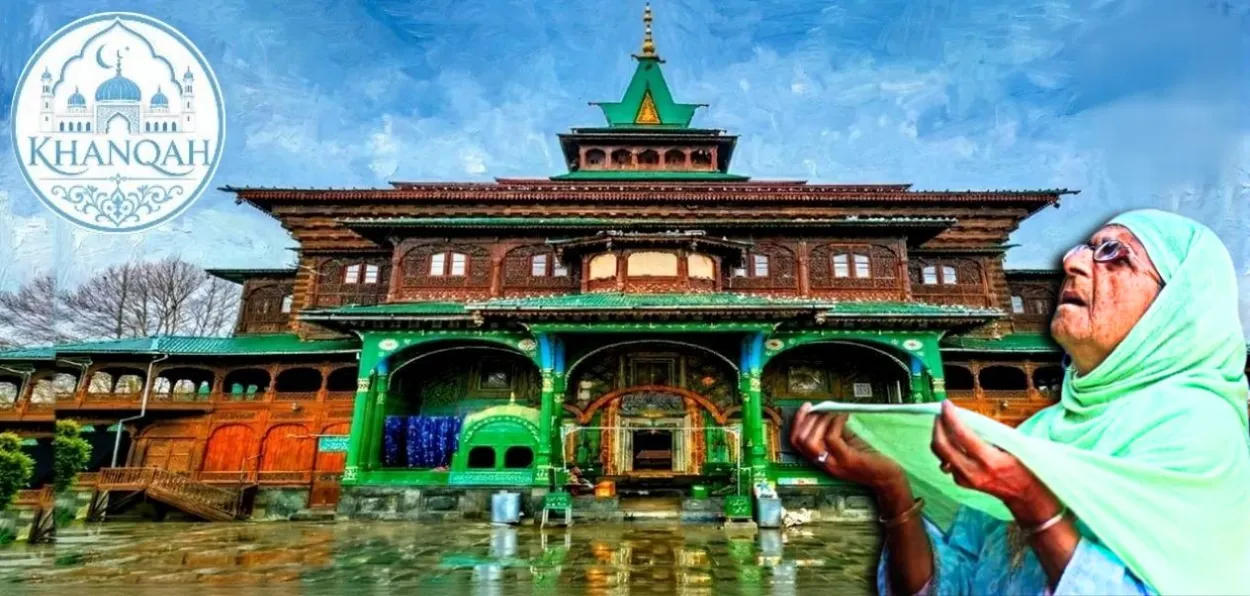
.webp) Khanqah-e-Moula entrance
Khanqah-e-Moula entrance
Khanqah-e-Moula, popularly known as Shah-e-Hamdan, stands as the finest symbol of this enduring legacy. Located on the banks of the River Jhelum in the heart of Srinagar, it is not merely one of Kashmir's oldest Islamic shrines but also a living centre of spirituality, culture, and history.
For generations, the Khanqah has served as a place of worship, meditation, remembrance of God, and spiritual learning. It reflects the values that Hazrat Shah-e-Hamdan introduced to Kashmir—faith rooted in compassion, morality strengthened through service, and spirituality expressed through everyday life.
Born in Hamadan in Persia during the fourteenth century, Hazrat Mir Syed Ali Hamadani devoted his life to Islamic scholarship, Sufism, and spiritual reform. He arrived in Kashmir in 1372, when the Valley was home to diverse religious and cultural traditions.
Rather than relying on confrontation, Shah-e-Hamdan won hearts through wisdom, humility, and moral character. His teachings centred on love for humanity and devotion to the Creator. He encouraged people to free themselves from prejudice, hatred, and selfishness, while embracing justice, honesty, compassion, generosity, and service to society.
His influence extended far beyond the religious sphere. The Khanqahs and centres of learning established under his guidance became institutions where worship, education, community welfare, and spiritual training flourished together. These efforts laid the foundation of Kashmir's enduring Sufi tradition.
.webp) Former Chief Minister Dr Farooq Abdullah at the shrine of Khanqah-e-Moula in Srinagar
Former Chief Minister Dr Farooq Abdullah at the shrine of Khanqah-e-Moula in Srinagar
Even today, visitors to Khanqah-e-Moula experience an atmosphere shaped by the timeless teachings of Shah-e-Hamdan. People from different backgrounds gather here for prayer, reflection, Qur'anic recitation, and spiritual guidance.
The essence of Sufism lies in the purification of the soul and the pursuit of closeness to God. Khanqah-e-Moula continues to embody these ideals by offering an environment that nurtures inner peace, self-discipline, and moral refinement.
More than a historic monument, the shrine represents a living spiritual tradition where history, architecture, faith, and culture come together in remarkable harmony. Its peaceful ambience, centuries-old wooden structure, and sacred legacy invite every visitor to embark on a journey of spiritual reflection.
The contribution of Hazrat Shah-e-Hamdan was not confined to religious life alone. He helped shape the social and cultural foundations of Kashmir by promoting the values of honesty, hard work, ethical conduct, and service to humanity.
The scholars, craftsmen, and artisans who accompanied him introduced and strengthened several traditional crafts that later became synonymous with Kashmir. Shawl weaving, wood carving, paper-making, and other indigenous arts flourished under their influence, linking spiritual values with economic prosperity and cultural excellence.
This unique synthesis of faith, craftsmanship, and social responsibility remains one of Shah-e-Hamdan's greatest legacies and continues to define Kashmir's civilisational identity.
Every year, Khanqah-e-Moula becomes the focal point of one of Kashmir's most significant religious gatherings during the annual Urs of Hazrat Shah-e-Hamdan. Thousands of devotees from across the Valley and beyond visit the shrine to pay homage to the revered saint whose teachings transformed the spiritual landscape of Kashmir.
.webp) Followers at the shrine of Shah-e-Hamadan
Followers at the shrine of Shah-e-Hamadan
The atmosphere during the Urs is marked by profound devotion and serenity. Special prayers, recitations of the Holy Qur'an, gatherings of Zikr (remembrance of God), and religious discourses fill the shrine with spiritual energy. For the faithful, the occasion is not merely a commemoration of a saint's life but an opportunity to reconnect with the timeless ideals of love, humility, sincerity, and selfless service.
The annual observance also serves as a bridge between generations. It introduces young people to the spiritual legacy of Shah-e-Hamdan while reinforcing the values of compassion, moral integrity, and peaceful coexistence that have long been the cornerstone of Kashmir's Sufi tradition.
The present Khanqah stands on the site where Hazrat Shah-e-Hamdan is believed to have stayed during his visits to Kashmir, making it one of the Valley's most sacred spiritual landmarks.
The original structure was modest in appearance but immense in spiritual significance. Over the centuries, however, the shrine faced repeated destruction due to devastating fires.
A major fire in 1480 severely damaged the building, after which Sultan Hasan Shah ordered its reconstruction in 1493. Another destructive fire in 1731 led to a fresh rebuilding under the patronage of Abu al-Barakat Khan. Subsequent restoration work carried out in different periods preserved the shrine while retaining its traditional Kashmiri character.
Today, Khanqah-e-Moula stands not only as a monument to history but also as a vibrant centre of worship and spiritual life, reflecting the resilience of Kashmir's religious and cultural heritage.
Khanqah-e-Moula is widely regarded as one of the finest surviving examples of traditional Kashmiri wooden architecture. Its design reflects a remarkable synthesis of Buddhist, Hindu, and Islamic architectural traditions, illustrating the Valley's rich cultural evolution.
The square-plan structure rests on a solid stone foundation, parts of which incorporate stones believed to have originated from ancient temple structures. Above this base rises a graceful two-storeyed wooden building crowned with distinctive multi-tiered pyramidal roofs—a hallmark of classical Kashmiri architecture.
Elegant arched verandahs surround the first level, while open balconies extend along all four sides of the upper floor. Above the main roof stands an open platform traditionally used by the muezzin, topped by a slender conical spire that has become one of the shrine's defining architectural features.
Today visited khanqah-e-moula ♥️
— Kashmir memories (@kshmirmemories) April 21, 2026
Khanqah-e-Moula also known as Shah-e-Hamdan Masjid. It is a historic 14th-century Sufi shrine located on the banks of the Jhelum River in Srinagar Kashmir. Built in 1395 and dedicated to preacher Mir Syed Ali Hamadani. It is a key cultural and… pic.twitter.com/4TDshDztWh
Perhaps the building's most striking feature is its extraordinary woodwork. Delicate carvings adorn doors, pillars, ceilings, windows, and interior panels, demonstrating the exceptional craftsmanship for which Kashmir has long been renowned. During certain seasons, patches of natural greenery emerge on sections of the roof, lending the shrine an added sense of harmony with its surroundings.
Within the north-western section of the Khanqah lies the sacred enclosure associated with Hazrat Shah-e-Hamdan. An inscription above its entrance bears the year 1384, commemorating the saint's passing.
Stepping inside, visitors are immediately enveloped by an atmosphere of tranquillity and reverence. The sacred enclosure is protected by beautifully crafted wooden lattice screens, where devotees quietly offer prayers and seek spiritual blessings.
The interior walls are embellished with elegant Qur'anic calligraphy and classical Sufi inscriptions, each reflecting the deep artistic and spiritual traditions that have flourished in Kashmir for centuries. These masterpieces are not merely decorative; they serve as enduring reminders of faith, devotion, and divine remembrance.
Beyond its religious significance, Khanqah-e-Moula remains one of Srinagar's most treasured cultural and historical landmarks. Situated along the serene banks of the River Jhelum, the shrine offers a rare combination of architectural beauty, historical depth, and spiritual calm.
Its finely carved wooden façade, centuries-old craftsmanship, peaceful courtyards, and timeless atmosphere continue to attract pilgrims, historians, architects, photographers, and travellers from around the world.
At sunrise and sunset, when the changing light is reflected on the waters of the Jhelum, the shrine presents one of the most captivating sights in Kashmir. The scene beautifully captures the harmony between nature, architecture, and spirituality that has defined this sacred place for generations.
More than six centuries after Hazrat Shah-e-Hamdan first arrived in Kashmir, his message continues to resonate across the Valley. Khanqah-e-Moula is far more than a historic monument—it is a living testament to a civilisation built upon faith, compassion, craftsmanship, learning, and peaceful coexistence.
ALSO READ: Fatima Sultana brought tigers back to forests of Rajasthan
In an era often marked by division and uncertainty, the shrine continues to remind humanity that the enduring values of love, tolerance, humility, and service remain the strongest foundations upon which any society can build a peaceful and harmonious


_(1)_(1).webp "Jagannath Rath Yatra")