Sabiha Fathima
Evening settles over a narrow lane in Delhi. The haunting strains of qawwali drift through the air. The fragrance of roses mingles with the scent of burning oud. Shops lined with colourful ceremonial sheets shimmer beneath fading light. People carry baskets of flowers, prayer slips are clutched tightly in hopeful hands, and a few men sit behind thick registers, waiting to write down names. Amidst this familiar scene, a young visitor stands still, taking it all in with quiet curiosity.
Weekend Longread
A man steps forward, placing a richly embroidered sheet in his hands."Offer this at the shrine," he says. "Your prayers will be answered sooner." A few steps ahead, another voice calls out,
"Register your name. A special prayer will be offered for you." The young man pauses. For a brief moment, a question rises in his heart, a question that has crossed the minds of countless thoughtful people before him:
Was this what a Khanqah was meant to be?
This is not merely a question about a shrine. It is a question about an entire civilisation.
Today, when the word Khanqah is mentioned, many of us immediately picture a saint's tomb draped in green cloth, annual urs celebrations, soul-stirring qawwali, and crowds of devoted visitors. Yet the true identity of a Khanqah was far greater than these images.
A Khanqah was never simply the resting place of a saint. It was an institution established during the saint's lifetime, a place where human beings were shaped, not merely sheltered. Worship certainly took place there, but worship alone was never its purpose. Its greater mission was to nurture character, refine the soul, and teach people how to become better human beings.
Perhaps that is why the earliest days of Islam do not present us with grand Khanqah buildings, yet they reveal their very spirit.
Look toward the humble platform known as Ashab-E-Suffah beside the Prophet's Mosque in Madinah. Those companions possessed neither wealth nor estates, nor the comforts of worldly life. Yet they carried a treasure far greater: knowledge, sincerity, selflessness, and an unwavering bond with God and Prophet Muhammad. From those simple beginnings grew a tradition that would eventually blossom into the great Khanqahs of the Muslim world.
Islamic spirituality was never built upon outward grandeur
The life of Caliph Umar ibn al-Khattab offers a timeless example. As he lay mortally wounded in his final hours, his son suggested that he should be buried in a new white shroud. Tradition relates that Umar gently refused, saying that the dead had no greater need for new clothes than the living, and that his old garment would suffice.
This was more than an act of personal simplicity. It reflected a philosophy upon which the Khanqah would later stand, a philosophy that valued character over clothing, humility over appearance, and the soul within a building more than the building itself.
By the fourth century of the Islamic calendar, communities of seekers had begun to emerge across Khurasan, Persia, and Central Asia. Ascetics, scholars, and wandering dervishes lived together under one roof. They prayed together, recited the Qur'an, remembered God, welcomed weary travellers, and struggled against their ego and arrogance.
These humble centres gradually came to be known as Khanqahs.

The Persian word combines khanah (house) and gah (place), but it meant far more than simply "a house." It described a home where lives were transformed.
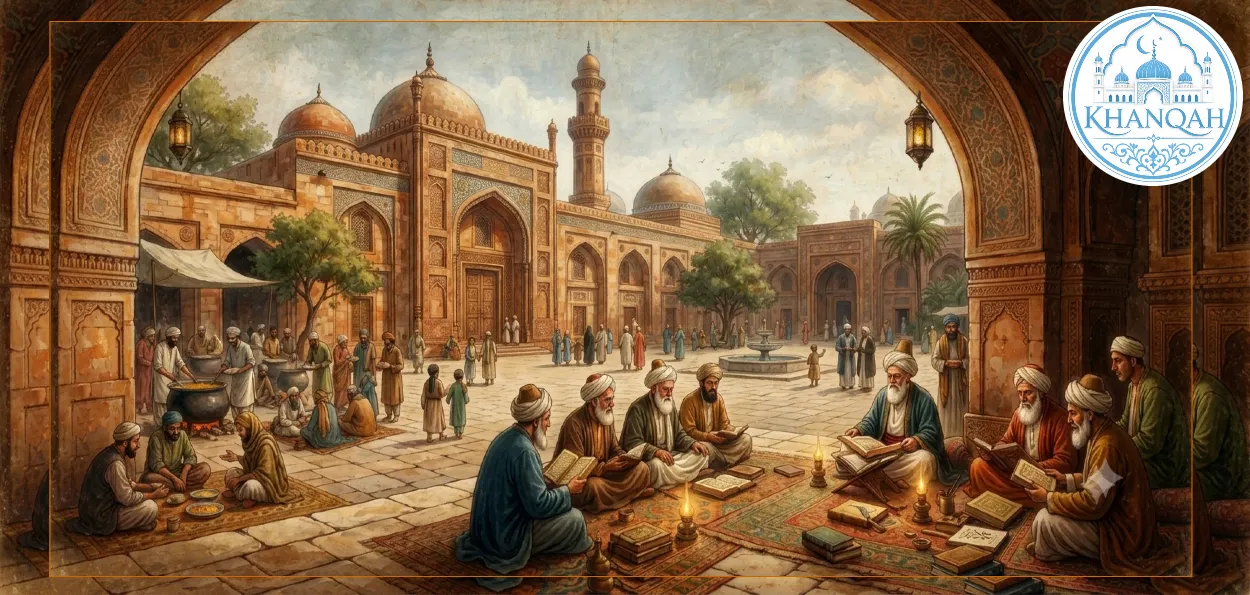
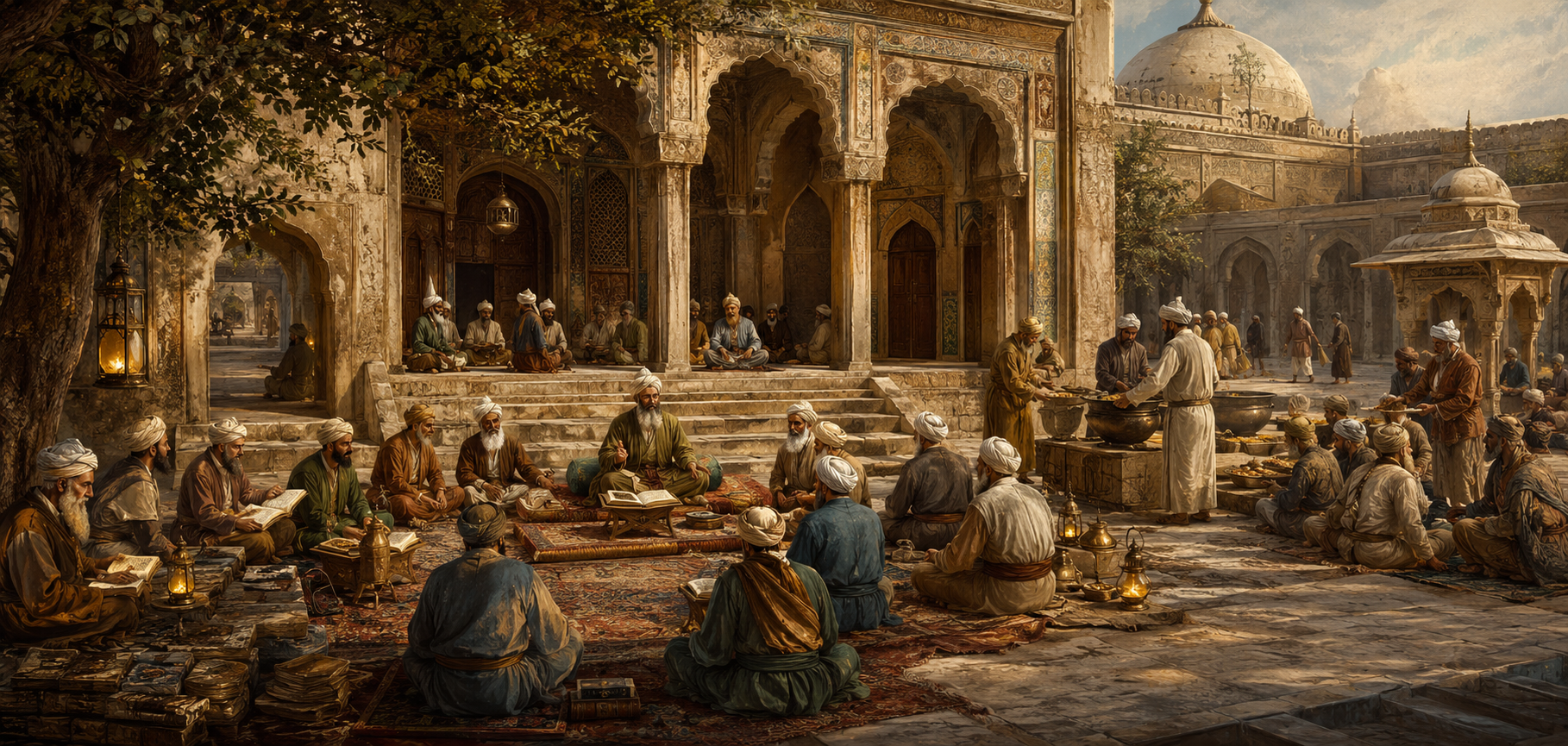
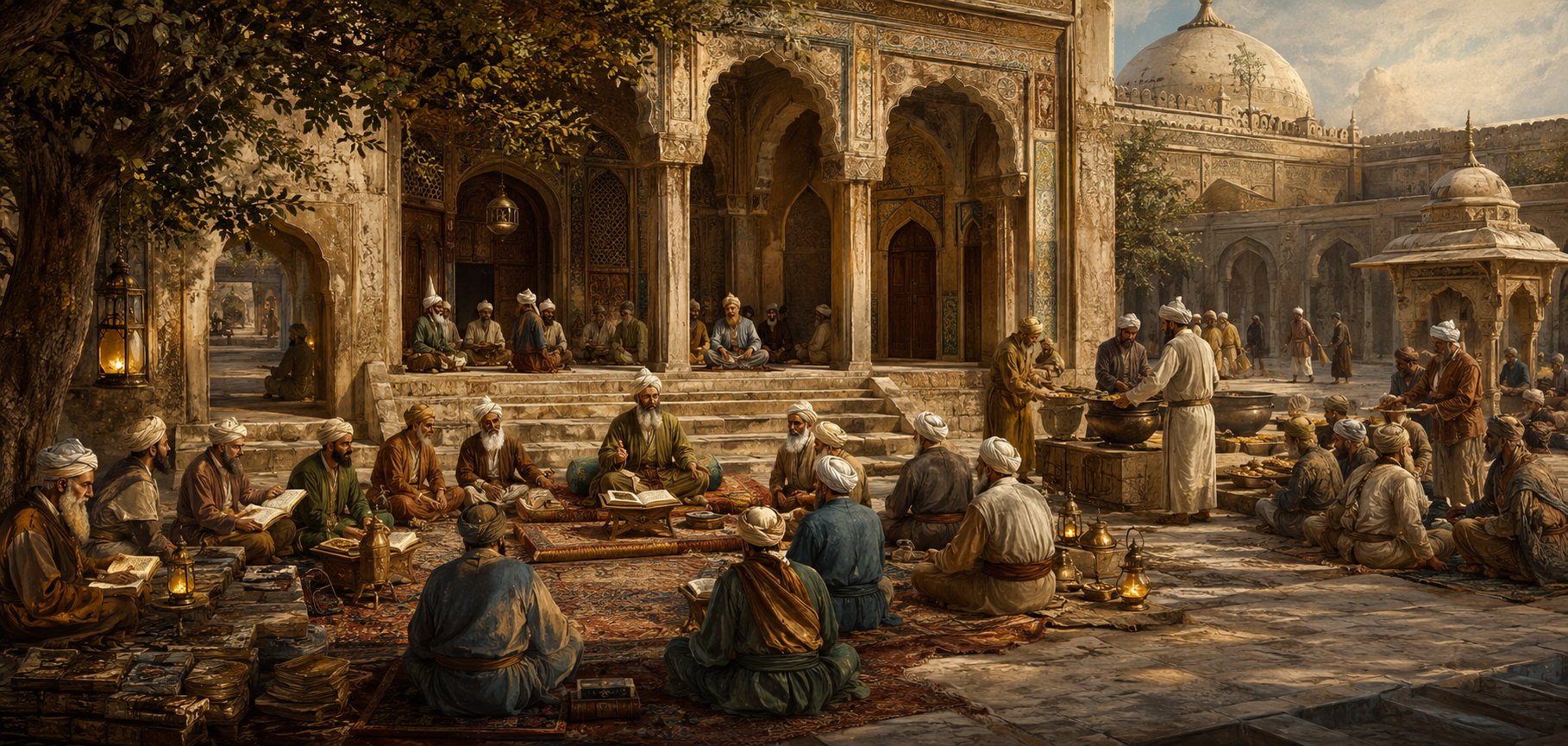
Close your eyes for a moment and imagine yourself entering a Khanqah eight hundred years ago.The dawn prayer has just ended. The courtyard rests in peaceful silence. A few oil lamps still flicker in the fading darkness. In one corner, a young student softly revises the Qur'an. In another, an elderly dervish sits absorbed in silent meditation. From the kitchen comes the comforting aroma of freshly baked bread.
At the entrance, a weary traveller removes his dust-covered shoes.No one asks him where he has come from. No one asks about his religion, his language, or his social status. Someone smiles and says, "Welcome. First, come and eat." That was a Khanqah.
If we were to describe it in today's language, we might call it many things at once: a spiritual retreat, a school, a public kitchen, a guesthouse, a library, a counselling centre, and above all, a place where the diseases of the heart, pride, envy, greed, and selfishness were patiently treated.
A Murshid, or spiritual guide, did not merely assign prayers or litanies to his disciples. He shaped their character. If a wealthy man arrived full of pride, he would be asked to sit beside the poor at the communal meal. If a scholar became arrogant about his learning, he might be sent to the kitchen to bake bread for everyone else.
The very first lesson of a Khanqah was simple.
Before God, all human beings stand equal.
When the great Sufi masters reached the Indian subcontinent, they did not come merely as preachers of a new faith. They arrived as builders of a civilisation.
Data Ganj Bakhsh in Lahore, Khwaja Moinuddin Chishti in Ajmer, Nizamuddin Auliya in Delhi, Bahauddin Zakariya in Multan, and Banda Nawaz Gesu Daraz in Gulbarga established Khanqahs whose doors remained open to everyone, regardless of religion, caste, language, or social standing.
These institutions did far more than spread Islam.
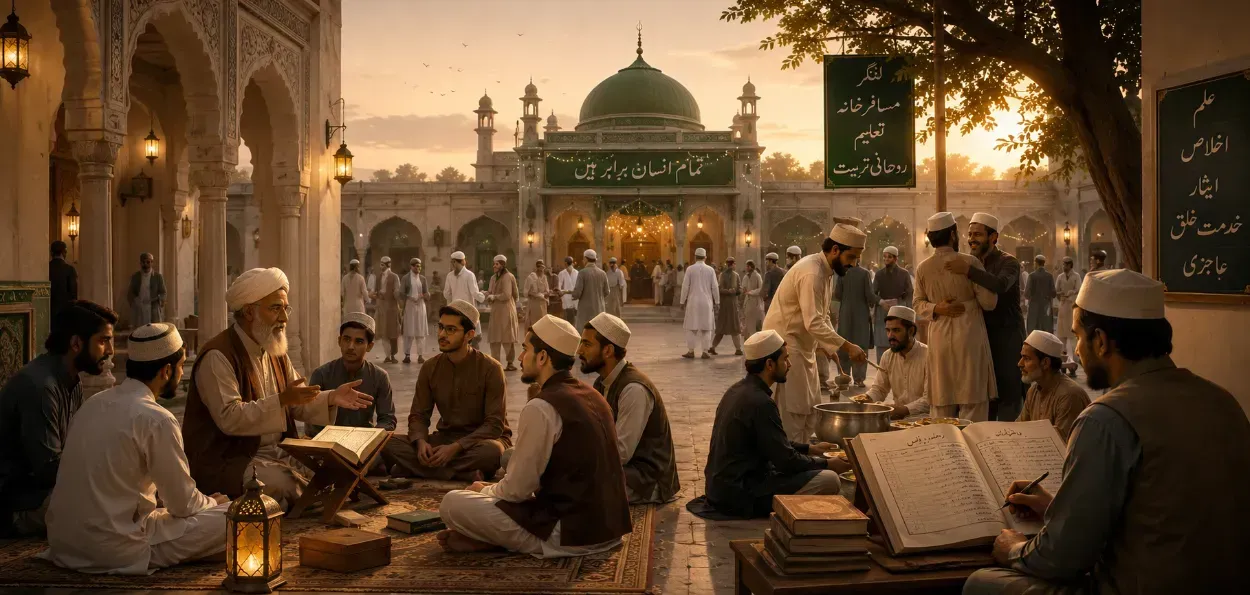
They helped shape the shared culture of the subcontinent. They became places where Persian met local languages, where literature flourished, where music found new spiritual expression, and where poets like Amir Khusrau transformed devotion into timeless art under the guidance of their Murshid.
It may not be an exaggeration to say that while the madrasa produced scholars, the Khanqah sought to produce human beings.
Yet history never remains still. Every living tradition is eventually tested.
When the great Sufi masters departed from this world, their resting places naturally became destinations of love and remembrance. People returned to them, not to seek new teachings, but to recall the lives they had lived, to pray, and to reconnect with the values they represented.
It was a natural evolution.
Gradually, the Khanqah became associated with the Dargah, the shrine built around a saint's grave. At first, there was no contradiction between the two. The Khanqah had been the living master's school; the Dargah became the place where people remembered his legacy.
But as centuries passed, the purpose began to shift in some places.
Where great cauldrons of langar had once simmered for everyone without distinction, the counting of donations slowly became more important. Where Murshids had taught their disciples to conquer pride, personality cults sometimes took root instead. The ceremonial sheet or the chaadar, the flowers, the sacred thread, the registers, symbols that may once have expressed devotion, gradually became, at certain shrines, part of an organised economy built around faith.
According to local tradition, Baba Qasim Shah was arrested and imprisoned inside the mighty Chunar Fort. Heavy iron chains were fastened around his wrists and ankles, and guards stood watch day and night.
Yet the story takes an extraordinary turn.
The elders of Chunar narrate that whenever the call to prayer echoed through the air, the chains would mysteriously fall away. Baba Qasim Shah would quietly leave the prison, offer his prayers in complete serenity, and then return to his cell. As soon as he finished, the chains would once again clasp around him as though nothing had happened.
Word of these astonishing events eventually reached Emperor Jahangir.
Curious and perhaps humbled he came to witness the matter himself. Tradition says that after seeing what he believed to be a miracle, the emperor repented for his actions, sought the saint's forgiveness, and granted him land upon which a Khanqah could be established.
Whether every detail of this account can be verified through historical evidence remains a matter of scholarly debate. Yet the story has endured for centuries because of the truth it seeks to express rather than the miracle it describes.
Its message is timeless: political power has often feared moral authority, yet, sooner or later, it has also found itself bowing before it.
The history of the Khanqahs of South Asia is filled with such narratives. Some are documented by historians; others live within the collective memory of ordinary people. Regardless of their source, they point toward the same reality:
A Khanqah was never merely a place of worship. It was the heartbeat of society.
Walk today through the Khanqahs and Dargahs of Gulbarga, Ajmer, Delhi, Kalyar, or Khuldabad, and you will encounter two very different worlds existing side by side.
One belongs to a centuries-old tradition. The langar still feeds the hungry. Travellers still find shelter. The Qur'an is still recited. Many people still come in search of peace rather than spectacle. The other belongs to the modern age.
Tourism, commerce, political influence, social media, and the economics of religion have transformed the atmosphere of some sacred spaces. Crowds are larger than ever. Religious devotion and commercial enterprise often stand shoulder to shoulder.
Neither image alone tells the whole story. Without seeing both, we fail to understand either the past or the present. Perhaps, then, the real question is not whether the Khanqahs have changed. The real question is whether we have managed to preserve their spirit.
A Khanqah was never defined by bricks, domes, or courtyards; it was an attitude and a civilisation. A vision of society in which a person's worth was measured not by wealth, ancestry, clothing, or fame, but by humility, compassion, and character.
Its purpose was not merely to produce religious scholars. Its purpose was to produce good human beings.
A Murshid taught character before he taught books. His disciples learned that knowledge without humility becomes a burden; that worship without service remains incomplete; and that spirituality which distances people from humanity has already lost its soul.
Yet time has altered this institution as well.
Many Khanqahs continue to remain vibrant centres of learning, charity, and spiritual guidance. Others, however, have gradually acquired a different role. Their spiritual influence has become social influence. Their social influence has become political influence.
During election seasons across South Asia, politicians often visit famous spiritual leaders. They do not come seeking blessings alone. They also recognise that the endorsement, or even the goodwill of a respected Murshid, may influence thousands of devoted followers.
In this sense, some Khanqahs have evolved from centres of moral transformation into institutions capable of shaping political fortunes. To describe this reality is not to diminish the institution itself. It is simply to acknowledge that every enduring institution eventually becomes intertwined with power. And power, history reminds us, always leaves its mark.
Worship was never meant to increase the number of prayers we offered; it was meant to soften the heart. Langar was never just about feeding the hungry, but about reminding us that dignity begins where distinctions end.
Perhaps that is why, in a world that feels increasingly connected yet deeply divided, we need the spirit of the Khanqah more than ever, not necessarily as a building, but as an idea. A place where knowledge is joined by humility, faith by compassion, and service by sincerity.
The real loss is not that many Khanqahs have changed with time. It is that, in preserving their walls, we have too often forgotten the values they were built to nurture. Their purpose was never to create followers, but thoughtful, compassionate human beings.
That is why the legacy of the Khanqah has outlived kingdoms. Empires faded, rulers were forgotten, yet its quiet lessons endured: to welcome without asking, to serve without expecting, and to lead without seeking power.
Perhaps a Khanqah was never merely a place. It was, and remains, a way of becoming human.
It is important, however, to make a distinction.
This is not the story of every Khanqah or every Dargah. Many continue to preserve their original spirit with remarkable sincerity. To judge every spiritual institution by the failures of a few would be unfair to history itself.
In the ancient town of Chunar, an old story continues to be told with deep reverence.
ALSO READ: Sajjad 'Bob' Hussain, the man behind Stringmo Sisters of Ladakh
People recount that during the reign of the Mughal emperor Jahangir, the spiritual influence of Baba Qasim Shah Sulemani had grown so immense that it unsettled the imperial court. The emperor feared that such moral authority might one day acquire political influence.
The author


_(1)_(1).webp "Jagannath Rath Yatra")








_(3).webp)