 Mansooruddin Faridi
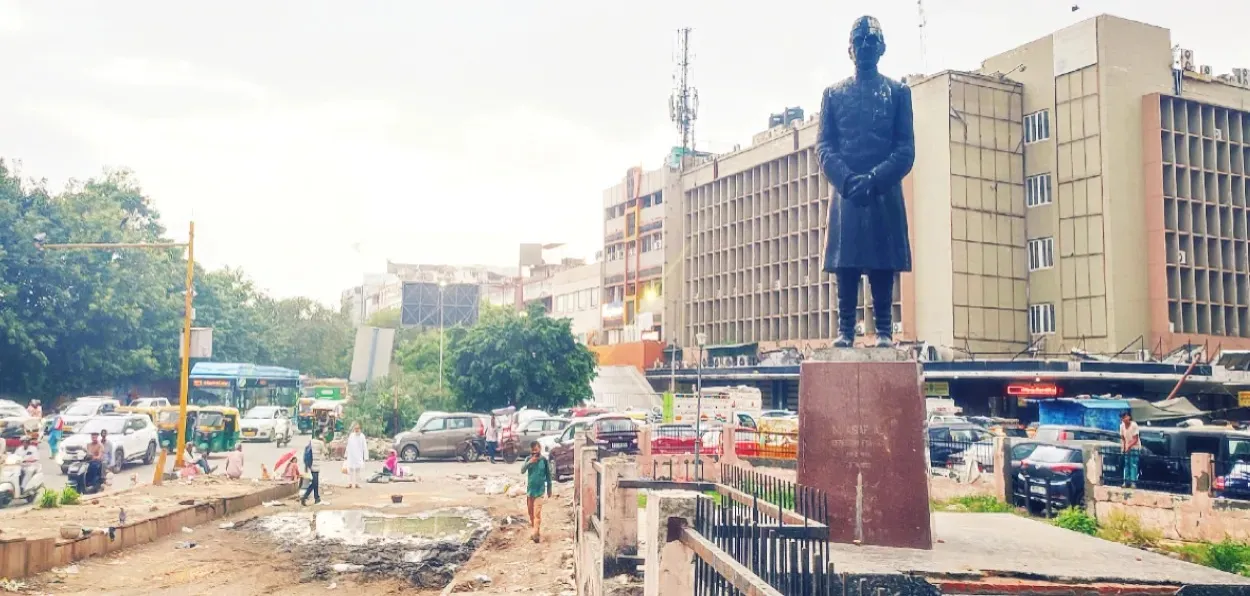
Stray dogs loiter around the statue of the great freedom fighter Asif Ali in Old Delhi. Birds perch on it, leaving their droppings across the statue and the platform below. The surrounding area is littered with dirt and garbage, while drug addicts, beggars and stray animals frequently gather around it.
Asif Ali was the first Railway and Transport Minister in the interim government formed before Independence and later became India's first ambassador to the United States. He is also remembered for his efforts to end the practice of serving separate drinking water to Hindus and Muslims at railway stations.
His statue stands at the boundary between Old Delhi and New Delhi, silently overshadowed by a towering national tricolour at the busy Delhi Gate intersection. The deplorable condition of a monument dedicated to such a prominent freedom fighter is a sad reflection of our changing attitude towards our national heroes and history.
.webp) People throwing feed for piegons in the vicnity of the Park
People throwing feed for piegons in the vicnity of the Park
For the past two years, whenever I have passed through Delhi Gate, I have found the statue in a state of neglect. It is frequently caked in mud and bird droppings.
Every time I passed it, I would faintly hope that perhaps the statue had finally been restored to its former glory. But on August 15 this year, when I passed through Delhi Gate once again, it was the same story.
I was reminded of Mohammed Rafi's famous Bollywood song, Na Kisi Ki Aankh Ka Noor Hoon ("I am no one's beloved"). For a moment, I wondered whether I was imagining the forgotten statue of the stalwart freedom fighter singing those words.
There were more shocks that day.
That evening, fireworks worth lakhs of rupees were set off across Old Delhi—popularly known as Delhi-6—to celebrate Independence Day. For hours, the sky was illuminated by colourful fireworks. Yet, amid all the celebration of India's freedom from British rule, apparently nobody thought of cleaning or sprucing up the statue of a man who sacrificed his youth to make that freedom possible.
I also wondered why the Muslim leadership of the Walled City, which often complains of neglect, discrimination and prejudice, could not make even a modest effort to pay homage to Asif Ali.
No ceremony is held at the statue. Nobody appears to offer flowers there, not even on the birth anniversary of this great freedom fighter.
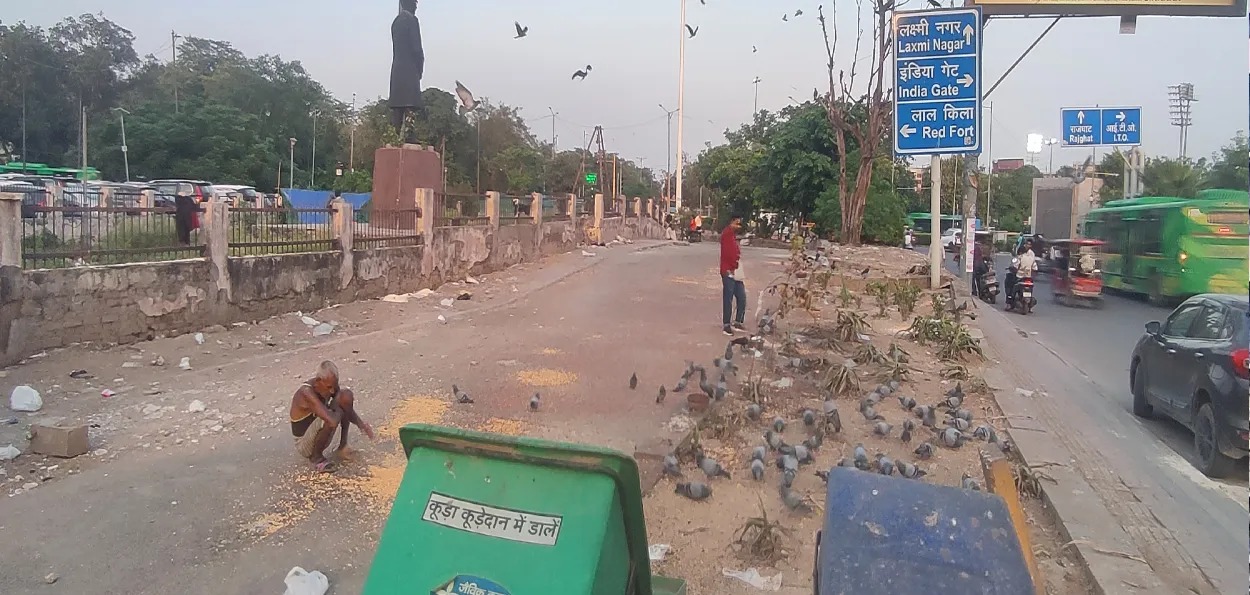 Lack of sanitation and proper care of the statue and the park is visible
I have observed the condition of the statue for many years. Governments have come and gone, but the monument seems to have remained nobody's priority.
This is not a park tucked away in some remote corner of the city. It is located at one of Delhi's busiest intersections, where 16 roads converge. The dirt, garbage and accumulated mud around the statue are visible to everyone.
The grass in the park has largely disappeared, replaced by bushes covered with debris and dirt. Sections of the iron railing have been broken, apparently by thieves, while other portions are rusty and neglected.
There are several reasons for the statue's deplorable condition, one of them being the large number of pigeons that are fed here throughout the day. Grains are scattered around the park and near the statue. Vendors regularly sell grain to people who then throw it on the ground. Alongside this are filthy water containers placed around the statue.
The extent of the filth becomes apparent only when one visits the site. Photographs and videos hardly convey the stench caused by stagnant water, rotting grain and mud.
Then there is the parking business.
Rows of cars and two-wheelers can be seen around the park surrounding the statue. Hundreds of vehicles use the parking facility every day, making it a source of considerable revenue. Parking on one of Delhi's busiest roads may be a commercial blessing, but the statue appears to be paying the price.
Local shopkeepers also contribute to the mess by dumping garbage in the park. Once, I saw a pile of rusty and discarded nails lying directly in front of the statue.
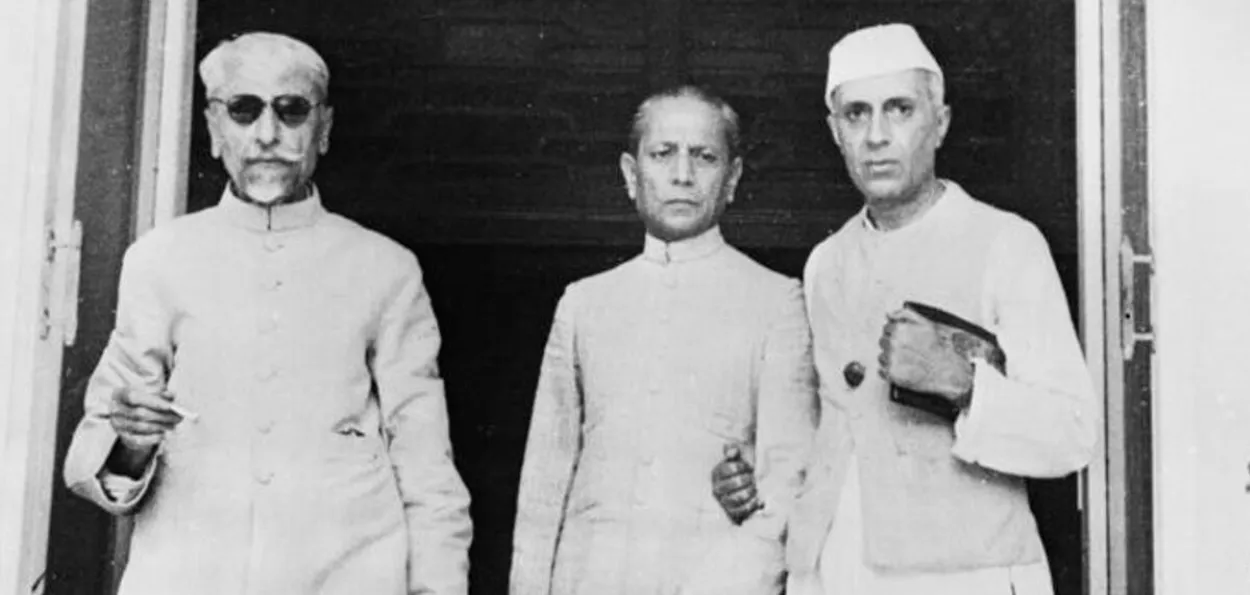 Asif Ali (in the centre) with Maulana Azad and Jawaharlal Nehru
Stray dogs roam freely around the monument. Drug addicts also use the area as a daytime shelter. At the same time, the park has become a place where the poor come to sit and seek some respite from the heat and congestion of the city.
Who is Asif Ali
For the uninitiated, Asif Ali was one of India's prominent freedom fighters who dedicated his life to the struggle for independence.Pandit Jawaharlal Nehru made special mention of his academic abilities in the preface to his book Talaash-e-Hind. Asif Ali studied at Model Primary School, Anglo-Arabic School and St Stephen's College. In 1909, he travelled to England for higher education and returned to India in 1912 after completing his law studies.
Along with practising law, he became active in journalism, literature and politics.
In 1916, he established a branch of the Home Rule League in Delhi and attended the Congress session in 1917. In 1919, the British government arrested him for his political activities. He defended himself in court and was released with honour.
Asif Ali also played an important role in Mahatma Gandhi's Satyagraha movement. During the Non-Cooperation Movement in 1920, he gave up his legal practice and joined the freedom struggle. He was arrested several times and imprisoned in various jails, including Mianwali.
He played a prominent role in the Civil Disobedience Movement of 1930 and the Quit India Movement of 1942. His name is particularly remembered for hoisting the Congress flag at Gowalia Tank Maidan. He also represented Bhagat Singh and Batukeshwar Dutt in court.
In 1935, Asif Ali was elected to the Central Legislative Assembly. In 1946, he became Minister of Railways and Transport in the interim government.
After Independence, he served as India's first ambassador to Washington, Governor of Odisha and Ambassador to Switzerland.
Asif Ali was also among the leaders who raised their voice against communalism before Partition.
When the interim government was formed under Jawaharlal Nehru in September 1946, Asif Ali was given charge of the Railways. Mahatma Gandhi subsequently expressed the hope, in his journal Harijan, that Asif Ali would take the first step towards ending the practice of serving Hindu Pani and Muslim Pani at railway stations.
Asif Ali sought to turn Gandhi's hope into action. He took steps towards ending the practice of maintaining separate drinking-water arrangements for Hindus and Muslims at railway stations.
The move established him as one of the public figures who actively challenged religious discrimination and demonstrated that public facilities should not be divided along communal lines.
Asif Ali died on April 1, 1953, while serving as India's Ambassador to Bern, Switzerland.
READ MORE: Rear Admiral (retd) Khurram Shahzad Noor's fascinating journey
The condition of his statue in the heart of Delhi is more a reflection on the India state and Public's attitude towards our national heroes than the freedom fighters who sacrificed their youth and careers for freeding us from alien powers.
The author is Editor, Awaz-the Voice, Urdu

_(1)_(1).webp "Khanqah Emadia Qalandaria, Patna, Bihar")