




 Aditi Bhaduri
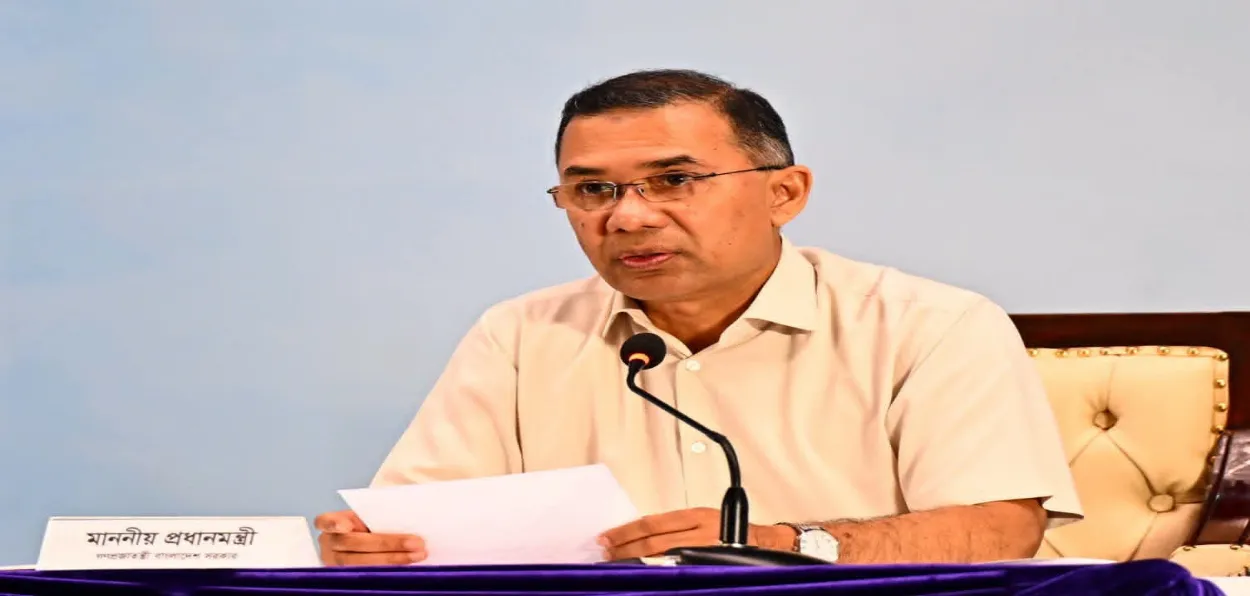
Bangladesh may be frittering away a good opportunity to reset and reboot ties with India. The latest pronouncements from Dhaka have not been encouraging. If Bangladesh Prime Minister Tarique Rahman’s proposed visit to India was uncertain earlier, it now appears increasingly improbable.
The Prime Minister’s Foreign Affairs Adviser, Humayun Kabir, has said that the chances of a bilateral visit ahead of next month’s BRICS summit would remain “slim” unless an “appropriate environment” is created. On Friday afternoon, a formal press release regarding the Prime Minister’s proposed visit to Delhi was published by India’s Rashtrapati Bhavan but withdrawn within an hour.
India, which is the BRICS chair this year, will host the annual BRICS summit in Delhi in September. It had invited Rahman to participate in the outreach session of the summit. This was the second invitation India had extended to him. The first was sent in February, soon after his party, the Bangladesh Nationalist Party (BNP), won the elections—polls whose legitimacy remains debatable, particularly as the other major political force, the Awami League, had been banned.
For India, this represented a careful recalibration of its policy towards its eastern neighbour. Historically, India has supported the Awami League but has always been prepared to work with whichever party is in power. Relations with the BNP have traditionally been strained, given that one of its principal allies is Jamaat-e-Islami Bangladesh, which collaborated with Pakistan during the Bangladesh Liberation War and remains virulently opposed to Sheikh Hasina and the Awami League.
The BNP’s last stint in power also witnessed widespread persecution of members of Bangladesh’s Hindu minority, many of whom fled to India. This author met many of them, particularly women from rural Bangladesh who had fled across the border into neighbouring West Bengal.
Despite the events of August 2024 and the strongly anti-India position adopted by the interim government led by Muhammad Yunus, the Narendra Modi government has been willing to turn the page and has struck a conciliatory note towards the BNP government.
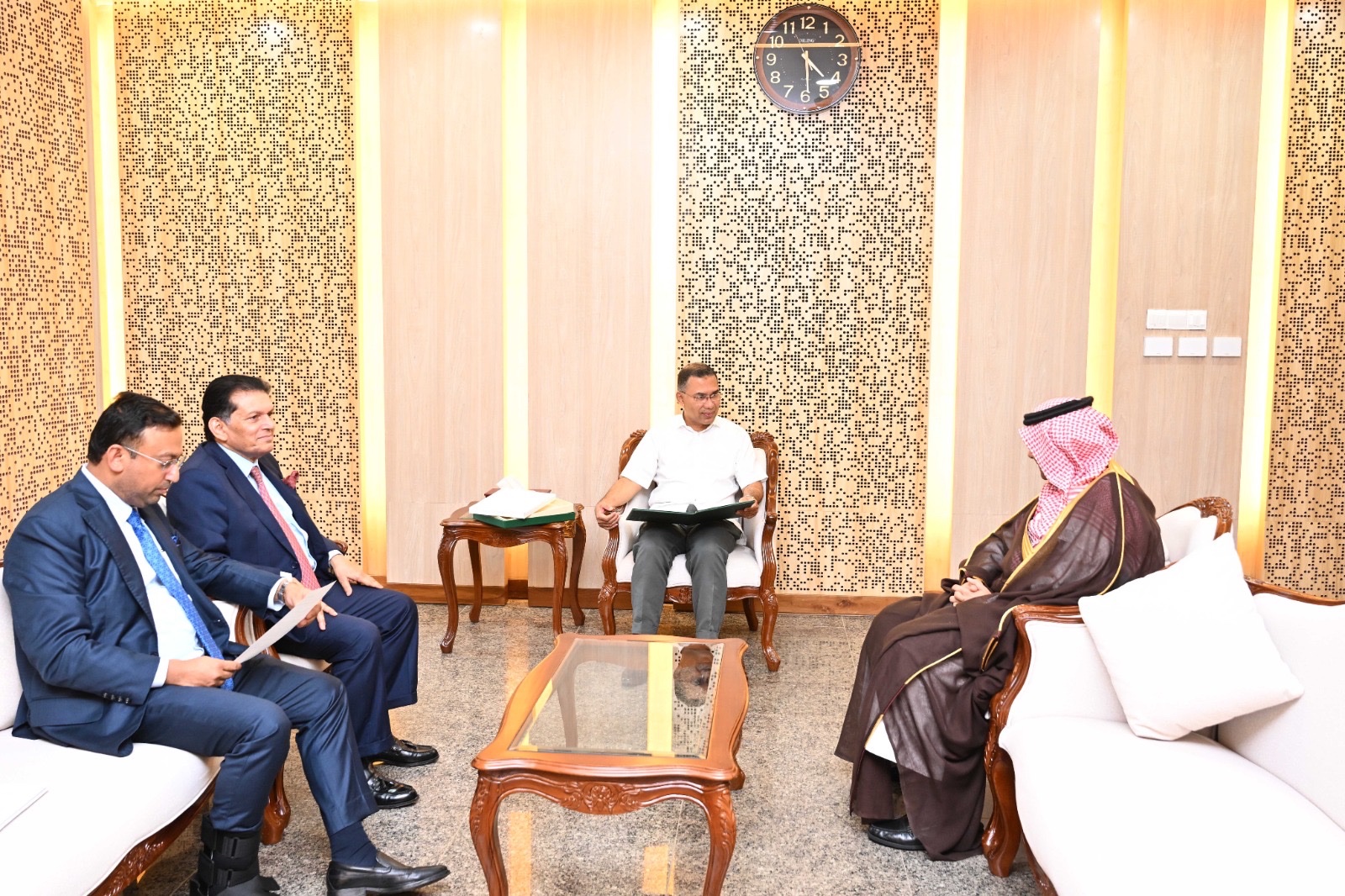 Bangladesh PM Tarique Rahman with visiting Saudi Arabian leaders
At the same time, relations between Bangladesh and Pakistan have been warming, with military and intelligence representatives from the two countries meeting and direct flights being restored. Bangladesh has also been developing closer ties with Turkey, another emerging security concern for India. None of this, however, appears to have affected India’s resolve to maintain friendly relations with its eastern neighbour, even as it continues to allow the deposed Awami League leader to remain in India.
Rahman, however, has not reciprocated the courtesy. His first overseas visits after assuming office, despite Modi’s invitation, were to Malaysia and then China—not India.
In China, he secured pledges from Chinese companies to invest $9.21 billion in Bangladesh over the next few years, as well as commitments towards the development of the Payra and Mongla ports. The latter had earlier been expected to be developed with Indian assistance. Bangladesh watchers also believe that Beijing may seek to extend the China-Myanmar Economic Corridor into Bangladesh.
Despite these developments, India has exercised strategic patience with Bangladesh and has doubled down on its outreach to Rahman. Indian High Commissioner Dinesh Trivedi said on August 18 that Prime Minister Narendra Modi had told him, “We need to meet,” and wanted him to convey to Rahman that he would receive an “honourable reception” in India.
Dhaka’s latest show of angst towards India apparently stems from the virtual press conference of Sheikh Hasina organised by the Foreign Correspondents’ Club of South Asia. The club is based in Delhi but represents foreign correspondents from across South Asia, not India alone. The press conference had nothing to do with the Indian government, which has publicly disassociated itself from the event.
Dhaka nevertheless issued a stinging condemnation, extending it to bilateral relations with India in, to put it mildly, non-diplomatic language.
Bangladesh’s response may be driven by several factors.
First, its leadership may be trying to play to the domestic gallery. The BNP government has completed six months in office and, while Rahman himself remains popular, his government does not have much to show for its time in power. Corruption remains rampant, the economy has yet to improve significantly, and many of the reforms promised in the party’s election manifesto are nowhere close to being realised.
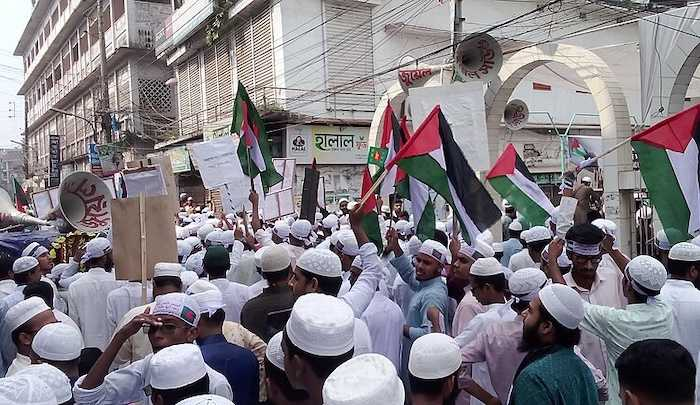 A street protest in Dhaka in support of the Palestinian cause
To cap it all, Bangladesh is facing an energy crisis, exacerbated by the Iran war, causing widespread hardship and disrupting industry and agriculture. In such circumstances, adopting an anti-India posture can help the government score political brownie points and placate the Islamist opposition.
Secondly, Bangladesh finds itself being wooed not only by the United States, which was largely supportive of the August 2024 movement, but also by China. This may have given Dhaka the perception that it has “options” and can look beyond India.
Thirdly, its list of suitors is growing. The Mecca Pact is the latest offer on the table. Not only do Bangladesh’s new-found friends—Pakistan and Turkey—want it to become part of the proposed defence arrangement, but Saudi Crown Prince Mohammed bin Salman has also invited Rahman to visit Saudi Arabia. That may well be his next overseas official destination.
Bangladesh is already a member of the Saudi-led military coalition formed in 2017, as well as the more recent Saudi-led naval alliance aimed at protecting shipping lanes in the Red Sea. Given Bangladesh’s economic dependence on Saudi Arabia, its religious and diplomatic ties with the kingdom, and the potential economic benefits of such an arrangement, there is little reason why Dhaka would not consider joining the Mecca Pact.
It is quite possible that one or all of these factors have emboldened Rahman to adopt such a hardened stance towards India and reconsider his proposed visit. If so, it would be, to put it mildly, a myopic step.
India is not merely a neighbour; it is a giant neighbour. As Rahman is likely to have learned from his Chinese counterparts, there is an old saying: “Better a good neighbour than a brother far away.”
Geography is destiny. Whether it is river-water sharing, an energy emergency, trade or connectivity, Bangladesh will inevitably have to turn to India.
ALSO READ: Yunus regime is supporting radicals in Bangladesh: Rokeya Prachi
For someone who has entered the highest office of his country for the first time, it would be wise to remember this.


.jpg "Gujarat’s women entrepreneurs bring their craftsmanship to life during Navratri")








_(2).webp)
.webp)
