Rushda Shaheen
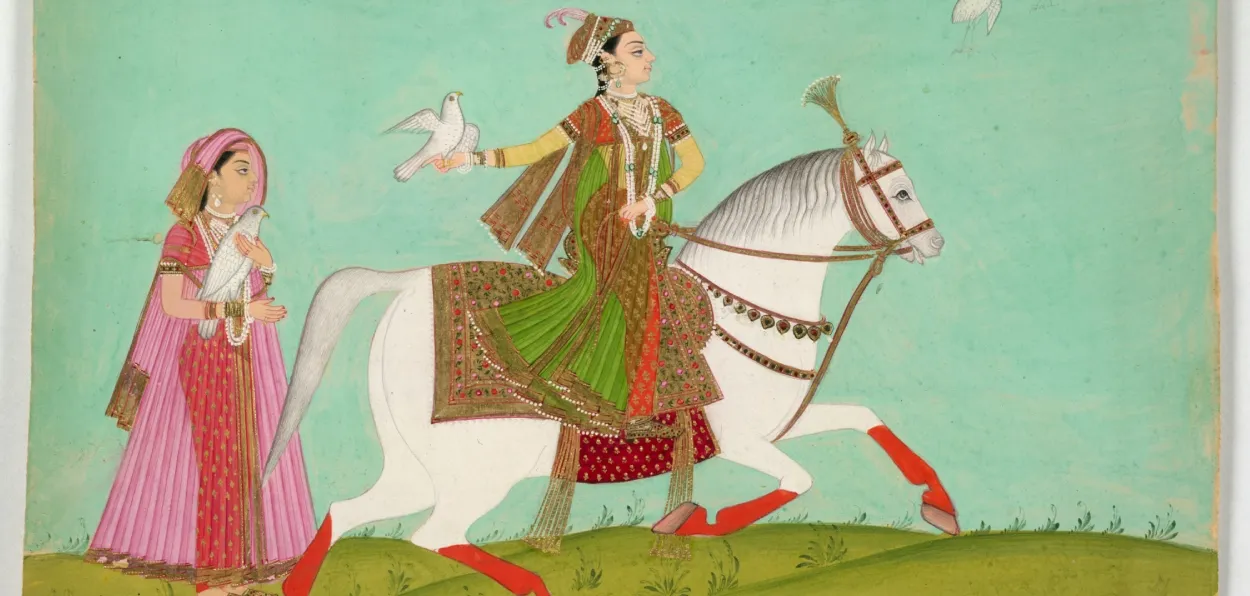
In late 1595, as forces sent by Mughal Emperor Akbar marched towards the Deccan to conquer it, a courageous Queen Chand Bibi led the resistance against one of the most powerful empires of her age.
The sixteenth-century queen belongs to a much longer history of women who ruled, fought, and acted as regents across South Asia. Yet, despite her legendary courage and leadership, Chand Bibi has remained far less prominent in mainstream historical narratives.
Historian Sarah Waheed’s Chand Bibi: The Lives and Legends of a Warrior Queen, published by Vintage, an imprint of Penguin Random House India, focuses on the life of this extraordinary woman.
In an interview with Awaz-The Voice, Waheed said the journey to Chand Bibi was personal. “Chand Bibi’s life and the religiously pluralist and multi-ethnic world of the Deccan to which she belonged were themselves deeply inspiring,” she says. “I was also inspired to write this book because of my own heritage as a Hyderabadi woman.”
She first heard of the queen as a child. But the book itself began somewhere unexpected. “The project really began when she found me in an old bookshop of my ancestral city,” Waheed recalls. “That encounter led me to not only the queen, but also her many ‘afterlives’, the way in which she has been remembered and represented.”
 The Book on Chand Bibi and its author Sarah Waheed
Chand Bibi has not gone entirely unwritten. Several Urdu accounts of her life exist. Many date to the early twentieth century or earlier, and lean heavily on Persian histories. There are also more recent publications. But Waheed says her own work departs from these in several ways.
“My book is not a straightforward biography,” she explains. “Biographies are useful, but they can also isolate an individual from the complex historical world that made her possible.” Instead, Waheed places Chand Bibi “within the wider political, intellectual and cultural landscapes of the Deccan.”
Central to her argument is a reframing of Chand Bibi's identity. Rather than treating her as an isolated anomaly, Waheed places her within “a much longer history of women in the Deccan who governed territories, commanded armies, and acted as regents who shaped cultural and political institutions.”
So, who exactly was this queen who made an empire pause? “Like other elites of her time and place, Chand Bibi was highly educated and multilingual,” Waheed says. “She was a queen who served as regent in both Bijapur and Ahmednagar. She was a diplomat, military strategist, accomplished sportswoman and huntress, patron of architectural and public works projects, and a formidable political leader. She belonged to a region whose leaders had long resisted being absorbed by an imperial centre.”
Chand Bibi is best known for defending Ahmednagar and forcing the Mughal army to retreat. But as Waheed shows, her power was not confined to one heroic moment, nor to any single, cloistered space. “Chand Bibi exercised authority not only in the women’s quarters, but also in the durbar at court. Her sovereignty was acknowledged even by her enemies, who referred to her as ‘sultan.”
That authority reached into the wider Indian Ocean world. Waheed discusses Chand Bibi’s 1598 correspondence with the Portuguese viceroy Dom Francisco da Gama as revealing because, “she wrote in the language of sovereign equality, referring to herself as sultan and addressing the viceroy as one ruler addressing another.” Waheed says. “She employed a Brahmin envoy to convey and explain her letters to the Portuguese.”
These exchanges, Waheed argues, show that Chand Bibi “was developing a diplomatic relationship with a maritime power, which challenged Mughal imperial claims to diplomacy with external powers, which made Chand Bibi an added threat to Akbar.”
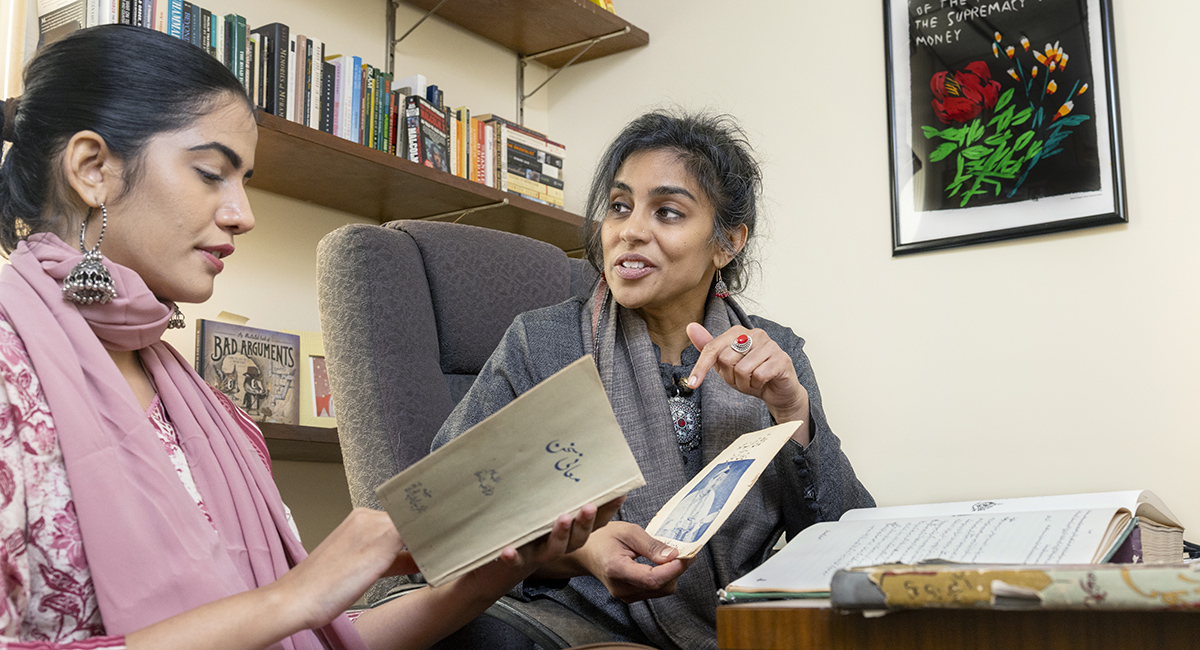 Sarah Waheed at the University of California
News of her successful defence of Ahmednagar travelled far. It “had already travelled through Portuguese networks even as far as Philip II in Spain,” Waheed says — evidence, she says, that Chand Bibi “was not merely a regional warrior queen, but a sovereign whose actions were being taken seriously across the early modern world far past India.”
Yet it was not only military resistance that impressed Waheed during her research. “Military courage was only one aspect of Chand Bibi’s rule,” she says. “I was impressed by her ability to build coalitions among the Deccan sultanates and her skills in diplomacy.”
She navigated rivalries close to home and negotiations far from it. “She managed competing groups within her own court and negotiated with external powers.” Chand Bibi, in Waheed’s telling, was often weighing “how long military resistance remained possible, and when negotiation might preserve more for the sultanate and the people than continued fighting.”
I asked Waheed why Chand Bibi still matters today. For her, Chand Bibi’s story is not just an artefact of the past, but it speaks directly to the present. When I asked her why Chand Bibi is relevant for women and young people today specifically, Waheed replied, “Chand Bibi was able, at crucial moments, to hold together a fragile and divided political community amid a great deal of instability. That feels relevant today, when women and young people are confronting the uncertainties posed by economic insecurity, war, authoritarianism, and communal, patriarchal violence.”
Reconstructing Chand Bibi’s life was no simple task. “The greatest difficulty was not that sources did not exist, but that in India, they were scattered, poorly preserved, inadequately catalogued or extremely difficult to access,” Waheed says.
Persian manuscripts, she found, are spread “among museums, libraries, private collections, and unofficial archives.” Often, the bureaucratic process of accessing them proved “a far more daunting process than the demands of interpreting the documents themselves.”
Language added another layer of difficulty. Many Urdu histories, Waheed explains, are translations or adaptations of earlier Persian works. Yet Urdu historiography can be notably reliable at the local and provincial level, since “Urdu scholars were present at many places in former Muslim princely states, and knew regional languages and were also scholars of Persian and Arabic, and at times even Sanskrit.” Still, she cautions, “more recent Urdu histories can contain omissions or ideological interventions.”
The Persian court histories carried their own bias. “They tend to preserve the voices of men, courts, and armies, much more readily than the voices of women, servants or ordinary soldiers,” Waheed says. Later English translations, she adds, “were a rupture from earlier forms of historical writing, and introduced extremely problematic perspectives... which imposed manufactured narratives onto the past.”
Waheed’s method, in the end, was one familiar to historians everywhere: triangulation. “I would have to compare Persian histories, together with Urdu translations, Portuguese correspondence, inscriptions, paintings, architectural remains, archaeological reports, poetry, folklore and oral histories.”
Why She Was Forgotten?
Why has a figure of this stature stayed on the margins of mainstream Indian history? Waheed points to several overlapping causes.
Much of the surviving record was written by elite men. In these accounts, “women tend to appear... in relation to men, as daughters, wives, widows or mothers, rather than political actors in their own right.” A woman’s rule, Waheed notes, could be dismissed “as merely temporary, or the result of a male ruler’s personal weaknesses, rather than her own political ambitions.”
Colonial and orientalist histories were extremely disruptive, Waheed says, by popularising “the idea that Muslim women were passive inhabitants of the harem, totally cut off from political life.” In fact, she argues, “the harem... was a major arena of political power and contests for sovereignty.”
Today’s both popular and scholarly histories of the period “remain heavily centred upon northern India and the Mughal empire,” with the Deccan “narrated only when it comes into contact with Mughal expansion.” This even though, in her words, “the Deccan produced so many female rulers, arguably more than most regions of South Asia.”
READ MORE:Woman pilot hit LeT's Muridke center, and more facts about Operation Sindoor
British colonial historians compounded this by sorting India’s past into separate “Hindu” and “Muslim” periods, “turning complex political struggles into an eternal religious conflict.”








_(1).webp)

_(1).webp)

.webp)