Dhaka
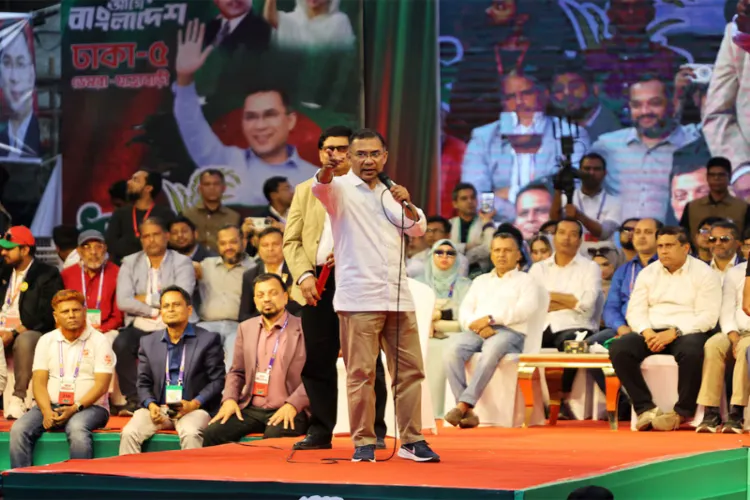
In his first remarks after the Bangladesh Nationalist Party’s decisive victory in the parliamentary elections, BNP chief Tarique Rahman on Saturday called for national cohesion, describing the verdict as a renewed mandate for democratic values.
Addressing the nation following the declaration of results, Rahman appealed for reconciliation across political divides. “Our paths and opinions may differ, but in the interest of the country, we must remain united,” he said, stressing the need for a shared national purpose.
Emphasising the broader significance of unity, he added, “I firmly believe that national unity is a collective strength, while division is a weakness,” linking his message to the responsibilities facing Bangladesh after the polls.
His appeal came as the Bangladesh Nationalist Party registered a sweeping performance in elections held on Thursday — the first national vote since the violent 2024 uprising that led to the removal of former prime minister Sheikh Hasina.
According to figures released by the Election Commission, the BNP-led alliance secured 212 seats, while the Jamaat-e-Islami-led bloc won 77 seats. Hasina’s Bangladesh Awami League was barred from participating in the elections.
Thanking supporters at the outset of his address, Rahman described the outcome as an endorsement of democratic aspirations. “Freedom-loving pro-democracy people of the country have once again brought victory to the Bangladesh Nationalist Party,” he said.
“This victory belongs to Bangladesh, belongs to democracy, and belongs to the people who aspired to and sacrificed for democracy,” Rahman added, portraying the result as part of a collective struggle for democratic restoration.
Even as he welcomed the mandate, the BNP chief cautioned that the incoming administration would face formidable challenges. “We have paved the way for the establishment of democracy in the country,” he said, while warning of a “fragile economy, weakened constitutional and structural institutions, and damaged law and order” left behind by what he termed an authoritarian regime.
The outcome marks a major political resurgence for the 60-year-old leader, who returned to Bangladesh in December after 17 years in exile in Britain and re-entered national politics at a critical moment.
READ MORE: Pakistan's newest talent Usman Tariq is inspired by M S Dhoni
Rahman is the son of former president Ziaur Rahman, who was assassinated in 1981, and former prime minister Khaleda Zia, a three-time officeholder and one of the country’s most influential political figures.