




New Delhi
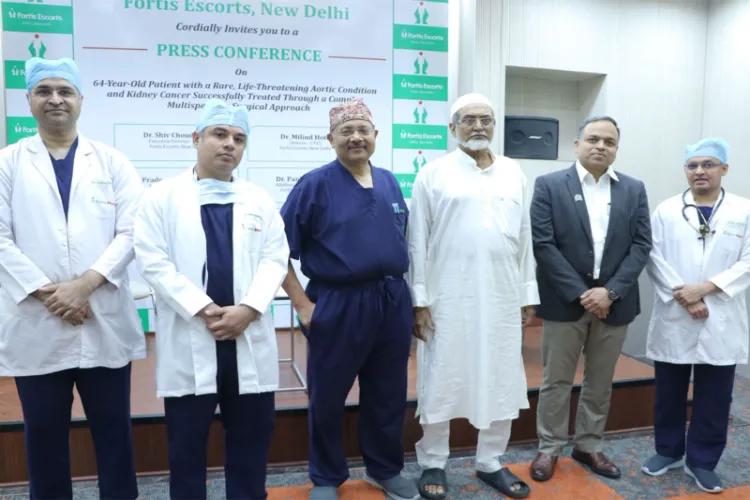
Doctors at a private hospital in Delhi have reported a rare medical achievement after successfully treating three potentially life-threatening conditions in a 64-year-old man during a single operation.
The multidisciplinary team at Fortis Escorts Hospital, Okhla, repaired a dangerous tear in the patient's aorta, treated a severely leaking aortic valve and removed a cancerous tumour from his left kidney during the same hospital stay.
According to the doctors, performing complex open-heart and aortic surgery together with robot-assisted kidney cancer surgery in a single operation has not previously been reported in the available medical literature, making the case a potentially world-first surgical combination.
The patient had initially approached the hospital with severe breathlessness and extreme fatigue, even while performing routine daily activities. Detailed investigations and medical scans revealed three serious conditions that required urgent attention.
Doctors found a dangerous tear and swelling in the patient's aorta, the body's main artery, along with a severely leaking aortic valve. During the evaluation, doctors also detected a cancerous tumour in his left kidney.
The combination presented an unusually complicated clinical challenge. According to the medical team, delaying treatment for the aortic condition carried the risk of a potentially fatal rupture, while the failing valve was placing increasing strain on the heart. At the same time, delaying treatment for the kidney tumour could have allowed the cancer to progress.
Under normal circumstances, such major procedures may be performed separately to allow a patient to recover between surgeries. However, the medical team determined that waiting between procedures could expose the patient to additional risks.
The doctors therefore planned a combined approach. The cardiac surgery team first performed an open-heart procedure to address the damaged valve and aorta. The team used the Frozen Elephant Trunk graft, a specialised hybrid technique that combines surgical reconstruction of the aortic arch with placement of a stent graft into the descending thoracic aorta.
Dr Shiv Kumar Choudhary, Executive Director, Adult Cardio Thoracic and Vascular Surgery at Fortis Escorts Hospital, said the complexity of the aortic repair required careful protection of the patient's organs.
"Repairing the aorta, the body's main blood vessel, is incredibly complex," Choudhary said, adding that the patient's body temperature was lowered during surgery to protect his organs while specialised pumps maintained blood flow to the brain.
He said the Frozen Elephant Trunk technique enabled the team to repair the damaged artery in a single procedure, avoiding the need for another major aortic surgery months later.
Once the cardiac procedure was completed and the patient's condition stabilised, the urology team performed robot-assisted partial nephrectomy to remove the cancerous kidney tumour while preserving as much healthy kidney tissue as possible.
Dr Milind Padmakar Hote, Director, Adult Cardio Thoracic and Vascular Surgery, said the presence of the aortic tear made the case particularly challenging. He said the seamless transition between the cardiac and urology teams allowed the tumour to be removed during the same anaesthetic cycle.
Dr Pankaj Panwar, Additional Director, Urology, said robotic-assisted surgery provided enhanced visualisation and precision, allowing doctors to remove the tumour while preserving healthy kidney tissue. The minimally invasive approach also helped limit blood loss and surgical stress following the major cardiac procedure.
The patient reportedly experienced improvement in his breathing and heart function following the surgery. After a smooth postoperative recovery, he was discharged from the hospital in stable condition and is currently doing well, according to the hospital.
The medical team was led by Dr Shiv Kumar Choudhary along with Dr Milind Padmakar Hote, Dr Pankaj Panwar and Dr Ashish Jai Kishan, Senior Consultant, Cardiology.
The case highlights the growing role of multidisciplinary surgical teams, particularly when patients present with multiple serious conditions that would traditionally require separate interventions.
However, the hospital's claim of a "world-first" relates specifically to the combination of these procedures in a single operation. Frozen Elephant Trunk procedures themselves are established techniques used for complex aortic disease and have been performed internationally for years. For example, medical institutions have reported other world-first variations involving the Frozen Elephant Trunk technique.
READ MORE:Aisha Ayub's digital business hinges on peoples' power
The Delhi case therefore represents an unusual combination of complex cardiac, aortic and robotic cancer surgery, rather than the first-ever use of the individual techniques involved.







.webp "Om Prakash Mathur")
_(1).jpg)
_(4).webp)