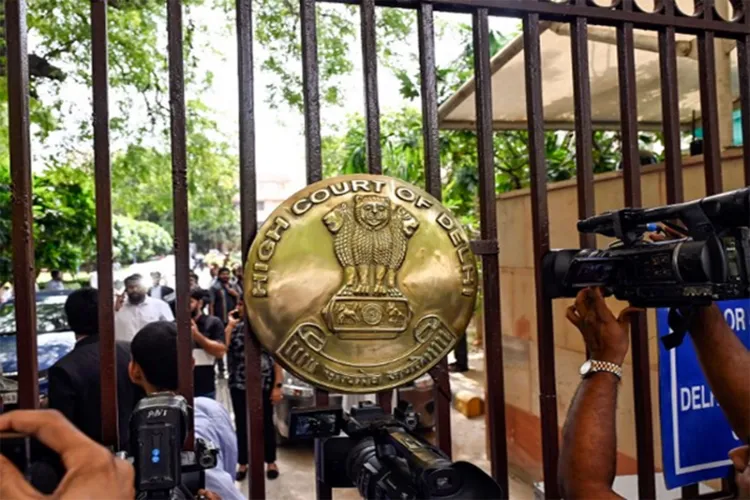
New Delhi
The Delhi High Court has dismissed a public interest litigation (PIL) challenging a 1980 notification listing certain mosques in Jahangir Puri as Wakf properties, observing that courts cannot allow stale disputes to be revived on "flimsy grounds" or permit misuse of PIL jurisdiction.
The Division Bench headed by Chief Justice Devendra Kumar Upadhyaya held that the petition filed by Save India Foundation lacked bona fides and appeared to be an attempt to unnecessarily rake up settled issues after nearly 46 years.
The Court emphasised that the purity and purpose of public interest litigation must be preserved and not diluted by petitions filed for oblique motives.
The petitioner had challenged a notification issued by the Delhi Wakf Board in April 1980 under the Muslim Wakfs Act, 1954, which listed three mosques in Jahangir Puri, locally known as Jama Masjid, Moti Masjid and Masjid Jahangir Puri as Sunni Wakf properties.
The Court noted that the list was prepared following statutory procedure, including an inquiry by the Wakf Commissioner and publication after examination of the report forwarded by the government.
The Wakf Board argued that the challenge was not maintainable because the notification was issued nearly five decades ago, the Act provided a specific mechanism to challenge Wakf listings, and any dispute should have been raised within one year before a civil court.
The Bench agreed, observing that the statutory scheme made the Wakf list final if not challenged within the prescribed time.
The petitioner claimed the land had been acquired by the government in 1977 for planned development and later handed to the Delhi Development Authority for the development of Jahangir Puri, arguing that the structures were illegal encroachments.
However, the Court found no material establishing the identity of the land allegedly acquired or any proof that it was the same land on which the mosques stand.
The Bench remarked that there was "nothing on record" to show the Wakf properties existed on acquired land.
The Court strongly questioned the intent behind the petition, noting that the petitioner organisation had filed numerous PILs on various issues.
It observed that PIL jurisdiction is meant to protect disadvantaged groups and genuine public causes, not to advance personal grievances or publicity interests. The Court cited Supreme Court rulings warning against the misuse of PILs by "busybodies" or litigants pursuing hidden motives.
READ MORE: Bengaluru cleric asks Muslims to help NIA in tracing a Lashkar terrorist
Reiterating principles laid down by the Supreme Court, the Bench stressed that a PIL petitioner must approach the court with clean hands, mind and objective, courts must prevent abuse of PIL jurisdiction, and frivolous or mala fide PILs should be rejected at the threshold.
The Court underscored that public interest litigation is a powerful judicial tool intended to deliver social justice and protect public rights. However, it warned that courts must ensure it is not used for personal vendetta, political motives, or publicity-seeking. Concluding that the present petition lacked merit and bona fides, the Court refused to interfere with the decades-old notification.












.webp "Seva Teerth, the new PMO complex")