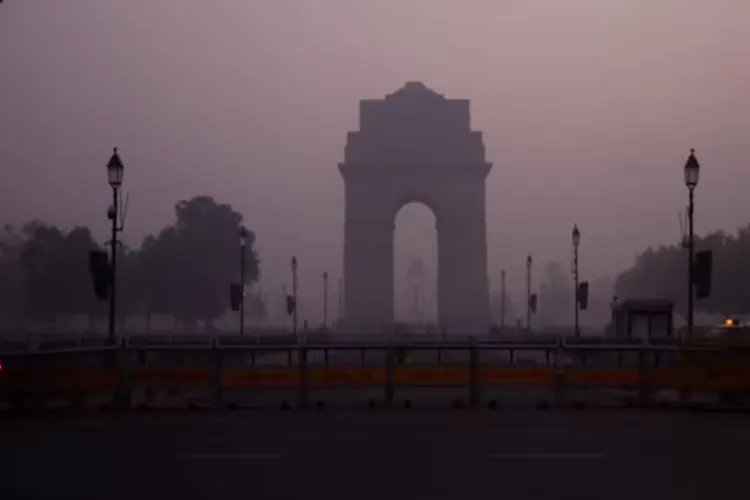
New Delhi
Amid a sharp decline in air quality triggered by adverse weather conditions, the Commission for Air Quality Management (CAQM) on Saturday implemented stricter Stage III measures under the Graded Response Action Plan (GRAP) across the Delhi-NCR region. The curbs include shifting schools up to Class 5 to a hybrid mode of teaching and tightening restrictions on construction and demolition activities.
According to CAQM, Delhi’s 24-hour average Air Quality Index (AQI) was recorded at 349 but deteriorated rapidly to 401 by 10 am on Saturday. The commission attributed the sudden spike to low wind speeds, a stable atmosphere and other unfavourable meteorological factors that hinder the dispersion of pollutants.
Taking into account the prevailing pollution trend and the likelihood of further deterioration, the GRAP sub-committee decided to activate all measures under Stage III, which corresponds to the ‘Severe’ air quality category, with immediate effect. These restrictions will operate alongside the Stage I and Stage II actions that were already in place across the National Capital Region.
Under Stage III, all non-essential construction and demolition work has been halted, along with activities such as stone crushing and mining. Restrictions have also been imposed on the movement of BS III petrol and BS IV diesel four-wheelers in Delhi, Gurugram, Faridabad, Ghaziabad and Gautam Buddh Nagar.
In addition, the entry of older diesel goods vehicles into Delhi has been prohibited. Schools up to Class 5 have been directed to switch to a hybrid mode of learning, while offices in Delhi-NCR have been advised to function with up to 50 per cent staff attendance, wherever feasible.
Every winter, Delhi-NCR follows the GRAP framework to tackle rising pollution levels. The plan classifies air quality into four categories — Stage I (Poor, AQI 201–300), Stage II (Very Poor, AQI 301–400), Stage III (Severe, AQI 401–450) and Stage IV (Severe Plus, AQI above 450).
ALSO READ: Rukhsana's story inspires Mewati women to fly with education
Pollution levels in the region typically spike during winter due to a combination of factors, including adverse weather conditions, vehicular emissions, stubble burning, firecracker use and other local pollution sources.