New Delhi
Union Minister for Minority Affairs Kiren Rijiju has promised to look into the demand of Muslim leaders for the extension of time for the registration of waqf properties on the UMEED portal.
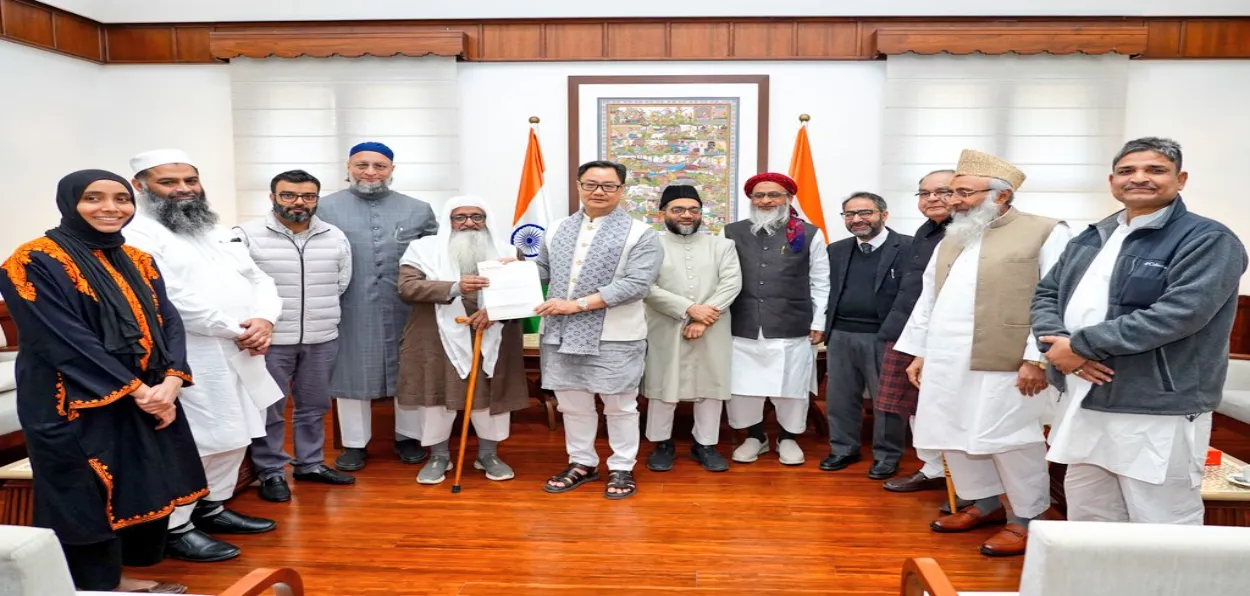
This came as a delegation of Muslim leaders representing All India Muslim Waqf Board met and apprised him of the hurdles faced by the community in meeting the just-expired deadline for uploading the Waqf properties on the government portal, explaining why the extension of timeline was needed.
The delegation requested a year-long extension to complete the uploading of the remaining properties in view of the technical glitches they faced earlier. The six-month deadline earlier given for the process has just expired.
The Minister wrote on X that he had an engaging interaction with the delegation of the All India Muslim personal Law board where they discussed about issues related to registration of Waqf Properties on UMEED portal and pleasantly exchanged ideas.
Had an engaging interaction with the delegation of the All India Muslim Personal Law Board at my office today.
— Kiren Rijiju (@KirenRijiju) December 11, 2025
We discussed about issues related to registration of Waqf properties in UMEED Portal and pleasantly exchanged ideas. pic.twitter.com/0UN3NcataG
Rijiju assured that these issues would be resolved in a positive and timely manner. The delegation included All India Muslim Personal Law Board Vice President Mr Syed Sadatullah Hussaini, General Secretary Maulana Muhammad Fazlur Rahim Mujaddidi, MPs Asaduddin Owaisi, Ruhullah Mehdi, Muhammad Javed Muhammad, writer Maulana Muhammad Hakimuddin Qasmi, Mufti Abdul Razak, Fazil Ahmed Ayubi, and Advocates Hakeem Muhammad Tahir Advocate and Nabila Jameel.
The delegation told Rijiju that while uploading the registered properties of the Waqf on the UMEED portal, they faced hurdles and technical issues and therefore lakhs of properties could not be registered.
The delegation suggested that the Waqf Boards should be involved in the process of registration, as it had a list of it and also manpower, and the timeline should have been two years.
The delegation rued that the amendments made to the Waqf Act and the UMEED Act, and making uploading mandatory under Section 3B, have put the entire community under pressure.
Punjab Waqf Board, Madhya Pradesh Waqf Board, Gujarat Waqf Board and Rajasthan Waqf Board also approached the tribunal for extension of time, and they have also been granted extension.
The delegation also pointed out that there is a clear difference between the period mentioned in the law and the date of practical implementation of the portal. The UMEED rules were issued only on 03/07/2025, and the uploading procedure is assumed to have started on the same date. The templates of the declaration of the trustee and the Chief Executive Officer were also issued for the first time on the same date. Therefore, the date of launch of the portal on 06/06/2025 cannot be considered as the date of practical implementation of the law.
Based on all these points, the delegation requested that the initial six-month period given in the law be extended by at least one more year so that the process can be completed and there is no need to go to the tribunal except in exceptional circumstances.
Jamaat-e-Islami Hind Ameer Syed Saadatullah Hussaini said that said that the law also provides that the government use power under the legal provisions to take necessary steps to resolve the problems of Waqf Boards. "We referred to this provision and told them that using this law they can take necessary steps to mitigate these difficulties. They assured us that they will consult legal experts and explore this possibility," he said.
The Muslim leaders said thathat everyone was trying to complete the uploading process honestly, and if an extension of one year is given, the work can be completed easily within the stipulated period.
ALSO READ: Parvez Khan’s flight from Mewat to Florida's tracks is a magical story of grit
Finally, the delegation reminded that Section 113 of the Waqf Act and the UMEED Act, 1995 empowers the Central Government to issue orders to remove difficulties encountered in implementation. The Minister assured them that solutions to these problems would be found soon.









.webp "The couple salvaging their belongings from the dutted house")


.webp "President APJ Abdul Kalam offering Namaz")