Vadodara
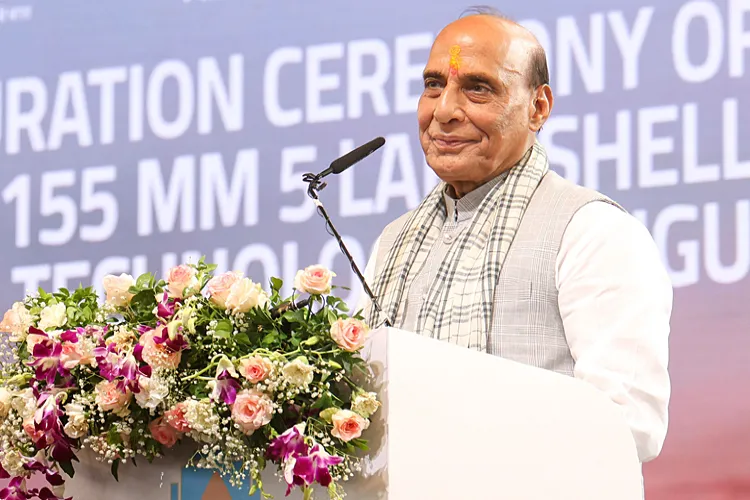
Defence Minister Rajnath Singh on Tuesday said Gujarat can potentially emerge as a major hub for defence manufacturing and technology and play a pivotal role in India's journey towards self-reliance through its industrial strength, skilled workforce and entrepreneurial spirit.
Addressing the valedictory function of the 4th Vibrant Gujarat Regional Conference (VGRC) for the central Gujarat region here, Singh said India has made significant strides in defence production and exports over the past decade, but "still has a long way to go" in achieving complete self-reliance.
He said India's domestic defence production has increased from around Rs 46,000 crore in 2014 to about Rs 1.78 lakh crore, while defence exports have grown from nearly Rs 1,000 crore to around Rs 39,000 crore during the same period.
"However, I consider this to be merely the beginning. We still have a long way to go, and I believe that Gujarat can play a very significant role in achieving the goal of self-reliance in defence production," the minister said.
Singh said the country had moved from being heavily dependent on defence imports to building a strong indigenous defence ecosystem driven by private industry, startups and innovation.
He said initiatives such as Make in India, the Defence Acquisition Procedure, Technology Development Fund, Srijan Portal, Innovations for Defence Excellence (iDEX), defence testing infrastructure, Green Channel Certification and self-certification had encouraged domestic industries, particularly MSMEs and startups, to participate in defence manufacturing.
The government has also simplified industrial licensing procedures and liberalised the foreign direct investment policy to attract greater investment into the sector, he said.
Highlighting Gujarat's growing importance in defence manufacturing, Singh said Vadodara is home to India's first private-sector military aircraft manufacturing facility under the Tata-Airbus C-295 transport aircraft programme, calling it a landmark in the country's aerospace journey.
He also noted that the K9 Vajra self-propelled artillery platform, one of the world's most advanced artillery systems, is manufactured at a facility in Gujarat, significantly strengthening the Indian Army's strike capability.
The minister said future warfare and economic growth would increasingly be driven by advanced technologies such as semiconductors, artificial intelligence, quantum computing, cybersecurity and space technology.
He said semiconductor ecosystems being developed in Sanand and Dholera would become the foundation of India's technological sovereignty, while Gujarat's strengths in chemicals, petrochemicals, engineering, ports, shipbuilding, renewable energy and green hydrogen could support the development of advanced defence technologies.
Earlier, Singh said the Vibrant Gujarat Regional Conference had evolved beyond an investment summit into a platform for generating new ideas, partnerships and opportunities for the state's development.
He said exhibitions organised during the event showcased Gujarat's strengths across sectors including industry, MSMEs, startups, automobiles, exports, handicrafts, women entrepreneurs and tribal products.
The minister said he also interacted with representatives of Tata Advanced Systems, Larsen & Toubro, the Society of Indian Defence Manufacturers (SIDM), MSMEs, startups and academia during a seminar on defence and aerospace industries and received valuable suggestions to strengthen India's defence manufacturing ecosystem.
Describing Gujarat as the "growth engine" of the Indian economy, Singh said the Vibrant Gujarat initiative launched in 2003 under then chief minister Narendra Modi had evolved into a globally recognised platform that complements the vision of making India a developed nation by 2047.
He said the goal of a developed India was not confined to economic prosperity alone but also envisaged a technologically advanced, socially empowered and strategically secure nation, with the defence sector serving as one of its key pillars.
Earlier in the day, Singh participated in a seminar on "Self-reliant India in Aerospace and Defence", where memoranda of understanding (MoUs) worth Rs 2,550 crore for investments in Gujarat's defence sector were signed in his presence.
He urged industry players and startups to contribute for making India self-reliant in defence manufacturing and invited suggestions on strengthening the sector.
During an interaction with representatives of industry, startups and other stakeholders, Singh said the government was keen to address their concerns and sought feedback on policy support required to accelerate indigenous defence production.
Participants raised issues relating to the development of globally competitive testing facilities, the availability of raw materials, Gujarat's role in the defence sector and the need for a defence industrial corridor in the state.
READ MORE: Fauzia Dastango's journey of reviving the art of storytelling
Responding to a startup founder who highlighted difficulties in identifying suitable end-users for defence products, Singh said entrepreneurs need not wait for formal conferences to engage with the government.
"Whether there is a conference or not, even if there is no meeting, as a startup you can directly take an appointment with the Defence Minister," he said, assuring startups that their concerns and challenges would continue to receive the government's attention.

_(1).jpg "Visitors gather at the Santosh Mitra Square Durga Puja pandal, themed on the 150th anniversary of Vande Mataram and its historic role in India's freedom movement, ahead of the festival, in Kolkata")

.jpg "Gujarat’s women entrepreneurs bring their craftsmanship to life during Navratri")





.webp "Bollywood actor Tiger Shroff")
.webp)