Ahmedabad
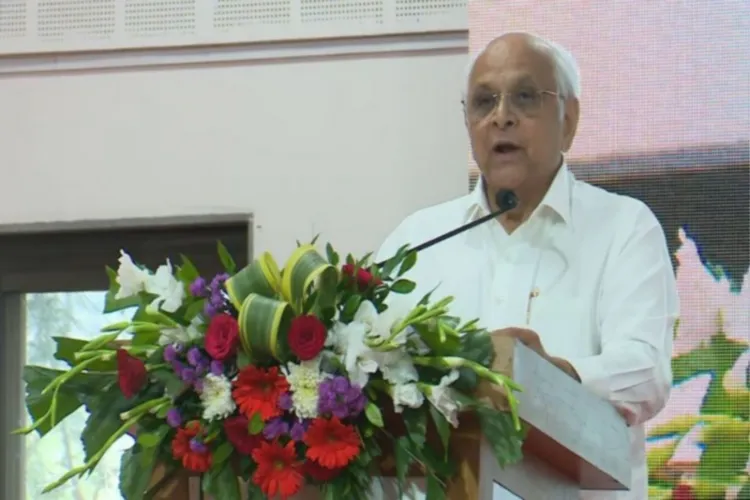
To further strengthen Prime Minister Narendra Modi's "Catch the Rain" campaign, the Gujarat Government, under the leadership of Chief Minister Bhupendra Patel, is undertaking several major initiatives to improve irrigation and water availability across the state's remote regions.
As part of this initiative, two advanced Air-Filled Rubber Dam projects have been approved and are currently under construction: Rajvasana Rubber Dam on the Heran River near Rajvasana village in Bodeli taluka, Chhota Udepur district and Pathakwadi Rubber Dam on the Ambika River near Pathakwadi village in Dolvan taluka, Tapi district.
Guided by Water Resources and Water Supply Minister Ishwarsinh Patel, the Rajvasana project is being developed at a cost of ₹82.97 crore and is targeted for completion by September 2027. Once operational, it will provide direct irrigation benefits to farmers in 25 nearby villages.
Similarly, the Pathakwadi Rubber Dam, being built at a cost of ₹79.13 crore, is based on advanced Japanese design and uses South Korean rubber bladder technology. It will provide irrigation water to approximately 650 hectares of farmland, significantly benefiting local farmers.
The project involves the installation of a 180-metre-long and 3.5-metre-high inflatable rubber bladder across the Heran River.
The key advantage of this technology is that it will significantly enhance the storage capacity of the existing weir, allowing it to store 3.5 million cubic metres (MCM) of water. This will substantially raise groundwater levels in surrounding areas, ensuring a reliable supply of irrigation and drinking water. Currently, 75% of the project has been completed.
Unlike conventional weirs, the rubber dam can release accumulated sand and silt, maintaining its storage capacity. During heavy monsoon floods, the dam can be deflated, allowing floodwaters to pass freely and protecting nearby villages. Construction includes 900 metres of flood protection wall on the left bank and 500 metres on the right bank of the river.
The project includes 10 years of Operation and Maintenance (O&M) to ensure smooth and uninterrupted functioning. It will provide irrigation to 3,420 hectares across 25 villages, enabling farmers to cultivate both Kharif (monsoon) and Rabi (winter) crops.
In the future, the Rajvasana canal network will also be connected to village ponds, improving groundwater recharge and ensuring long-term availability of both drinking and irrigation water.
A major breakthrough in water conservation is taking shape in Tapi district, known for its perennial rivers and natural beauty.
The Government of Gujarat is constructing a ₹79.13 crore Air-Filled Rubber Dam across the Ambika River near Pathakwadi village in Dolvan taluka.
The project will provide sufficient irrigation water for Kharif and summer crops to farmers in Pathakwadi, Dhodiyawad, Unai, Sindhai, and nearby villages. At present, 90% of the construction work has been completed.
Due to the region's flat terrain and low riverbanks, constructing conventional check dams or weirs was not technically feasible.
Following representations from local farmer leaders and Mohanbhai Kokni, the Water Resources Department conducted a survey and decided to adopt the innovative Air-Filled Rubber Dam technology instead of a traditional barrage.
The dam has been designed according to the Japanese Code 2000. Its specially manufactured South Korean rubber bladder, ranging from 18 mm to 32 mm in thickness, is engineered to withstand temperatures exceeding 50°C and has an estimated service life of 30 years.
One of the project's most advanced features is its SCADA (Supervisory Control and Data Acquisition) automation system. The rubber bladder can be inflated and deflated remotely using a computer, eliminating the need for manual operation.
The structure consists of a 2.0-metre-high concrete base, a 2.5-metre inflatable rubber bladder, fixed with J-bolts, a total height of 4.5 metres, a total length of 280 metres across four spans, Flood Protection and Reduced Soil Erosion.
Unlike conventional steel-gated dams, the inflatable rubber dam allows floodwaters to pass freely during the monsoon when deflated, reducing riverbank erosion.
It also enables accumulated silt to flow downstream naturally, ensuring that the reservoir maintains its water storage capacity over the long term.
The Pathakwadi Rubber Dam will store approximately 3.5 Million Cubic Metres (MCM) of water and provide irrigation to 650 hectares of agricultural land.
READ MORE: Rutba Shaukat sets Guinness World Record in Origami
It will also recharge nearby wells and borewells, improving groundwater levels and ensuring a reliable supply of drinking water for local communities. In the future, this technology can also be used as a tidal regulator to prevent seawater intrusion into freshwater systems along coastal regions.

.webp "Pilgrims on the way to Amarnath shrine")











.webp)