




New Delhi
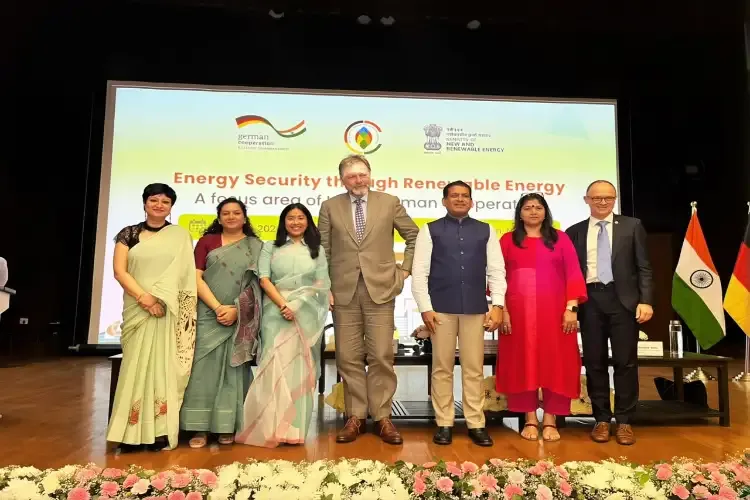
The Indo-German Green and Sustainable Development Partnership (GSDP), in collaboration with the Ministry of New and Renewable Energy (MNRE), organized the 10th GSDP Dialogue Session on the theme “Renewable Energy for Energy Security.” The high-level panel discussion brought together senior representatives from MNRE, industry leaders, think tanks, private-sector stakeholders, and renewable energy experts to deliberate on how India can accelerate its renewable energy transition and how renewable energy can strengthen the resilience of the Indian economy against fossil fuel price shocks.
In his opening remarks, Dr. Philipp Ackermann, Ambassador of Germany to India, said:
"Renewable energy is no longer just a climate imperative; it has become an economic and strategic necessity. India and Germany face a common challenge of reducing dependence on imported fossil fuels and enhancing energy independence. Renewable energy forms a powerful trilogy of climate action, economic opportunity, and energy security. India has made significant progress in scaling up renewable energy, which now contributes nearly 26 percent of the country's electricity generation. The GSDP partnership is particularly significant as India and Germany celebrate 75 years of diplomatic relations. The long-standing bilateral development partnership has evolved into a collaboration for climate action and sustainable development that promotes resilient economic growth."
Panelists (L-R): Ms. Shreya Jai (Indie Energy Hour), Ms. Aparna Roy (ORF), Mr. Santosh Kumar Sarangi (Secretary, MNRE), Dr. Philipp Ackermann (German Ambassador), and Ms. Vaishali Nigam Sinha (Co-founder, ReNew).
The two countries are working together in areas such as renewable energy expansion and manufacturing, battery storage, grid integration, energy efficiency, decarbonization of hard-to-abate sectors, green urban mobility, biodiversity conservation, climate change mitigation and adaptation, sustainable urban development, and vocational education.

Highlighting India’s renewable energy priorities, Mr. Santosh Kumar Sarangi, Secretary, MNRE, spoke about the relevance of energy security and the importance of international cooperation. He said:
"The recent crisis in West Asia has once again underscored the importance of energy security. Renewable energy—including solar, wind, battery energy storage systems, and green hydrogen—has immense potential to strengthen energy security while supporting sustainable development.
India has made remarkable progress, with non-fossil fuel sources now accounting for nearly 54 percent of the country’s installed power capacity. We remain fully committed to achieving 500 GW of non-fossil fuel capacity by 2030. As trusted partners in the global energy transition, India and Germany can work together to foster innovation, mobilize investments, and advance our shared goals of energy security, sustainable development, and climate action."
India has set ambitious targets of achieving 500 GW of non-fossil fuel energy capacity by 2030 and net-zero emissions by 2070. Solar energy, wind power, and energy storage technologies are expected to play a critical role in reducing dependence on fossil fuels and facilitating India’s transition to a low-carbon economy.
India’s rapid economic growth and rising energy demand have made energy security one of the most important pillars of national development. Ensuring reliable and affordable energy is essential for sustaining economic growth and achieving the vision of “Viksit Bharat” and a USD 30 trillion economy by 2047.
During the discussion, speakers emphasized the need to accelerate renewable energy deployment, invest in energy storage and grid modernization, and strengthen public-private collaboration to support energy security and sustainable economic growth.
Renewable energy is increasingly being recognized as the cornerstone of decarbonization across sectors. The next phase of India’s renewable energy transition will require an integrated approach encompassing generation, transmission, distribution, storage, financing, domestic manufacturing, localized energy solutions, and the electrification of energy-intensive industries.
According to NITI Aayog’s report “Pathway to Net Zero,” published in February 2026, “The real risk in net-zero implementation is whether the system can absorb, transmit, finance, and reliably utilize clean energy at scale.”
Distinguished panelists included:
Germany has been a long-standing partner in India’s energy transition. Through Indo-German development cooperation, the two countries are working together in areas such as renewable energy expansion, power sector reforms, power transmission and distribution, energy storage, green hydrogen, energy efficiency, climate finance, and skill development.
READ MORE: Tasir Ali is a proud father of five sons in uniform
About GSDP
The Indo-German Partnership for Green and Sustainable Development (GSDP), launched in 2022, is a strategic cooperation framework that supports sustainable and climate-aligned development. The partnership advances solutions that contribute to the achievement of the Sustainable Development Goals (SDGs) and the objectives of the Paris Agreement.



.webp "Rocks bearing inscription in ancient Arabic excavated in Saudi Arabia's Madina region")







.webp "Union minister Manohar Lal")


.webp)
_(1).webp)

.webp)
.webp)