




New Delhi
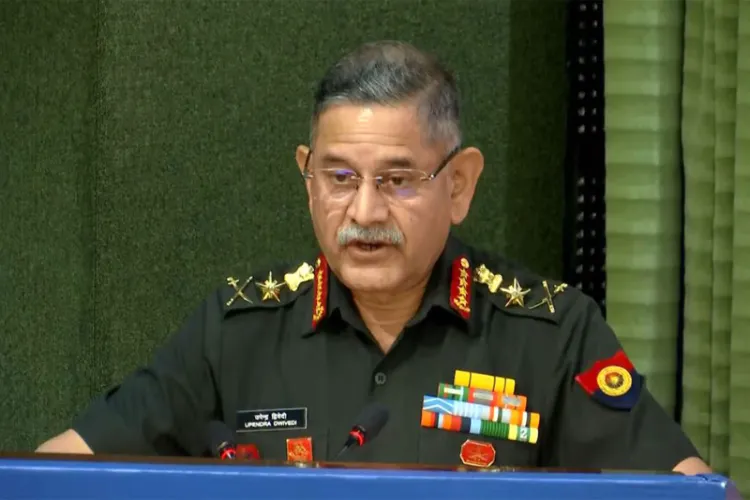
Indian Army Chief Upendra Dwivedi on Tuesday outlined a sweeping vision linking national security with economic growth, while drawing lessons from Operation Sindoor and warning against growing strategic vulnerabilities in an increasingly polarised global order.
Speaking at the “Security to Prosperity” seminar organised by Centre for Land Warfare Studies (CLAWS) in New Delhi, General Dwivedi described Operation Sindoor as an example of coordinated national strength combining military action, diplomatic signalling, information management and economic resolve into a unified strategy.
Referring to the operation, the Army Chief said it successfully targeted terror infrastructure and challenged long-standing strategic assumptions. He also defended the decision to halt hostilities after 88 hours, calling it a deliberate and calibrated exercise of “smart power” rather than a sign of restraint forced by limitations. According to him, the operation demonstrated the importance of applying the right instruments of national power at the right time and intensity to achieve broader strategic objectives.
General Dwivedi also painted a stark picture of the changing global order, arguing that the post-Cold War belief that economic interdependence would prevent major conflicts has weakened significantly. He noted that technologies, supply chains and trade routes once seen as tools of global cooperation are now increasingly being used for geopolitical leverage and coercion.
Highlighting global developments, he pointed to the strategic importance of semiconductors, tensions around the Strait of Hormuz and the sharp rise in worldwide defence expenditure, which he said now exceeds the United Nations’ budget for Sustainable Development Goals. He remarked that power politics is increasingly shaping economic systems and global prosperity rather than the other way around.
At the centre of his address was the idea that security and economic growth can no longer be treated as separate domains. The Army Chief stressed that modern conflicts place demands not only on armed forces but also on industrial capacity, research ecosystems and governance structures. He said security today forms the foundation upon which prosperity can be built and sustained.
General Dwivedi further emphasised the rapid transformation of warfare due to technological advancements. He warned that the time taken for innovations to move from laboratories to battlefields has drastically reduced, making speed and scalability critical factors in modern defence preparedness.
Calling for stronger investment in emerging technologies, he advocated expanding capabilities in artificial intelligence, cyber systems, quantum technologies, autonomous platforms, space research and advanced materials. He also urged the government, private industry, academic institutions and research organisations to work together in building a robust dual-use innovation ecosystem.
In one of the strongest parts of his speech, the Army Chief cautioned that dependence on foreign supply chains, critical minerals and digital infrastructure could become a major strategic weakness. He argued that reducing such dependencies is not merely an economic necessity but a vital national security priority.
He stressed that countries leading the next generation of technology would likely shape future conflict outcomes, adding that India must not only adopt emerging technologies but also indigenise and operationalise them effectively.
Concluding his address, General Dwivedi invoked former prime minister Atal Bihari Vajpayee, saying peace is built on capability, confidence and resolve rather than the absence of strength.
READ MORE: Dr Sofia Banu’s mission to make science serve society
While acknowledging India’s growing momentum on the global stage, he ended with a note of urgency, asking whether the country is moving fast enough to keep pace with the rapidly changing strategic and technological landscape.












.webp "Karnataka BJP chief BY Vijayendra")




_(3).webp)