Chennai
The Indian Navy on Friday commissioned INS Anjadip, a state-of-the-art warship designed to significantly enhance anti-submarine warfare (ASW) capabilities and coastal surveillance.
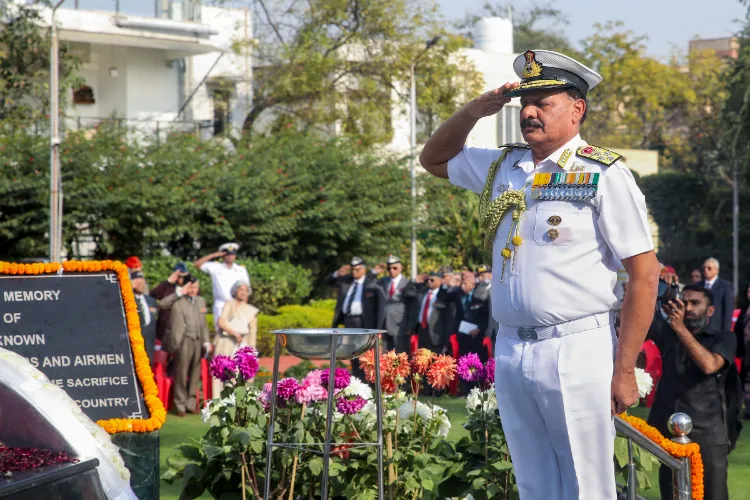
The vessel was commissioned at Chennai Port by Admiral Dinesh K Tripathi, Chief of the Naval Staff, in the presence of senior naval officers, government officials and industry representatives.
INS Anjadip is the third of eight vessels being constructed under the Anti-Submarine Warfare Shallow Water Craft project. The ship is equipped with an indigenous, advanced ASW weapons and sensor suite, including the hull-mounted sonar Abhay, lightweight torpedoes and anti-submarine warfare rockets.
Designed as a “Dolphin Hunter”, the vessel specialises in detecting, tracking and neutralising enemy submarines in coastal and shallow waters. Measuring 77 metres in length, it features a high-speed water-jet propulsion system that allows it to achieve speeds of up to 25 knots, ensuring rapid response and sustained operations.
Built by Garden Reach Shipbuilders and Engineers, INS Anjadip has been developed to address the challenges of littoral combat environments that are critical to India’s maritime security. In addition to its ASW role, the ship is capable of undertaking coastal surveillance, low-intensity maritime operations, and search and rescue missions.
Named after Anjadip Island off the coast of Karwar in north Karnataka in the Arabian Sea, the induction of the ship strengthens the Navy’s ability to protect India’s extensive coastline, including the waters off Tamil Nadu and Puducherry.
Addressing the gathering, Admiral Tripathi said the Navy plans to induct around 15 more ships this year. He noted that in 2025 alone, the Navy commissioned 12 warships and one submarine, marking an unprecedented pace of induction.
He described INS Anjadip as a worthy successor to its illustrious predecessor, the Petya-class corvette that served the nation from 1972 to 2003. Referring to history, the naval chief recalled that Anjadip Island had witnessed decisive naval action during Operation Chutney, which culminated in the liberation of Goa in December 1961.
Highlighting India’s focus on under-sea warfare, Admiral Tripathi said the commissioning of the shallow water ASW craft marked a substantial strengthening of maritime security on the eastern seaboard. He also underscored the growing role of indigenous design and manufacturing, calling the ship a clear affirmation of Aatmanirbharta in defence shipbuilding.
READ MORE: Anika’s battle for life: Muslims extend a helping hand
In a complex maritime security environment marked by tensions in the Red Sea and the Strait of Hormuz, he said the Navy has played a key role in safeguarding global trade. Since October 2023, Indian naval deployments in the Red Sea have ensured the safe passage of nearly 400 merchant vessels carrying cargo worth over USD 7 billion bound for India, he added.










.webp "Akhilesh Yadav")
.webp "Representational image")