




Bhakti Chalak
In 2023, when a person holding a constitutional position in Uttar Pradesh remarked that Muslims should not set up shops around Hindu festivals, artist Pramod Kurlekar was deeply disturbed.
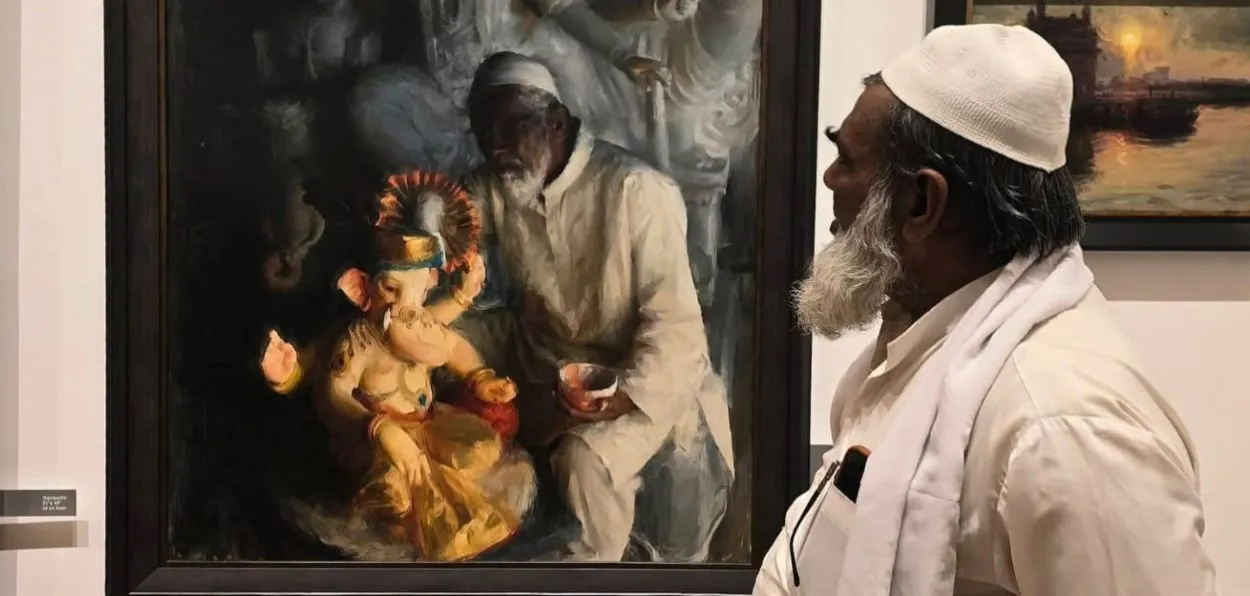
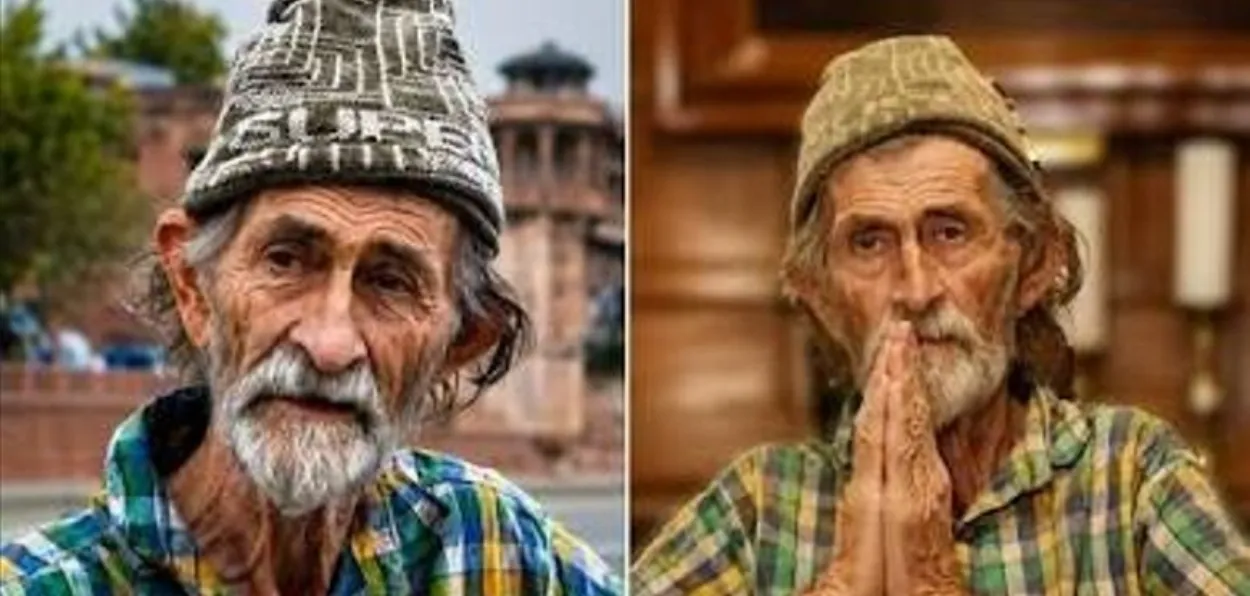
Instead of reacting with anger, he chose to respond through art. The result was His Nurturer, a powerful painting that conveys a message of communal harmony and interdependence.
Today, the artwork has earned international recognition and is set to be displayed at an exhibition organised by Sotheby’s in New York, one of the world’s most prestigious auction houses.
In an interview with Awaz-The Voice, Kurlekar spoke about the inspiration behind the painting and his artistic journey.
A native of Nune village in Maharashtra’s Satara district, Kurlekar grew up in an environment marked by communal harmony.
“My entire childhood was spent in an atmosphere of religious harmony,” he says. “Hindus and Muslims around me always lived together peacefully. My art teachers were R.B. Kulkarni and S.S. Shaikh. As a child, I never even realised that they belonged to different religions.”
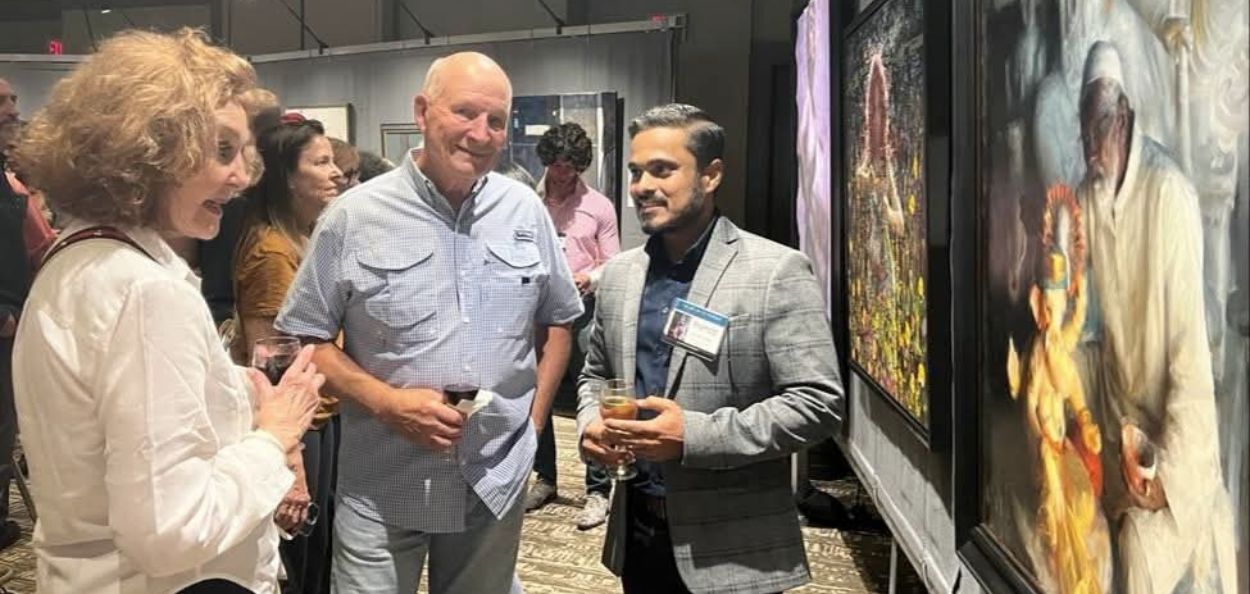 Artist Pramod Kurlekar (right) with art lovers in an European City
Reflecting on social divisions, he adds, “Caste and religion are identities imposed on us after birth. When we are born, we do not even have a name. To forget our shared humanity because of such labels is foolish. Hindu saints have taught us Vasudhaiva Kutumbakam—the world is one family. Then why should there be hatred?”
It was this belief that inspired His Nurturer.
Speaking about the concept, Kurlekar says the controversial statement from Uttar Pradesh compelled him to reflect on the growing mistrust in society.
“I found the statement deeply troubling,” he says. “As an artist, I could not accept it. Today, people increasingly look at one another with suspicion, and this is affecting the social and economic fabric of the country.”
He points out that businesses and livelihoods are interconnected.
“If buying and selling begin to depend on caste or religion, it will have serious consequences for society. Our economic lives are interdependent, and attempts to divide people ultimately hurt everyone.”
Kurlekar acknowledges that every community has individuals who break the law but stresses that wrongdoing should be dealt with through legal action rather than collective blame.
“There are bad elements in every religion. Strict legal action should be taken against them. But if society follows a policy of division, innocent people will inevitably suffer,” he says.
The painting has received significant international recognition. In 2024, His Nurturer was honoured at an international competition organised by the Portrait Society of America.
The following year, it secured third place among nearly 5,000 entries at an international competition conducted by the Art Renewal Center. Now, the same artwork is set to be showcased before a global audience at Sotheby’s in New York.
Sotheby’s has estimated the painting’s value at between $25,000 and $35,000 (approximately ₹21 lakh to ₹30 lakh).
“My objective was never to win awards,” Kurlekar says. “I simply wanted the message behind the painting to reach as many people as possible. What makes me happiest is that this thought has now found a global platform.”
Despite the recognition, parting with the painting remains an emotional decision.
READ MORE: Aabroo's rise triggered Muslim women's aspiration to join civil services
“Sotheby’s approached me regarding the auction,” he says. “To be honest, I still do not wish to sell it. But if I had not agreed to put it up for auction, the painting might not have been included in the exhibition. Since auctions and exhibitions are central to their work, I agreed to send it.”
For Kurlekar, the painting represents far more than artistic success—it is a reminder that humanity and coexistence remain stronger than the divisions that seek to separate people.
_(1)_(1).webp "Jagannath Rath Yatra")







_(1)_(1).webp)

_(1).webp)