




.webp "Ms. Naghath Tabassum Abroo")
Sabiha Fathima/Bengaluru
Long before titles and designations adorned her name, there was simply Abroo—a girl raised in a home where achievement was not an exception but a quiet expectation, and where faith and discipline walked hand in hand with laughter and love.
“They say it takes a village to raise a child,” she often reflects. “In my case, it was true. My achievement feels like I only held the steering wheel—everything else was already perfectly aligned.”
Naghath Tabassum Abroo, who retired from Indian Administrative Services recently, alias Aabroo studied at Kendriya Vidyalaya, growing up between two remarkably progressive families—paternal and maternal—both rooted in Bengaluru. Her grandfather was a veterinary doctor. Her maternal grandparents had served in the army. In an era when discrimination between sons and daughters was rampant, in her home, it did not exist.
Her phuppis and khalas held postgraduate degrees. In her clan achievement was normal and education sacred.
 Naghat Tabassum inspiring District Coordinators of Suvarna Arogya Suraksha Trust
Religion was part and parcel of her upbringing—not as a command, but as a lived philosophy.
After Fajr prayers, books were her only companions until 7 a.m. Then came an hour of Arabic lessons, and only then school. Discipline was natural; no one enforced it harshly. It was simply the culture.
Every afternoon at 4 p.m., the aroma of snacks prepared by Nani would pull all the children running to her deewan seating. Along with the snacks came stories—of prophets, of virtue, of trials. Not a single story ended without a moral. Through the story of Prophet Yusuf, she learned about nafs long before she understood the depth of the word.
Nani would say, “There are angels who worship all the time. But humans are tested—to pray while dealing with worldly matters. If you don’t achieve in dunya, how will you be best in aakhirat?”
Faith was never divorced from worldly excellence.
Her father, a postmaster, and her mother, a school teacher, shared a compatibility so profound that even the weekly menu was decided together—amicably.
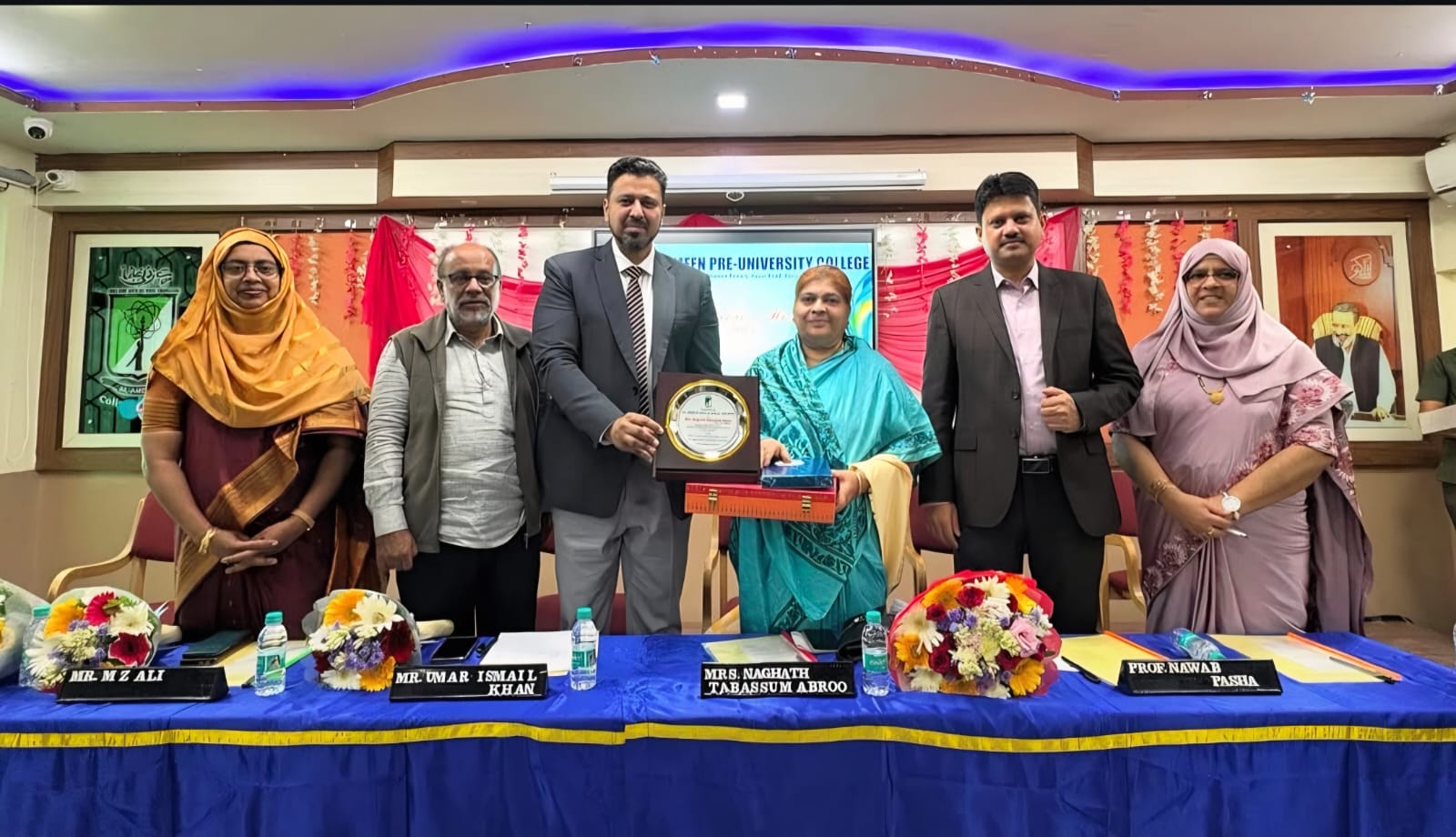 With Naghath Tabassum at a college function
On Sundays, her father would gently say, “For six days you have cooked for the family. On the seventh day…” And on that seventh day, the caring husband would step into the kitchen.
It was neither common nor customary in those days—but in their home, it was natural. Aabroo still recalls how he would add those extra spices, an extra spoon of ghee, turning a simple meal into something festive—as though love itself had been stirred into the pot.
He bathed the children. He took care of household chores. His entire salary was handed to her mother every month; if even ten rupees were missing, she would ask—not out of suspicion, but out of openness. Discussions were common. Communication was effortless, leaving no room for resentment.
Unity and bonding were not taught; they were lived. Sundays were sacred family days: English films for father, Hindi movies for mother, theatre outings, hotel dinners. A beautifully balanced, very normal family—she credits this normalcy for everything she became.
Even before marriage, she had applied for the Karnataka Public Service Commission exam. When her marriage was fixed, she chose not to write it.
Her father’s words still echo: “Life ke saath itni laparwahi nahi karte. You should have told us about your passion for these services.” She promised him she would attempt it again. The opportunity came—not next year, not soon—but ten years later. By then, she was married, settled in Tumkur, and mother to three daughters.
 Naghat Tabassum at a public function
A neighbour casually suggested she apply for the KPSC exam. It had been a decade since she had held a pen. She had been immersed in family life. Essays felt distant. Confidence seemed buried under diapers and domestic rhythms.
In 1996, when the mains and interview approached, her youngest daughter was just one month old. She wrote the exam—and secured 3rd Rank. She often says she had two options: An easy, lavish life—or a life of service. She chose service.
In 1997, she joined as a KAS officer, serving as Assistant Commissioner in Kolar. In 2008, she was promoted to the Indian Administrative Service. From 2008 until her retirement in 2020, Ms. Naghath Tabassum Abroo’s journey became synonymous with transformative governance.
In 2001, as Head of the Karnataka State Commission for Women, she was responsible for impactful policy reforms. Later, under her Directorship of the Total Sanitation Campaign (TSC), Karnataka won 426 Nirmal Gram Panchayat Awards for the first time—a professional “aha” moment that affirmed what sustained public service could achieve.
She played a leading role in major IT initiatives such as KSWAN, the e-procurement platform, and Bengaluru One—projects on which the state government relies today. She mooted the idea of bringing all state financial transactions onto a single seamless platform, leading to the Khajane II e-Governance project.
During the Covid pandemic, as Head of Suvarna Arogya Suraksha Trust, she ensured free treatment under the Ayushman Bharat Arogya Karnataka scheme. As a reward for this good work, she was granted an extension beyond retirement.
In her time, dignified roles for women were narrowly defined—doctor or teacher. Office-going women faced scrutiny. She rode a two-wheeler when it was rare. Backbiting happened. Someone once whispered about her lifestyle to her elders.
She often mentions Shameem Banu as Kerala’s pioneering Muslim woman IAS officer. In Karnataka, Aabroo too carved a similar position. “Women create obstacles for themselves,” she says.“Don’t bother about the talks of the town. Society may pull you down initially—but it always stands with winners.”
Family pressure, she adds, eventually transforms into support—when achievement speaks.
 Naghat Tabassum celebrating her daughter’s completion of her MD
Every milestone in her childhood—10th standard, PUC, Degree, PG, and other turning points—was celebrated across the extended family. Gifts flowed from uncles and aunts. Encouragement was collective. Each celebration became motivation to climb the next step. Achievement was never treated as a final destination—but as a doorway to greater responsibility.
She worries about the nuclear family trend. Joint families build personalities, she insists. They teach resilience, accountability, empathy. “We simply command religion but don’t explain it to our children. We are missing something essential.”
Her own daughters stand as quiet testimony: One is a cardiologist; One is a scientist; One holds an MBA.
READ MORE: 5 Muslim youth showered with praises for saving lives in Delhi hotel fire
She asks families to consciously build environments like the one she grew up in—where spouses strive for unity, where discussions replace domination, where achievement is celebrated, where religion is explained with meaning, and where girls and boys are equal.











_(1).jpg)
_(4).webp)