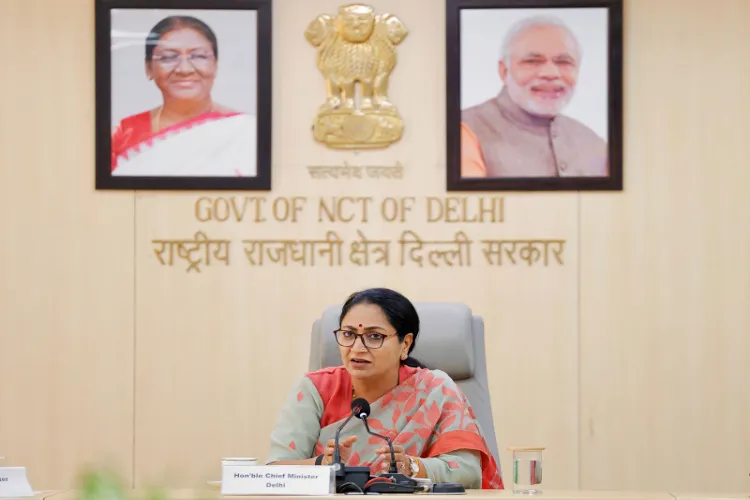
.webp "Delhi Chief Minister Rekha Gupta")
New Delhi
Delhi Chief Minister Rekha Gupta has described air pollution and the contamination of the Yamuna river as long-standing issues stemming from years of neglect and short-term decision-making by the previous Aam Aadmi Party (AAP) government, asserting that her administration has adopted a sustained and comprehensive approach to tackle both challenges.
In an exclusive interaction with ANI, Gupta dismissed claims that interventions such as the Graded Response Action Plan (GRAP), the Odd-Even vehicle scheme, artificial rain, and the use of anti-smog guns have failed, stating that these measures were never intended as permanent fixes.
“Pollution did not arise overnight. It is the outcome of prolonged negligence. If we only focus on clean air without addressing dust, water, and waste management together, we will not see meaningful improvement. The solution requires an integrated and long-term vision,” she said.
Criticising the previous dispensation, Gupta said earlier governments depended on stop-gap arrangements and publicity-oriented actions rather than addressing the root causes. “Sprinklers, misting systems, and anti-smog guns can offer temporary relief at best. What was missing was sustained work on dust control, strengthening public transport, and structural reforms,” she added.
The Chief Minister identified vehicular emissions, road dust, and improper waste handling as major contributors to Delhi’s pollution levels, which frequently remain in the ‘severe’ category during winter. She said public transport expansion was neglected despite being a key solution. “Vehicles are blamed for pollution, yet the public transport network was never developed to its full potential,” she noted.
Gupta said her government has rolled out a phased plan to transition Delhi’s public transport system to clean energy. “When we took office, we decided that public transport must move towards 100 per cent electric and clean fuel. Delhi currently has around 3,600 buses. We added 1,700 buses after coming to power, and by December 2026, the fleet will expand to 7,700. The target is 11,000 buses by 2028,” she said.
She added that funds have been approved for Metro network expansion, improved last-mile connectivity using electric autos, e-bikes and bicycles near Metro stations, and stricter action against polluting and unfit vehicles. “A government has to work in all directions simultaneously. Every aspect needs attention,” she said.
On reducing road dust, Gupta said her administration is reforming construction and maintenance practices. “Earlier, one agency would build a road and another would dig it up. That culture is being changed. We are enforcing ducting norms and fixing accountability,” she said, adding that engineers from the PWD and MCD are now coordinating to standardise procedures.
Linking landfill sites directly to air pollution, the Chief Minister said visible progress has been made in waste management through policy-driven and time-bound measures. “Delhi produces nearly 11,000 metric tonnes of waste every day. For years, it was left unprocessed, leading to garbage mountains. The opposition only shifted waste from one place to another,” she said.
Gupta expressed confidence that legacy waste at the Okhla and Bhalswa landfill sites would be cleared by 2026, while work at Ghazipur may take longer. “These outcomes are the result of clear policy and sustained effort,” she added.
Speaking on the condition of the Yamuna, Gupta said untreated sewage, cattle waste and industrial effluents entering drains had severely polluted the river over time. “Drains were discharging directly into Yamuna ji. Sewage treatment plants were outdated and neglected. This damage accumulated over many years,” she said.
She said the government has upgraded 37 ageing sewage treatment plants and launched extensive de-silting of drains across the capital. “As soon as we assumed office, desilting began. Advanced machinery from Finland is being deployed at locations such as Najafgarh, Barapullah and Sunheri Pullah,” she said.
The Chief Minister also highlighted initiatives to process cattle dung through biogas plants. “For years, no one addressed this issue. Thousands of tonnes of dung flowed into drains and then into Yamuna ji. We have now started a biogas plant capable of processing 600 tonnes, with more planned,” she said.
Responding to criticism over the pace of cleaning the river, Gupta said expectations of instant results were unrealistic. “People ask when the Yamuna will be clean. I remind them that the damage was caused over decades. Our interventions are time-bound, and their impact will become visible gradually,” she said.
READ MORE: Indian Muslims are not tenants, they are landlords: Indresh Kumar
Reiterating the need for collective responsibility, Gupta said, “The government will fulfil its role, but citizens must also participate. Only together can we ensure cleaner air and a healthier Yamuna for Delhi.”

_(1)_(1).webp "Khanqah Emadia Qalandaria, Patna, Bihar")






.webp)