Ashhar Alam | New Delhi
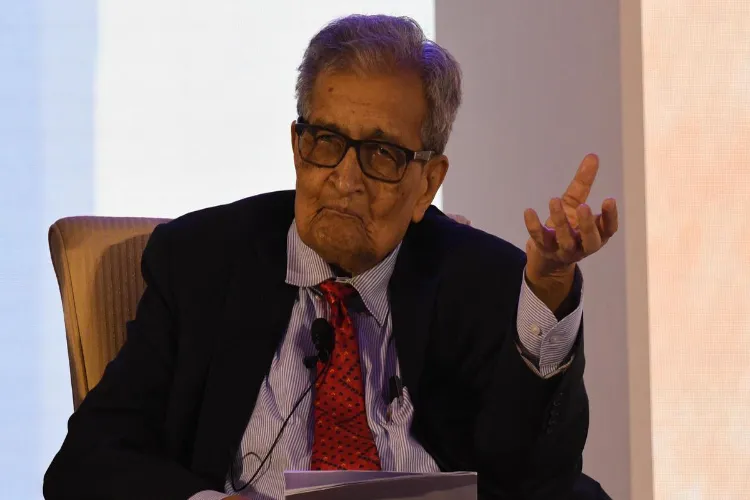
Nobel laureate Amartya Sen has raised a sharp red flag over the Special Intensive Revision (SIR) of electoral rolls in West Bengal, warning that the process is being pushed through with “undue haste” and risks undermining democratic participation just months ahead of the assembly elections.
Speaking to a news agency, from Boston, the 92-year-old economist stressed that electoral roll revisions, when carried out carefully and with sufficient time, can strengthen democracy. But what is unfolding in Bengal, he said, falls far short of that ideal.
“A thorough review of electoral rolls done carefully with adequate time can be a good democratic procedure,” Sen said. “But this is not what is happening in West Bengal at this time.”
According to Sen, the rushed nature of the SIR has left voters with inadequate opportunity to submit documents needed to establish their eligibility, calling the situation “unjust to the electorate and unfair to Indian democracy.”
The concerns, he noted, are not merely theoretical. Sen recounted his own experience during the SIR, where time pressure appeared evident even among Election Commission officials.
“Sometimes, the officials themselves seem to lack enough time,” he said.
Despite being a long-registered voter from Santiniketan, Sen said his right to vote was questioned over what officials described as a “logical discrepancy” involving the age difference between him and his deceased mother details that were already part of official records.
“They questioned me about my mother’s age at my date of birth, even though both our details were already stored in their records,” Sen recalled.
The episode, though eventually resolved, left him deeply uneasy about the fate of less privileged citizens.
“Like many Indians born in rural areas, I do not have a birth certificate,” he said, pointing out that such documentation gaps are common across rural India. “My eligibility required additional paperwork.”
While friends helped him navigate what he described as the “rigid gates” of the Election Commission, Sen worried about those without similar support.
“I could say, like the Beatles, ‘I get by with a little help from my friends,’ but what about those who don’t have such help?” he asked.
On whether the SIR could politically benefit any party, Sen said he could not offer a definitive judgment.
“I am not an election expert,” he said. “I have been told by people who claim to know more that the BJP may benefit from under-accounting. I don’t know if that is true. But the real issue is that democracy should not be made to commit an unnecessary error, no matter who benefits.”
Sen identified the poor and underprivileged as the most vulnerable to exclusion under the current process, warning that documentation-heavy requirements carry an inherent class bias.
“The documents needed are often hardest to obtain for the underdogs of society,” he said.
He also flagged concerns about minority communities, noting that voting rights can become more fragile in a polarised political climate.
“Indian Muslims are sometimes relegated to disadvantaged positions,” he said, adding that some Hindu communities too may face discrimination.
Calling for institutional vigilance, Sen urged both the Election Commission and the Supreme Court to ensure that no eligible adult citizen is denied the right to vote.
“The EC and the Supreme Court must make sure that no adult Indian citizen has difficulty qualifying for voting,” he said.
Despite his age and demanding academic commitments in the US and the UK, Sen said he remains determined to vote in the upcoming Bengal elections, subject to scheduling.
“I would very much like to do that,” he said, recalling a past instance when he travelled across continents within 48 hours just to cast his vote in Santiniketan.
ALSO READ: INA represented the real idea of secular India
Now, at 92, Sen reflected on the journey with characteristic grace, recalling re-reading Rabindranath Tagore during one such trip a reminder, he said, of India’s plural cultural inheritance.
“I hope I can think about Tagore’s explanation again,” he said softly, “if I manage to do what I should.”

.webp "Buddha statue")
.webp "Representational Image")