New Delhi
Opposition MPs on Thursday questioned the government for allowing private operators into the nuclear power sector, saying it could impact the sovereignty of the country, as the Rajya Sabha discussed the SHANTI Bill 2025.
Participating in the debate, Trinamool Congress MP Sagarika Ghose said the Sustainable Harnessing and Advancement of Nuclear Energy for Transforming India (SHANTI) Bill is not just flawed but "fundamentally dangerous".
"This Bill brings neither Shanti nor security... we are not debating whether India should pursue nuclear energy, India has always pursued nuclear energy responsibly for decades..." she said.
"But as a country, are we now prepared to abdicate our sovereign responsibility, gamble with public safety and place one of the most sensitive sectors of the nation at the mercy of crony capitalism and government-friendly oligarchs as well as foreign pressure?"
"This Bill is not reform, it is recklessness. This Bill is not for the public, it's for profit," she said.
Ghose said it is a huge policy shift that ends seven decades of state exclusivity over nuclear power.
"Let's admit that the scale of investment needed for setting up such industry can only be undertaken by high-profile cronies of this government. And the question arises, is cronyism the reason why this government is paving the way for them?" she said.
She also said the Bill shifts liability and recourse rules towards contract rather than statute, meaning suppliers can be insulated in the fine print of the contract and victims' ability to seek redress becomes uncertain.
She added that the Bill also reflects a blind and obsessive push for nuclear expansion without adequate debate on alternatives or consequences.
DMK MP P Wilson said the Bill is a "nuclear bomb which threatens the country's peace and security".
"The nuclear supply chain is sought to be removed from the sovereign functions and from the Union of India government's active oversight. There is nothing peaceful, nothing sustainable, nothing transformative about this legislation.
"On the contrary, it is a reckless, dangerous and deeply flawed attempt to privatise one of the most sensitive and high-risk sectors of a nation, the nuclear energy sector," he said.
He said one of the most critical essential sovereign functions of an elected government is given to the private sector.
Wilson expressed concern over "blanket opening of the entire nuclear fuel cycle from uranium mining to waste management to private entities with undetermined qualification, unclear accountability and profit as their primary motive".
He said fissile material, radioactive waste and technologies that can devastate entire regions for generations and handing over operational control of uranium, plutonium and high-level radioactive waste to private corporations driven by quarterly profits and shareholder pressure is nothing short of irresponsible.
He demanded that the Bill be sent to a Select Committee of Parliament.
Sandeep Pathak of the Aam Aadmi Party, meanwhile, questioned if India should focus on expanding nuclear power, or renewable energy.
"Nuclear energy is expensive, complex, and risky. You have to ensure waste management for the whole lifecycle (of the fuel). It is not a small thing," Pathak said.
He pointed out that the BJP had opposed the India-US civil nuclear deal due to foreign involvement, and questioned the change in their stand.
"Do you accept the opposition at that time was political not ideological? If it was ideological, do you accept that you have changed your ideology?" he said.
The AAP MP questioned why the government wanted to bring private players in the nuclear power sector.
"Is it for money? Or do you think they will bring technology? We are importing a foreign model without importing their regulatory spine," he said.
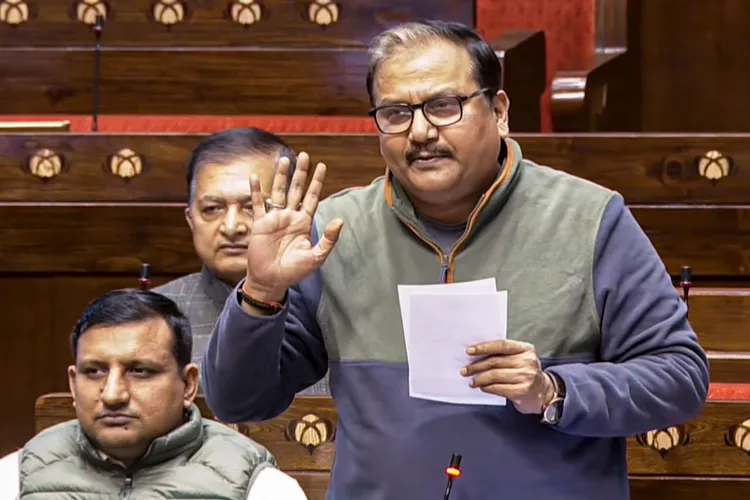
Manoj Jha of RJD said some "invisible power" appeared to be behind the SHANTI Bill.
"Our whole nuclear program historically was based on some principles. One was that where there is a possibility of a catastrophic risk, the state should not be absent. I am seeing the document of the absence of state," he said.
Jha said in countries like China, France, and Russia, which lead in nuclear power generation, the facilities are largely state-owned, while the US is the exception where 80 per cent of nuclear power plants are in the private sector.
"The American model cannot be considered as a best practice model for my country," he said, adding that the Bill privatised profit, while making the risks public, and also attacked the federal structure.
Muzibulla Khan of the BJD also demanded that the Bill be sent to a JPC.
"This Bill will benefit private companies. But if private players enter, there would be concern on security. How would security be ensured? How would compensation be given?" he said.
READ MORE: Cricket taught me to value human talent over caste and religion
Ayodhya Rami Reddy of YSRCP pointed out that the Bill bill does not mandate community consultation, transparent information sharing and continuous engagement with people living around nuclear facilities.
"The first responders (in case of an accident) will be local communities, not authorities sitting in Delhi... Yet it does not mandate emergency drills, public awareness... Given the present state government's poor track record in routine disaster response, the gap becomes even more alarming," Reddy said.



.png)