New Delhi
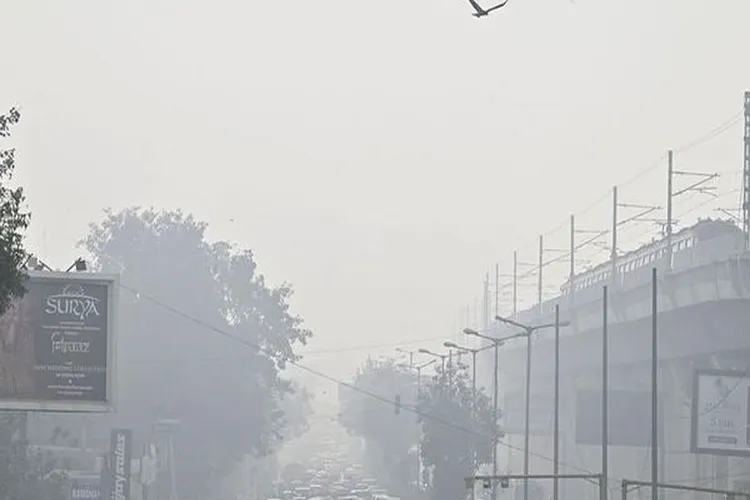
Delhi’s air quality deteriorated sharply on Tuesday morning, with the Air Quality Index (AQI) touching the ‘hazardous’ category and severely impacting visibility and public health. At around 8 am, the AQI was recorded at 413, reflecting extremely polluted conditions.
Data from the Central Pollution Control Board (CPCB) showed that air quality in several parts of the National Capital Region (NCR) had worsened to ‘severe’ levels, with many areas continuing to experience dangerously high pollution.
In view of the alarming situation, the Commission for Air Quality Management (CAQM) implemented all measures under Stage-IV of the Graded Response Action Plan (GRAP) across Delhi-NCR.
Several pollution hotspots reported critical readings, including Anand Vihar at 466, Ashok Vihar at 444 and Chandni Chowk at 425, all falling in the ‘severe’ category. Prominent areas such as India Gate, Kartavya Path and Rashtrapati Bhavan were also engulfed in dense smog, recording an AQI of 384, which falls under the ‘very poor’ classification.
To tackle the worsening air quality, authorities enforced GRAP Stage-IV measures in the national capital and deployed truck-mounted water sprinklers to suppress dust and particulate matter.
As per AQI standards, values between 0 and 50 are considered ‘good’, 51–100 ‘satisfactory’, 101–200 ‘moderate’, 201–300 ‘poor’, 301–400 ‘very poor’, and 401–500 ‘severe’.
Meanwhile, the Delhi government has announced a series of stringent steps to address the pollution crisis and improve air quality. Delhi Chief Minister Rekha Gupta reiterated the government’s commitment to a zero-tolerance approach against all sources of pollution.
A high-level review meeting was convened on Monday at the Delhi Secretariat to evaluate existing pollution-control measures and take further action. Among the key decisions were strict enforcement of Pollution Under Control (PUC) norms without exemptions, exploring pooled and shared electric bus services across Delhi-NCR, issuing revised guidelines for e-rickshaws, and rationalising Delhi Transport Corporation (DTC) bus routes.
READ MORE: Nirmal, my Abba's most trusted son
The meeting was attended by senior officials from the Environment and Transport Departments, the Delhi Pollution Control Committee (DPCC), the Public Works Department (PWD), and the Delhi Traffic Police, along with Environment Minister Manjinder Singh Sirsa.

.png)