Saquib Salim
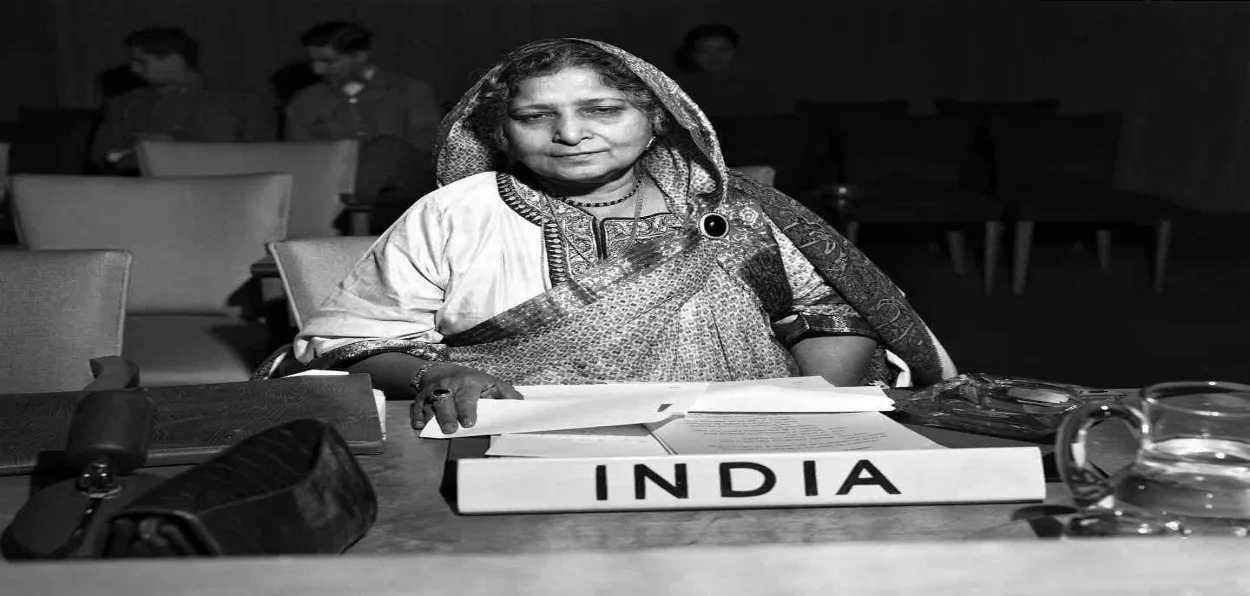
What is the main obstacle (in the way of women's empowerment? Begum Shareefa Tayabji was asked this question. She laughed and replied, “Men, of course.” This was at the conclusion of the United Nations’ Commission on the Status of Women on 19 January 1948.
Begum Shareefa was representing India among 15 nations that attended the commission's hearings. She believed that political power was the key to the overall development of women. She told the gathering, “Get the franchise, and you get the power, then to attain the other objectives — education, medical care, and so on.” As one of the founding members and the first Indian Chairwoman of the All-India Women’s Conference, Begum Shareefa fought a long battle for the right to suffrage for Indian women. In 1933, she was among the delegates who favoured voting rights for women in India.
When the All India Women’s Conference (AIWC) was formed in 1926 under the chairwomanship of Margaret Cousins, Shareefa was one of its members. Cousins presided over the Conference in 1927 and also in 1928. Shareefa became the first Indian woman to chair the conference.
On the records, she is mentioned as Begum Hamid Ali and not Shareefa Tayabji. It's an irony that one of the most important feminist thinkers and activists of India is known by her husband's name and not by her own. She married Hamid Ali, an ICS officer, in 1908. Even the records of AIWC mention her as Begum Hamid Ali.
Margaret Cousins wrote, “I never think of the Begum without seeing beside her, her equally distinctive husband, and remembering the devoted comradeship between those two. They looked as if they had walked tight out of an old Moghul picture.”
Sarrefa was born to Abbas and Amina Tayabji, two of the most important pillars of the Gandhian movement in Gujarat, in 1883. She entered public life a year before her marriage to her cousin, Hamid Ali, when she attended the Indian National Congress Session in 1907.
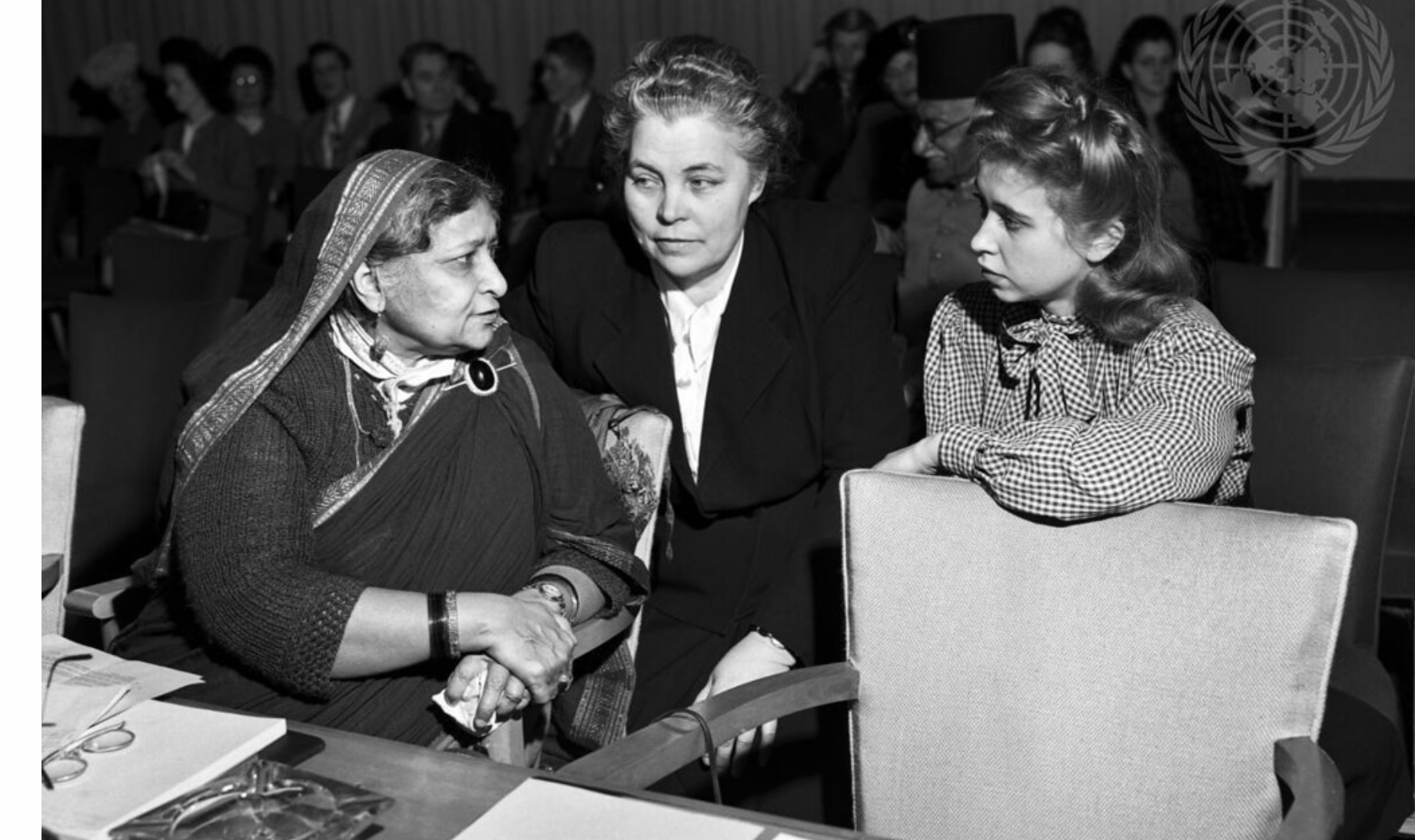
Shareefa Hamid Ali with other delegates at the UN
Robert Fleming notes, “Begum Hamid Ali was one of the three Indian representatives to the Round Table Conference in London in 1933 and gave evidence on the status of women in the New Constitution. The next year, she was a representative to the World Conference of Women held in Istanbul. In 1937, she again represented India at the Women's Conference in Luhacovice, Czechoslovakia. In 1933 and in 1937, the Begum Sahiba was in Geneva, where she and her colleagues secured the acceptance of their point that no non-Indian woman might represent India. She backed the 1939 Delhi resolution calling for a revision of the marriage laws in India and has worked for a number of years for equal rights for women. In 1947 and 1948, she was a delegate representing India on the Status of Women's Commissions of the United Nations at Lake Success in the United States.”
Shareefa was active with the Gandhian Movements as well as Mazdoor Seva Sangh. She opened several hospitals and schools wherever she lived with her husband. In 1940, she presided over the AIWC at turbulent times when Mohammad Ali Jinnah-led Muslim League had raised demand for a separate Muslim country.
“The cry for the partition of India is a passing phase. It will die out soon, but we will come out perhaps as a sadder but wiser nation,” she had said.
The British asked the Indians to join the war against Hitler’s Nazi Germany. She famously quipped, “We have suffered from many Hitlers in the home in every generation.”
In her presidential address in 1940, Shareefa asked Indian men, “When will the men of India realise that it is of no use asking a third party to play fair when they themselves are willing to close their eyes to all the wrongs women suffer, and have mental reservations when freedom is proposed for womanhood? The sons of slave mothers will always remain slaves mentally, whatever their legal position may be. I would remind our brothers that they cannot and will not gain Swaraj until they have set their house in order and given one-half of the population ofIndia its due share of rights and privileges.”
Comparing the treatment of women by Indian men to Nazism, she said, “Every daughter and wife should get her due share in an honest community, and, judged by modern standards, the son’s share would be half of what it is at present. Every woman will be a free agent to earn her living, to live her own life, in short, to be mistress of her own destiny. She will, if she likes, be free to decline her mistresship of the kitchen. She will bear children or not bear children. She will also be a guardian of equal rights with the father of the children she bears. It is monstrous, it is indecent, that such obvious human rights and privileges are still denied to our women. We have suffered from many Hitlers in the home in each generation. Let us pray devoutly that Hitlerism in every shape or form may be banished from the world forever.”
The criticism became all the more important given that Jawaharlal Nehru and other leaders at the Congress session in Allahabad (Prayagraj), demanded Swaraj and action against Hitler. Shareefa directly addressed these male leaders.
As the Chairwoman of AIWC, Shareefa supported the Common Civil Code. In an article published in Roshni, the quarterly bulletin of AIWC, in August 1940, she said, “For Indian women belonging to every caste and creed, it is necessary to bring all the laws governing marriage, divorce, inheritance, dowry, etc. up to date. We are now thinking in terms of personal laws which will have to be modified until such time when a common Indian code is evolved, and accepted by the nation, putting aside all the personal laws which govern us at present.
"The position of women in Islam is particularly difficult to handle, as the factor of Shariat is ever at hand. As things now stand, Muslim women have certain advantages as compared with their sisters of other creeds, but Muslim women also suffer from many grave disadvantages. For instance, a woman has to suffer the misery following the custom of polygamy. A woman can never have equal rights of inheritance or divorce or guardianship of children.”
ALSO READ: At Sabrimala divine lullaby embraces all faiths to put Lord to sleep
In 1940, Shareefa had hoped for a revolutionary change in personal laws. She said, “We visualize the ‘not distant’ future when the principle of the equality of the sexes will be fully recognised and maintained throughout the modern Indian code, which will govern the lives of us all alike, whether we follow one religion or another. Revolutionary changes regarding marriage, divorce, dowry, minimum age for marriage, health certificate before marriage and registration of marriages are outlined in a new draft law sponsored by the Ministry of Social Affairs of Iraq; the
Turkish nation accepted a very modern code long ago; there in no reason why, with education, the Muslims of India should not follow in their footsteps.”








.webp)