 Sreelatha Menon
My recent pilgrimage to Sabarimala was an emotionally fulfilling and rewarding experience. Spiritual fulfilment is beyond my understanding, and perhaps I may never fully grasp it. However, for lesser beings, the only wish is to see joy around, to see that people care for one another, and not fight.
Unforgettable Experiences
Here, I witnessed something that pleased me to the core of my being.
After walking four kilometres, I was just a few meters away from the 18 holy steps that lead to the deity at Sabarimala. But the crowd in front of the steps was such that even after waiting four hours, we hadn’t moved forward by an inch.
And then suddenly I knew there was no chance of darshan that night. The temple began to play Harivarasanam—a lullaby dedicated to Swami Ayyappan, usually played at 11 pm. The song lasts 4-5 minutes, and it is accompanied by priests blowing out the lamps in the shrine as the deity is being put to sleep.
The song was written by a forgotten devotional poet of the 19th century, Kumbakudi Kulathur Iyer. He lived in Tamil Nadu and wrote the verse in Sanskrit. It was composed by Malayalam music legend G Devarajan (of course, a parallel universe for the world outside Kerala) and sung in the immortal dulcet voice of Gana Gandharvan K Yesudas.
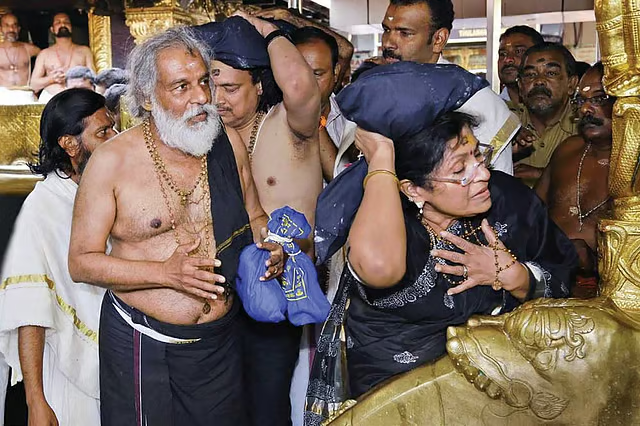
K Yesudas and his wife at Ayyappa Temple at Sabrimala
What did I feel in those five to six minutes, as I knew that I wouldn’t have darshan? Strangely, I felt a bit happy that the darshan wouldn’t get over tonight. It is still in the future. That is a little disease I always suffer from when I go to temples—I prefer the wait to the actualisation.
But apart from that thought, I felt part of a secret ritual, as if I was also a mother putting the baby to sleep, as everyone maintained pin-drop silence even in that madly restless crowd. Somehow, the all-powerful Ayyappa suddenly became a little infant who needed to rest, sleep after listening to and attending to the prayers of millions of devotees.
But all these feelings were wrapped in one thing—the voice of Yesudas, dripping with divinity and devotion. My whole being bent in gratitude to Ayyappa, who has let this tradition continue—or to even begin in the first place—that a song sung by a Christian should put the deity to sleep at Sabarimala.
Sabarimala has always been above the divide of caste and creed. While some temples in Kerala still prohibit the entry of non-Hindus, Sabarimala never had such rules. So, while Yesudas, a devotee of Ayyappa, was always allowed to have darshan here, he is not allowed inside some other temples in Kerala.
Going back to the song, the practice of singing this Sanskrit bhajan as a lullaby to Ayyappa at the hill shrine began in the 50s when a monk of the Ramakrishna Mission order started singing the bhajan every day at the time of temple closure. After some time, the temple authorities accepted this personal practice as an institutional ritual, singing it within the sanctum.
.jpg)
Pilgrims inside Ayyappa temple at Sabrimala
Later, in the 1970s, when the song was composed by G Devarajan for a film called Swami Ayyappan, devotees and pilgrims started playing the song on loudspeakers during temple closure.
The song composer G Devarajan is a Syrian Christian by birth, but has composed devotional songs dedicated to Ayyappa and Krishna, which are closest to the hearts of devotees—for example, Chethi Mandaram Thulasi, Sabarimalayil Thanka Suryodayam, and many others.
In the coldness of the winter of life’s realities, human beings cannot live alone, isolated, and separated from one another. The warmth of togetherness is the safe and soft blanket that will hold us and our future generations together, enabling them to face the challenges posed by nature or destiny.
So, a Hindu like me needs the song tuned and sung by two Christians to be moved to tears and feel close to the creator, who is trying so hard to keep us all together despite our best efforts to create disharmony.
.jpg) Sabrimala Temple, Kerala
Sabrimala Temple, Kerala
These are moments when I actually feel that I have seen God—in those who rose above sectarian narrowness and embraced a song and offered it to God.
I did not have regrets about not having darshan that night. I saw and experienced God standing right there at the foot of the shrine as I listened to Yesudas and Devarajan’s song being accepted by the divine, along with my tears of wonder and gratitude.
I realised that while religion may have boundaries, devotion and music have none.
The author is an independent writer



.webp "Representational Image")









_(1).webp)