




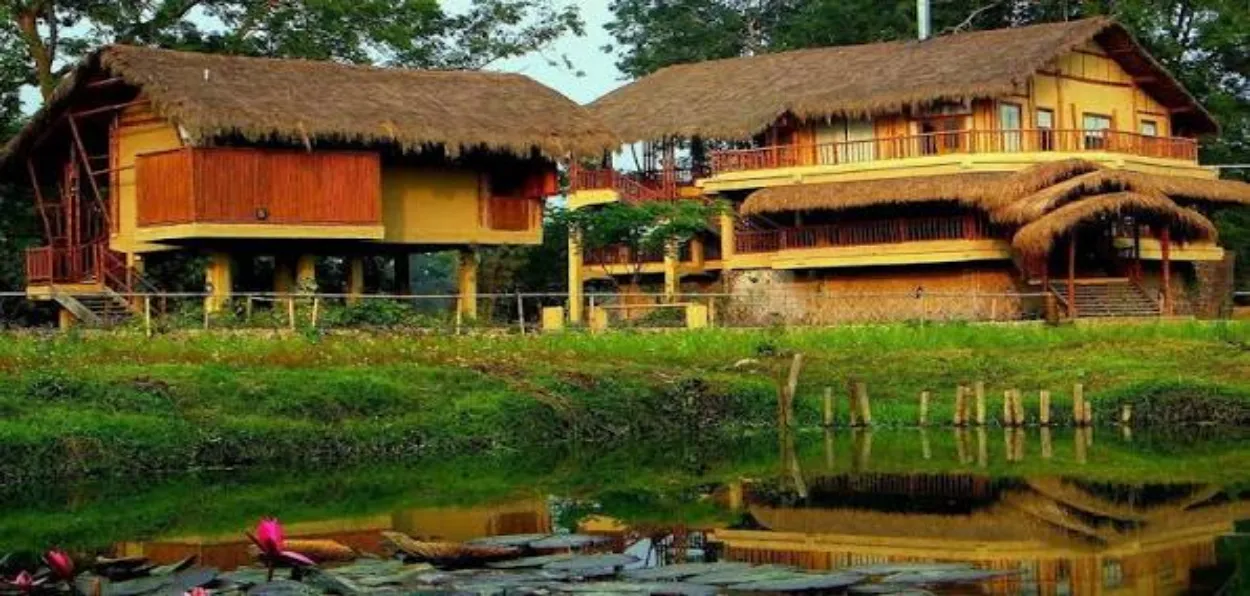

Bamboo has been part of human civilisation for centuries, but its value in an era of climate change and growing environmental concerns is only now receiving wider recognition. In India, it is deeply embedded in community life—as cultural memory, a source of livelihood, a repository of indigenous knowledge and an ecological resource. Today, it is also emerging as a promising material for sustainable industries, renewable energy and green development.
This makes World Bamboo Day, observed on September 18, particularly significant for India. The country has one of the world's richest bamboo resources, with 136 species, including 125 indigenous varieties.
According to the India State of Forest Report 2023, bamboo cover within India's recorded forest areas was estimated at about 1,54,670 square kilometres, an increase of 5,227 sq km.
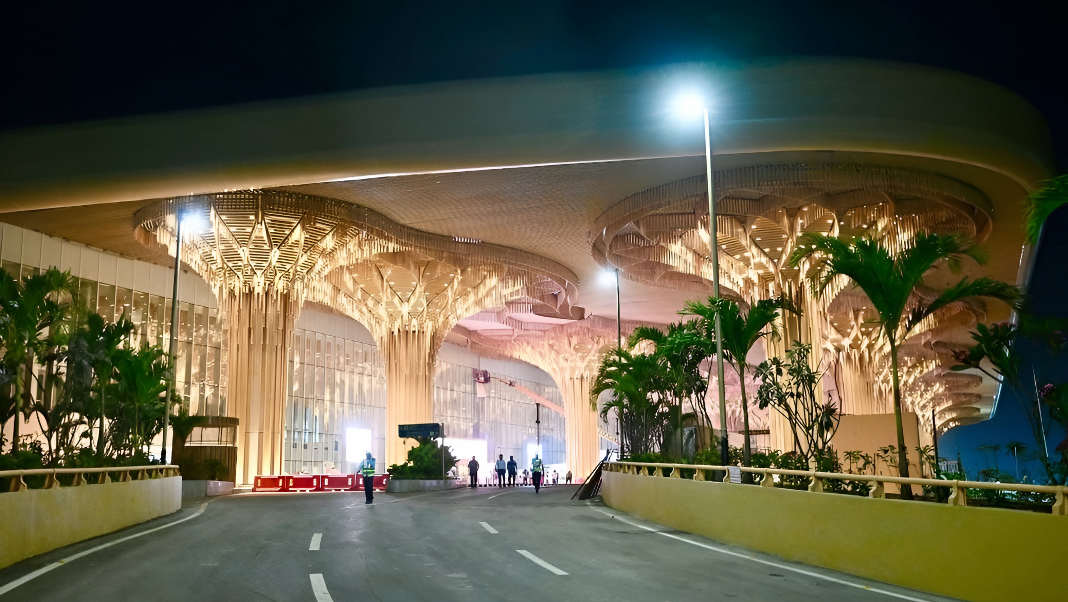 Guwahati Airport made of Bamboo
Yet these figures tell only part of the story. Bamboo's real significance lies in its deep connection with communities that have lived alongside it for generations.
Across India, bamboo has traditionally been used to build houses, fences and bridges and to make baskets, mats, furniture, agricultural tools, household articles and musical instruments. In several regions, bamboo shoots are also part of the local cuisine.
This relationship is particularly strong in Northeast India, where states such as Assam, Arunachal Pradesh, Manipur, Meghalaya, Mizoram, Nagaland and Tripura have incorporated bamboo into architecture, food, festivals, handicrafts and traditional occupations. For many tribal communities, bamboo-related knowledge is an important part of their cultural heritage.
A bamboo basket made by a rural artisan, therefore, is more than a commercial product. It represents skills and experience passed down through generations. When such crafts disappear, a livelihood is lost, but so is a part of the community's cultural memory.
 A Bamboo Forest
The development of the bamboo sector must therefore go beyond increasing production. It should preserve and modernise traditional skills while improving the livelihoods of the communities that have safeguarded this knowledge.
Often described as "green gold", bamboo has an extraordinary range of uses. It can be converted into furniture, flooring, panels, paper, handicrafts, incense, textiles, and charcoal and construction materials. Modern technology has further expanded its potential to engineered products, composite materials, bioenergy and biofuels.
This versatility gives bamboo particular importance in India because it can connect three economic groups often separated from one another: farmers, rural artisans and modern industry.
With appropriate cultivation practices and reliable market access, bamboo can provide farmers with an additional source of income. Processing units located near growing areas can generate rural employment while ensuring that more of the final product's value remains in the producing region.
 Bamboo Furtniture
There are also opportunities for women's self-help groups, tribal cooperatives, farmer producer organisations (FPOs) and small enterprises. A well-developed bamboo economy could generate employment and reduce the pressure for rural-to-urban migration.
The key question, therefore, is not simply how much bamboo India can grow, but how much economic value it can derive from what it already produces.
The renewed global interest in bamboo is closely linked to the environmental crisis. Bamboo grows rapidly and, unlike most trees, does not have to be replanted after every harvest. Its underground stems, or rhizomes, continue to produce new shoots.
Its dense root system can help bind soil and reduce erosion, making suitable bamboo species useful for restoring degraded land and protecting vulnerable slopes.
Like other plants, bamboo absorbs carbon dioxide as it grows and stores carbon in its biomass. When converted into durable products, some of that carbon can remain locked away for extended periods. This has brought bamboo into discussions around nature-based climate solutions and the emerging bio-economy.
However, bamboo should not be presented as a magic solution to climate change. Commercial plantations must not come at the expense of natural forests or biodiverse ecosystems. Different species are adapted to different environments, and large-scale monoculture plantations can themselves create ecological problems.
 Food being cooked in Bamboo
The appropriate approach is scientific cultivation: selecting suitable or locally adapted species, protecting biodiversity and balancing economic use with ecological considerations.
A significant step in developing India's bamboo economy came through a change in the law. Although bamboo is botanically a grass, the Indian Forest Act of 1927 classified it as a "tree", creating regulatory difficulties for its harvesting and transportation, including bamboo grown by farmers outside forests.
In 2017, the government amended the Act to exclude bamboo grown outside forest areas from the legal definition of "tree". The change was intended to make it easier for farmers to grow, harvest and transport bamboo and encourage commercial cultivation outside forests.
The National Bamboo Mission was subsequently restructured in 2018-19. Its approach extends across the entire value chain—from quality planting material and cultivation to harvesting, processing, manufacturing, product development, skill development and marketing.
The mission currently operates in 24 states and Union Territories. It supports farmers and entrepreneurs, promotes farmer producer organisations and encourages value-added bamboo products and industries.
This policy shift is important because producing more raw material alone does not make agriculture profitable. Farmers also need processing facilities, technology, transportation, finance and, above all, dependable markets.
Perhaps the clearest example of bamboo's changing role in India is emerging in Assam, where it has entered the field of advanced biofuel production.
The bamboo bioethanol project at Numaligarh represents a convergence of a traditional natural resource and modern technology. Bamboo, known and used by the people of Northeast India for generations, is now being explored as a raw material for second-generation (2G) bioethanol.
If managed effectively, the benefits could extend beyond energy production. The project could create a market for bamboo farmers, generate rural employment, support tribal communities and contribute to India's efforts to diversify its energy sources.
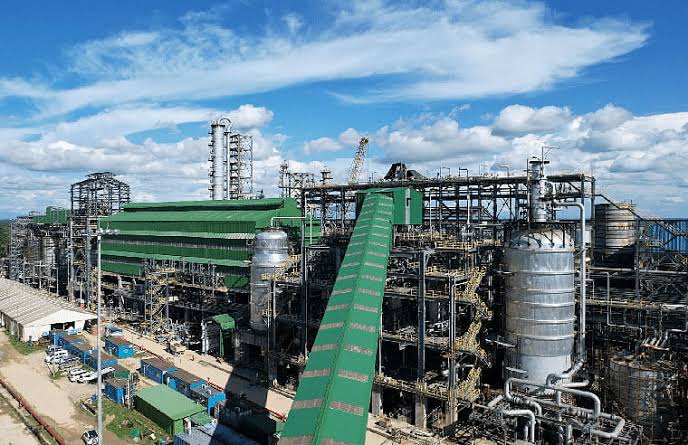 Numaligarh Refinery producing biofuel from Bamboo
The journey from bamboo baskets made in rural homes to bioethanol produced in a modern refinery reflects the evolution of India's bamboo economy. The material has remained the same; what has changed is our ability to harness its potential.
The missing link: Value addition
India's biggest challenge is no longer simply demonstrating that it has abundant bamboo resources, but converting them into competitive, high-quality products.
Selling raw bamboo generates limited income. Its value can increase substantially when it is transformed into engineered wood panels, furniture, construction materials, textiles, charcoal, processed food or high-quality handicrafts.
This requires sustained investment in research, product design, preservation and processing technologies, quality standards and market development. Partnerships among universities, agricultural institutions, designers, engineers and local artisans can help bridge these gaps.
Traditional handicrafts, meanwhile, should not be treated merely as relics of the past. They are valuable economic and cultural assets. Skilled artisans should not remain at the bottom of the value chain while retailers and middlemen capture most of the profits.
Better design, professional branding, market access and digital marketing can help artisans capture a greater share of the value they create.
ALSO READ: Can Muslims flourish under non-Muslim rule?
India's bamboo story is ultimately not just about a fast-growing grass. It is about connecting ecological sustainability with traditional knowledge, rural livelihoods, modern technology and economic opportunity. If these strands are brought together, bamboo can become an important part of India's green and inclusive growth.
Professor Mujibur Rahman, Centre for Arabic and African Studies, Jawaharlal Nehru University (JNU)




.webp "Union Home Minister Amit Shah")







.webp "Representational Image")



.webp)