Saquib Salim
"The Assistant Engineer is beginning his career badly as regards energy and obedience to orders." This is what the Executive Engineer for Irrigation, Khandesh and Nasik District, wrote in a departmental memorandum in 1884 about a 22-year-old subordinate who had asked permission to suspend a flood-hit pipe-laying job rather than waste government money. Today India celebrates the birthday of this Assistant Engineer, who started his career ‘badly’, as Engineers’ Day.
The engineer in question was Mokshagundam Visvesvaraya, born at Kolar on 15 September 1861, the date India now observes as Engineers' Day. Visvesvaraya himself recalled the 1884 episode in his Memoirs of My Working Life.
Discouraged by the reprimand, the young Visvesvaraya withdrew his request and returned to the flooded worksite near Datarti village on the Panjra river. For three days the swollen river cut him off from his own bungalow. He crossed the river on a raft built by Bhil workmen to reach his camp. The pipe syphon was finished. On receiving his report, the Executive Engineer wrote back and formally withdrew the remark he had recorded against him. It would not be the last time a superior's first judgment of Visvesvaraya had to be corrected by his work.
It is often argued that in the colonial Public Works Department, Indian officers merely carried out designs made by their European superiors, and that the credit travelled upward with the salary. A reading of the department's own record shows otherwise.
On the Nira Canal near Pune, Visvesvaraya devised what came to be called the Block System of Irrigation, dividing the command area into blocks so that only a third of the land carried a perennial crop at a time, multiplying the number of cultivators the same water could serve.
Four years into its working, Sir John Muir Mackenzie, Senior Member of the Government of Bombay, told the Bombay Legislative Council in June 1908 that the scheme was already paying dividends on its own cost, and added, "The development of this system is due entirely to the genius of Mr. Visvesvaraya, certainly one of the ablest officers, European or Indian, of the Public Works Department, with whom it has been my pleasure and honour to work."
Interestingly, it was the government's own gazette, not an Indian newspaper, that had put a name to genius.
The same years produced Visvesvaraya's most literal invention. Lake Fife at Khadakvasla, which supplied Pune city and cantonment, wasted its surplus over an ordinary weir every monsoon. Visvesvaraya designed automatic sluice gates that let the reservoir hold eight additional feet of water without raising the dam by an inch, closing the instant a flood receded and opening again only when it returned. He took out a patent for the device.
The Chief Engineer, Mr W. L. Cameron, later noted that Visvesvaraya had refused any royalty on an invention built under his own charge. Gates of the same pattern were later adopted for the Tigra Dam at Gwalior, and for the reservoir Visvesvaraya was yet to build in his own Mysore.
On 28 September 1908, the river Musi flooded Hyderabad city after 12.8 inches of rain fell in twenty-four hours and 221 tanks upstream gave way, sending the discharge from 110,000 to 425,000 cusecs.
Visvesvaraya was on leave in Italy when a cable reached him at Milan from the Governor of Bombay, dated 29 October 1908, "Nizam's Government are anxious to secure services of Visvesvaraya, Superintending Engineer, on leave, to advise and assist in reconstruction of Hyderabad and prepare a drainage scheme. We would willingly lend him."
The holiday was cut short, and Visvesvaraya studied the two river basins that had drowned the city, and designed the reservoirs and drainage works meant to spare Hyderabad a repetition. At the foundation-stone ceremony in March 1913, T. D. Mackenzie told the gathering that the Nizam's advisers had been fortunate, for the task had fallen upon "Mr Visvesvaraya, one of the very ablest of India's engineers."
The dam that followed dwarfed everything he had built before it. As Chief Engineer and later Dewan of Mysore, Visvesvaraya proposed a reservoir on the Cauvery at Kannambadi holding just over 48,000 million cubic feet of water and irrigating 150,000 acres, a scheme so costly that the Maharaja's own officers talked him out of sanctioning it.
When the funds were refused for the project, Visvesvaraya quietly prepared to resign. "Don't be hasty, I will do what you want," the Maharaja told him, and sanctioned every one of his proposals without altering a line.
The Government of Madras was the next to object, since its own planned reservoir at Mettur drew on the same river. Visvesvaraya built the dam's foundation wide enough for its full designed height of 124 feet, though sanction so far covered only eighty, and an Arbitration Committee, backed by Viceroy Lord Hardinge, upheld Mysore's claim.
When it was finished, the Krishnarajasagara was the largest reservoir built anywhere in India, thirteen years before Madras's own Mettur dam was even begun, fed by a canal tunnel a mile and a half long that remains among the largest of its kind in the country. It lit the Kolar Gold Fields, Bangalore and Mysore city, and turned the country around it into the cane fields that fed Mysore's sugar mills.
Sir Alfred Chatterton, who had himself once served Mysore, told the Royal Society of Arts in London on 22 May 1925 that the Bhadravati Iron Works, an industry Visvesvaraya had founded as Dewan, was an enterprise that "will have to be shut down."
Visvesvaraya, past sixty and out of office, returned to Bhadravati as Chairman of its Board and nursed it back to profit within six years. Again, without drawing the honorarium owed to him.
During that stewardship, Mahatma Gandhi visited Mysore and made a point of inspecting both the Iron Works and the Krishnarajasagara Reservoir, because he had heard interested parties speak ill of the two projects and could not bring himself to believe them. What he saw moved him to tell a public reception in Mysore city that "The Krishnarajasagara alone, which was one of the largest of its kind in the world, would perpetuate the name of Sir Visvesvaraya."
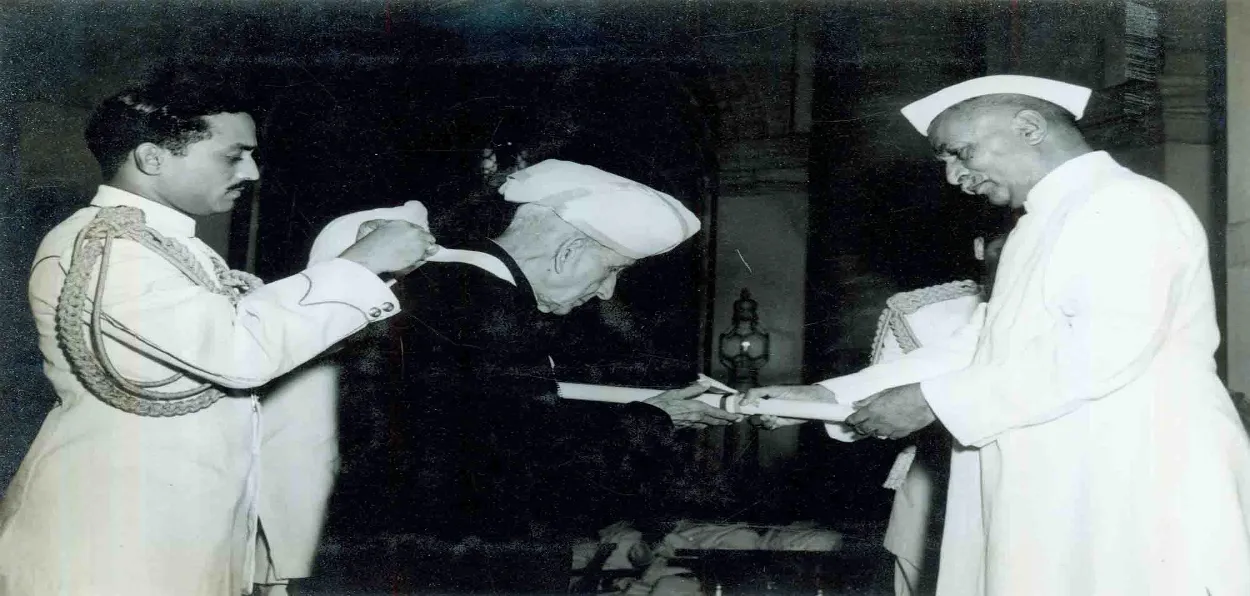
Visvesvaraya went on to advise on the Sukkur Barrage, the Tungabhadra Dam and the floods of Orissa well into his eighties, and in 1955 the Government of India gave him its highest civilian honour, the Bharat Ratna.
ALSO READ: Mizan – Towards a new Muslim imagination
India has raised taller dams and dug wider canals since Visvesvaraya laid down his instruments. But the nation did not fix on the fifteenth of September to honour a statesman who happened to know engineering. It is set on the birthday of an engineer who happened to become a statesman, and who never once let the second title excuse him from the arithmetic of the first. That is worth remembering every year the calendar turns to 15 September, the Engineers’ Day in India.

.webp "Union Home Minister Amit Shah")