 Dear Readers,
We are happy to announce the launch of our new series – Mizan-Towards a New Muslim Imagination. The series seeks to address some of the most pressing issues of our times.
Why are Muslims left behind in the Indian growth story? Whenever we ask this question, we tend to blame politics or the governance of the country.
It is a fact that Muslims feel marginalised due to changing political realities over the decades. But this only tells part of the story. If political representation was the panacea for improving the community’s condition, then both Pakistan and Bangladesh should have been better off. But that is not the case. The reality is that the community's present challenges arise from within.
The poor condition of Indian Muslims is due to their inability to keep up with fast-changing social, economic and political realities.Indian Muslims have always lacked a constructive discourse, which could catapult them into a growth trajectory. Perhaps it is time they get a fresh narrative.
Muslims have distinguished themselves as scientists, entrepreneurs, jurists, artists, civil servants, scholars and soldiers, but these remarkable achievements are minuscule in the bigger picture.
Public discourse on Muslims has largely been shaped by politics rooted in fear, identity and polarisation. Priorities of education, institution-building and economic advancement of the community have taken a back seat in the face of competitive political rhetoric.
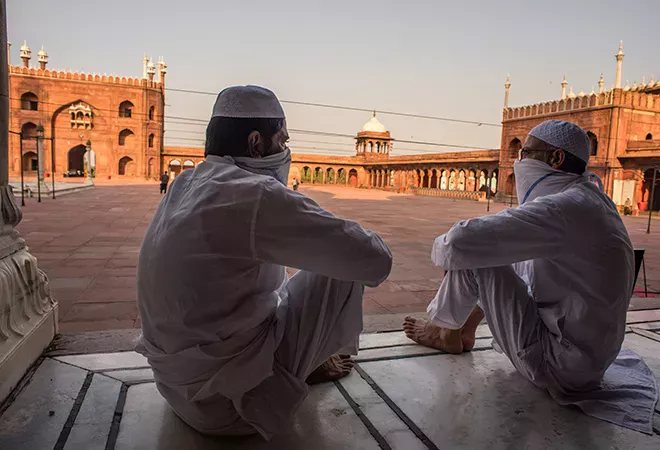 Muslim men in Jama Masjid, Delhi
The response to this challenge cannot be self-pity; it must be honest introspection and passion to grow.
For most Indian Muslims, religion shapes both personal identity and social consciousness. This inherent quality could have been a boon, but Muslims' inability to contextualise Islamic teachings for today’s realities has led to an inertia.
Faith is eternal, but laws, customs and traditions are not. They should change with the changing realities of our time.
Our religious understanding has been shaped by inherited customs, sectarian loyalties and cultural practices rather than through a direct engagement with the teachings of the Quran, Sunnah and the rich intellectual tradition of Islamic scholarship.
Human agents or agencies have become more important for attaining the noble goals than the religious texts. That’s why misconceptions have persisted, internal divisions have deepened, and many Muslims have become disconnected from Islam's own dynamic tradition of reflection.
The consequences are visible. Educational advancement is inadequate, women's participation in public life is discouraged, and quality institutions have not been built. These shortcomings have contributed to economic stagnation and reinforced negative perceptions of Muslims among fellow Indians.
The paradox is striking. A community that made extraordinary contributions to India's freedom movement, literature, culture, education, science and public life today finds itself grappling with uncertainty, declining social confidence and widespread mistrust. Fragmentation, rigid thinking, a persistent sense of victimhood and the absence of a shared developmental vision have stunted the Indian Muslim growth.
The Sachar Committee Report released in 2006, documented the educational, economic and social deprivation of Indian Muslims and underscored the urgent need for reforms.
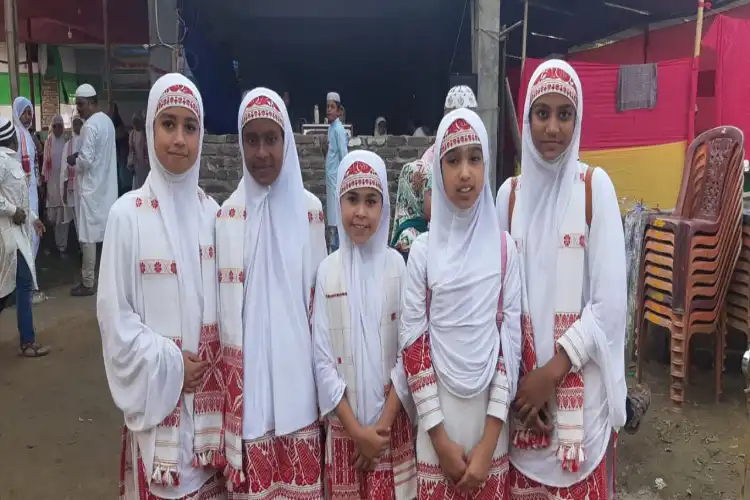 Assamese Muslim women in traditional attire
Unfortunately, instead of seeing it as a red flag, it soon became a subject of political contestation rather than a roadmap for social transformation. Nearly two decades later, many of the underlying challenges remain.
Debates over identity have eclipsed the fundamental requirements of education, entrepreneurship, institutional excellence and social reform. Indian Muslims are not a homogeneous. They speak different languages, have different ethnicities, follow different cultures, and traditions.
No single prescription can address every challenge confronting such a diverse population. Yet despite this diversity, many of the structural issues are remarkably similar.
Indian democracy has evolved, political realities have changed, and in the new landscape, Muslim electoral arithmetic doesn’t add up to the required numbers. These changes require recalibration, a corresponding shift in Muslim mindset.
Clearly, the future of the Muslim community in the coming decades will not depend on political patronage but far more on education, intellectual confidence, economic strength, institutional capacity and constructive engagement with the nation. This has to come within the community.
This moment therefore calls for a new vocabulary of progress—one that replaces nostalgia for a glorious past, victimhood with self-confidence, symbolism with institution-building, and confrontation with meaningful participation.
It is this conviction that forms the foundation of Mizan, a major editorial initiative being launched by Awaz-The Voice today.
Over the past several years, Awaz’s journalism has consciously sought to move beyond the cliched narratives through which Indian Muslims have been perceived.
Even today, the community is identified with conflict and politics of identity. Indian Muslims will have to transform this image and primarily focus on the community’s institution-building rather than trying to strengthen politics of polarisation.
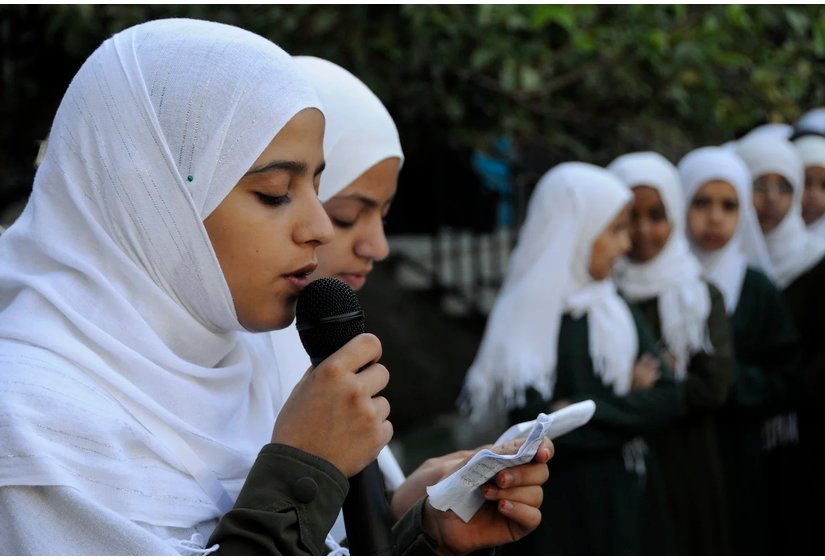 Muslim girls
In Awaz, we have chosen a path rooted in research, evidence, inclusiveness and intellectual honesty. Our purpose has been to encourage dialogue rather than deepen divisions.
The challenge before the community is not to choose between Islam and modernity, but to demonstrate how timeless Islamic ethical principles can guide meaningful engagement with the complexities of the Twenty-First Century.
Equally important is the need for greater engagement with fellow citizens. The future demands cooperation rather than isolation, dialogue rather than suspicion and active participation in nation-building rather than parallel existence.
India's pluralistic democracy offers opportunities that can only be realised through confidence, participation and mutual trust.
It is with this vision that Mizan –series brings together essays, conversations and podcasts of distinguished scholars, thinkers, professionals and public intellectuals from India and abroad to examine some of the most pressing questions confronting the community today.
It does not seek to offer cosmetic solutions or simplistic answers. Nor does it attempt to redefine Islam according to changing political fashions.
Islam is complete in its moral and spiritual foundations. It does not require continual renewal, but our correct understanding of its teachings and their application to changing social realities. Muslims have in the past interpreted Islamic guidance within the context of its own age while remaining faithful to the eternal message of the Quran and the example of the Prophet Muhammad.
Our generation deserves—and indeed requires—the same spirit of thoughtful engagement. The idea behind Mizan is to start a conversation for Indian Muslims' upliftment.
It is an invitation: to think more deeply, to question inherited assumptions that make us complacent, to recover the ethical vitality of Islam, and to participate in shaping India's future.
Thousands of young Muslims are quietly excelling in universities, startups, public service and the professions. Their achievements demonstrate that the obstacles confronting the community are neither permanent nor insurmountable.
As India aspires to become a developed nation by 2047, Indian Muslims have both the opportunity and the responsibility to be active participants in that national journey.
ALSO READ: Pune Muslims lead campaign for drug-free city
The community needs a new generation of leaders—not only in politics, but also in education, business, science, law, media, civil society and religious scholarship.
The future is not something that will happen to Indian Muslims. It is something they must help shape.
We invite our readers to send their feedback on our content to us at [email protected]
Atir Khan
Editor-in-chief
Awaz The Voice

.webp "Ganapati idols being hander over to activists for Kashmir")