




Bhakti Chalak
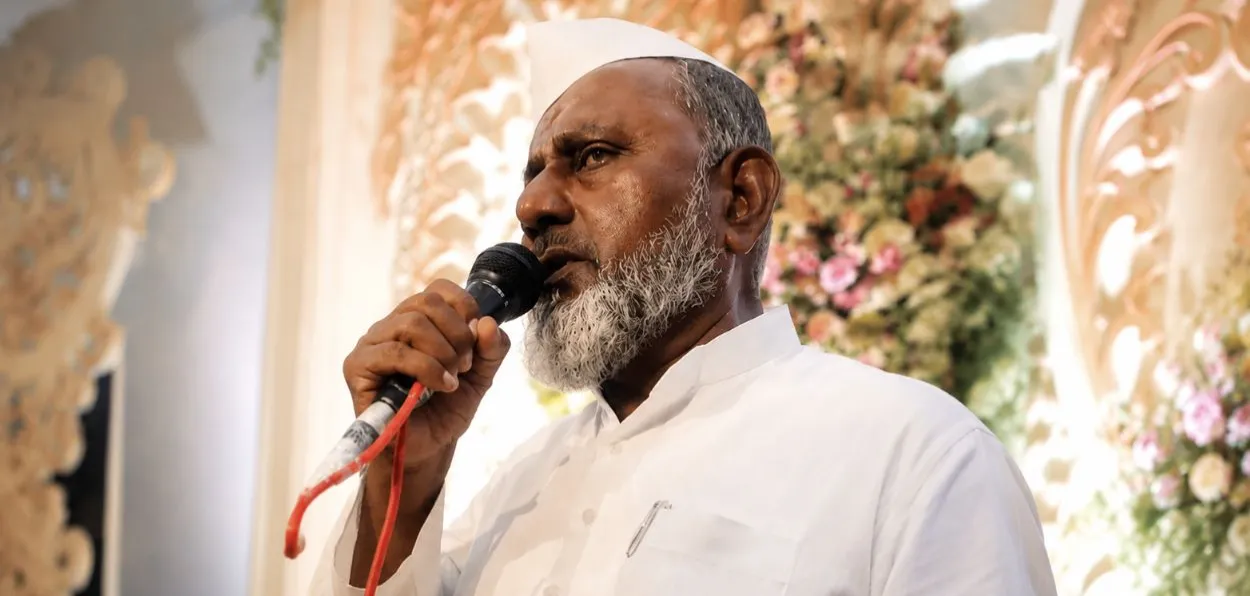
When the sacred chants of "Shubhmangal" reverberated through a wedding hall in Maharashtra's Purandar, the guests were in awe, for the person reciting the wedding chants, Mangalashtakas—the auspicious Hindu wedding verses in Sanskrit — belonged to a Muslim man.
Mangalashtak is a set of eight sacred verses traditionally recited during Hindu and Jain weddings, particularly in Maharashtra and Gujarat, to bless the bride and groom.
The occasion was the wedding of the daughter of Suresh Nivruti Yadav, a Tax Inspector with the GST office in Yerwada. Among the guests was his close friend, Mubarak Shaikh. As the auspicious wedding muhurat was drawing to a close, Mubarak, who had memorised the Mangalashtakas, stepped forward and began reciting the verses.
His effortless rendition of one of the most sacred elements of a Hindu wedding ceremony left everyone present spellbound.
Watching his friend recite the Mangalashtakas at his daughter's wedding moved Suresh Yadav deeply. He said, "Singing the Mangalashtakas at my daughter’s wedding is just a glimpse of his broad-mindedness. His actual work is much bigger than this. He is always working for others. His father, Karim Bhai, was the Chairman of the Panchayat Samiti. Today, Mubarak Bhai is preserving the legacy of his father's inclusive thoughts. We are incredibly proud of him."
Mubarak Shaikh says he learned the Mangalashtakas simply by spending time with his Brahmin neighbour and close friend, Rajaram Atre. Since childhood, he has loved singing, particularly patriotic and inspirational songs.
He has long been associated with organising cultural and public events across the taluka. Whether reciting Naat Sharif, Salaam, and Milad or offering prayers at the mosque, Mubarak displays the same devotion when participating in the festivals and ceremonies of his Hindu friends. He attends them with the warmth and sense of belonging of a family member.
_with_Suresh_Yadav.jpeg) Mubarak Shaikh with his friend Suresh Nivruti Yadav
Mubarak Shaikh with his friend Suresh Nivruti Yadav
His inclusive outlook has deep roots in his upbringing. His late father, Karim Bhai Shaikh, was a widely respected political and social leader in Purandar. Elders in the taluka still recall the remarkable election of 1979, when villagers, impressed by his public service, collected funds themselves to help him contest the Panchayat Samiti election as an Independent candidate. Without the backing of any major political party, he won and later served as Deputy Chairman while representing the Someshwar Gram Panchayat for many years.
During the annual fair of the historic Shri Kshetra Bhuleshwar Temple, Karim Bhai would organize a community feast (Bhandara) at his own expense, feeding the entire village. That spirit of service continues in the family today. Whether it is Muharram, Diwali, or the village fair, celebrating festivals across religious lines has long been a cherished tradition in their household.
Inspired by his father's values, Mubarak Shaikh carried the same spirit into his government service. As an employee of the Zilla Parishad's Health Department, he served thousands of patients and was known for responding to emergencies during outbreaks of gastroenteritis and cholera, often rushing out in the middle of the night to save lives.
He lived by his father's simple philosophy of feeding the hungry and giving water to the thirsty. His dedication earned him several government awards.
People from all communities continue to acknowledge his contributions. His close associate and Secretary of the Zilla Parishad Employees Union, V.L. Pawar, praised his lifelong commitment. He said, "By participating in various social causes, Mubarak Bhai is truly living a valuable life. Even at this age, he dedicates himself to this work just like a government job. He never disappoints anyone from any section of society who comes to him for help. His noble work must continue."
Serving Society After Retirement
Retirement has done little to slow Mubarak Bhai's commitment to public service. Despite advancing age, he remains actively engaged in promoting communal harmony.
Through the KGN Khidmat Foundation, he extends assistance to poor and needy people from all communities. The foundation operates from Hadapsar, Pimpri, Kondhwa, Shirwal, and Jejuri.
To protect families from financial exploitation by commercial marriage bureaus, the foundation has made the biodata of thousands of prospective brides and grooms available free of cost. It neither charges registration fees nor matchmaking fees and has facilitated the marriages of many financially disadvantaged families, including several Hindu couples.
Every December, the foundation's matrimonial fair supports thousands of families. It also distributes assistance collected through Zakat and Fitra to widows, abandoned women, critically ill patients, and needy students.
Even after leaving government service, Mubarak continues to work for social and religious harmony. Just as he once cared for the health of Warkaris while serving in the Health Department, he still volunteers whenever the Dnyanoba-Tukaram Palkhi reaches Saswad, standing at the forefront to serve the pilgrims.
Carrying the Legacy Forward
The family's commitment to public service continues into the next generation. Mubarak Bhai's brother and his family, who are settled in Pune, are also deeply involved in social work.
His elder son, Rashid, serves in the Health Department, following his father's path. His daughter-in-law, Rahmat, is a primary school teacher. His younger son, Mushtaq, works in the private sector, while his daughter, Shabana, who holds an M.A. degree, teaches at a high school. The entire family actively supports his humanitarian initiatives.
Mubarak Bhai has passed on his message of communal harmony to his children and grandchildren. He often sings a favourite song to them, reminding them of India's shared heritage. He says, "Hindu-Muslim naam juda hai, dono ka matlab ek hai... Dadhi-shendi naam juda hai, dono ka matlab ek hai... (Hindu and Muslim are separate names, but their meaning is one...
ALSO READ: Why is Ranjit Bajaj betting everything on India's football future
“A beard and a tuft are separate names, but their meaning is one. Muslims have also sacrificed their lives for the freedom of our country. Every human being must preserve the integrity, tolerance, and unity of the nation. We must all live together in harmony. We have to keep India's Ganga-Jamuni culture alive."

_(1)_(1).webp "Jagannath Rath Yatra")










.webp)
_(1).webp)
.webp)