Eman Sakina
There is a beautiful paradox in Islam: the more we give, the richer we become.
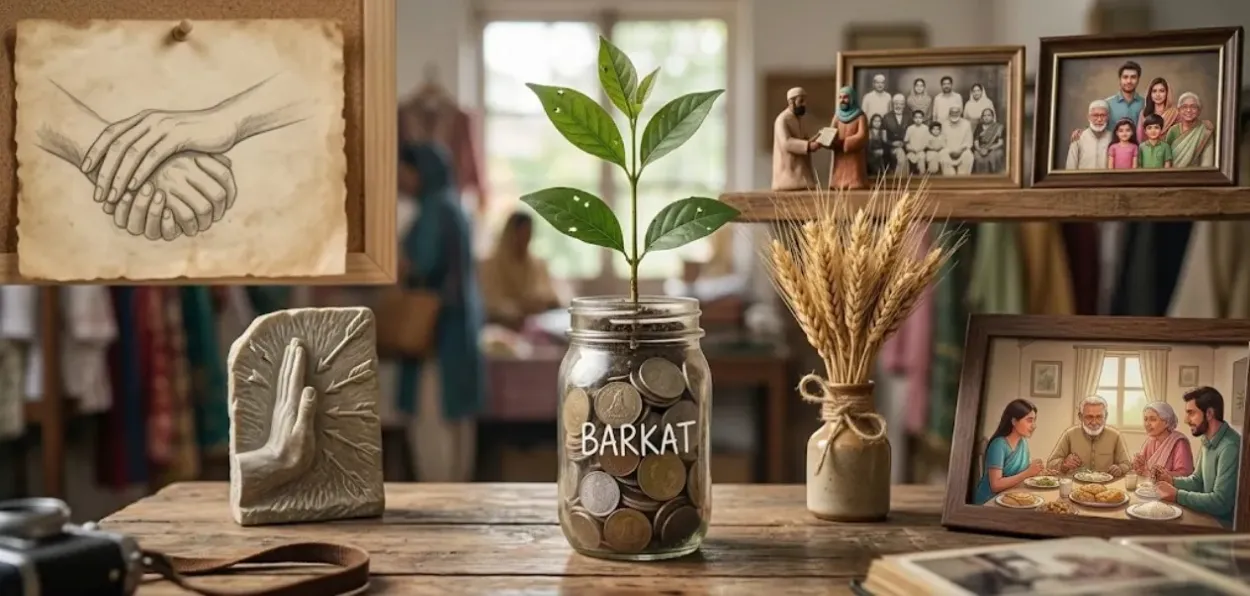
At first glance, this seems to contradict the logic of the world. We are taught that wealth grows by saving, protecting, and accumulating. Yet Islam teaches a different mathematics—one where what leaves our hands often returns in ways we never imagined. Sometimes it comes back as wealth, sometimes as health, sometimes as peace, and sometimes as protection from a calamity that we never even knew was approaching. This is the mystery of barakah (abundance).
Friday Musings
Barakah is not merely "more." It is Allah placing extraordinary goodness in something that appears ordinary. Two people may earn the same salary, yet one constantly struggles while the other lives comfortably, helps others, and remains content. One family may own little but eat together in peace, while another possesses abundance yet never experiences satisfaction. The difference is often not in the amount—it is in the blessing.
Among the greatest doors to barakah is sadaqah, voluntary charity given sincerely for the sake of Allah.
Allah reminds us in the Qur'an: "The example of those who spend their wealth in the way of Allah is like a grain that grows seven ears; in every ear are one hundred grains. And Allah multiplies for whom He wills." (Surah Al-Baqarah 2:261)
Notice that Allah does not promise a simple return. He speaks of multiplication.
Likewise, Allah says: "Whatever you spend, He will replace it. And He is the Best of Providers." (Surah Saba 34:39)
Replacement does not always mean receiving the exact amount back. Sometimes Allah replaces money with better opportunities, stronger relationships, healthier children, emotional peace, or protection from difficulties.
The Prophet emphasised this truth in a profound hadith: "Charity does not decrease wealth." (Sahih Muslim)
At first, this statement seems impossible. If someone gives one hundred rupees, they now possess one hundred rupees less. Yet the Messenger of Allah was teaching us to see beyond numbers. Wealth is not measured only by bank balances but by blessing. A thousand rupees with barakah can accomplish what ten thousand without barakah cannot.
One of the most remarkable lessons comes from a famous narration recorded in Sahih al-Bukhari and Sahih Muslim.
Three travellers sought shelter inside a cave during heavy rain. Suddenly, a massive rock rolled down the mountain and sealed the entrance. Escape became impossible.
Realising that no human being could rescue them, each man turned to Allah and mentioned one sincere deed performed purely for His sake.
One of them spoke about honouring his elderly parents.
Another mentioned resisting temptation despite having the opportunity to commit a grave sin. The third recalled an incident involving honesty in business. A labourer had once worked for him but left without collecting his wages. Instead of keeping the money, the man invested it until it grew into livestock and wealth. Years later, the labourer returned asking only for his original payment.
Rather than giving him the small wage, the employer handed over everything that had grown from it, refusing to keep what ultimately belonged to the worker.
Because these acts were done sincerely, Allah gradually moved the rock until the cave opened and they walked out safely. While this story is not specifically about sadaqah, it beautifully illustrates that sincere generosity and integrity become treasures stored with Allah, ready to benefit us when we need them most.
Another inspiring example comes from the Companion Abu Talhah. He owned one of the finest gardens in Madinah called Bayruha'. It was beloved to him and frequently visited by the Prophet.
When the verse was revealed: "You will never attain righteousness until you spend from that which you love." (Surah Aal 'Imran 3:92)
Abu Talhah immediately offered his cherished garden in charity. The Prophet praised this act and advised him to distribute it among his relatives.
The lesson is timeless. True generosity begins where attachment ends. Giving what we no longer need is good. Giving what we genuinely love transforms the heart.
Throughout Islamic history, scholars have narrated countless personal experiences of charity returning in unexpected ways. While these accounts are not religious proofs like the Qur'an or authentic hadith, they beautifully illustrate how believers have witnessed Allah's promise.
A merchant once made it his habit never to begin a business journey without quietly giving charity. On one occasion, his caravan narrowly escaped a robbery after taking an unexpected route because one of his animals had fallen behind. Looking back, he would often say that perhaps the small charity he had offered that morning was the reason Allah diverted him from danger.
Many righteous scholars advised their students that whenever illness struck, hardship intensified, or confusion clouded the heart, they should increase in charity before increasing in complaint. They believed that sadaqah softens hardships because it draws a servant closer to Allah's mercy.
Even today, countless Muslims share stories that sound remarkably similar. Someone gives charity before an important examination and unexpectedly finds calmness replacing anxiety.
Another helps an orphan despite financial struggles and soon discovers an employment opportunity that had seemed impossible.
A family sponsors the education of a needy child, only to witness harmony returning to their own home after months of conflict. A woman quietly pays for a stranger's medicine, and days later receives help from an unexpected source when her own family faces difficulty.
These experiences are not guarantees that every act of charity will produce an immediate worldly reward. Rather, they remind us that Allah's ways are often beyond our calculations. Sometimes the return is visible, and sometimes it is reserved for the Hereafter, where every sincere deed will be found waiting.
Generosity transforms the giver before it transforms the receiver. It weakens greed. teaches gratitude, and it reminds us that we are caretakers rather than owners. Most importantly, it nurtures tawakkul—complete reliance upon Allah.
Every time we give despite our own needs, we quietly declare that our trust is not in our wallet but in our Lord. This trust attracts barakah. Money earned honestly becomes sufficient.
Meals become satisfying.
Homes become peaceful.
Children grow with gratitude.
Time becomes productive.
Life itself feels lighter.
ALSO READ: Ex-Ad Guru Zahir Mirza makes Ashad Wari devotees paint on canvas
These are blessings that no financial statement can measure.