




Vidushi Gaur/ New Delhi
The stadium was already buzzing long before the first ball was bowled. Flags fluttered, chants rose and fell like waves, and thousands of phones hovered in the air, ready to capture a moment worth keeping. For most people, that moment would be a six sailing into the stands or a wicket celebrated with raw passion. But that day, the most memorable moment came not from the pitch, but from the boundary line, quiet, brief, and unexpectedly tender.
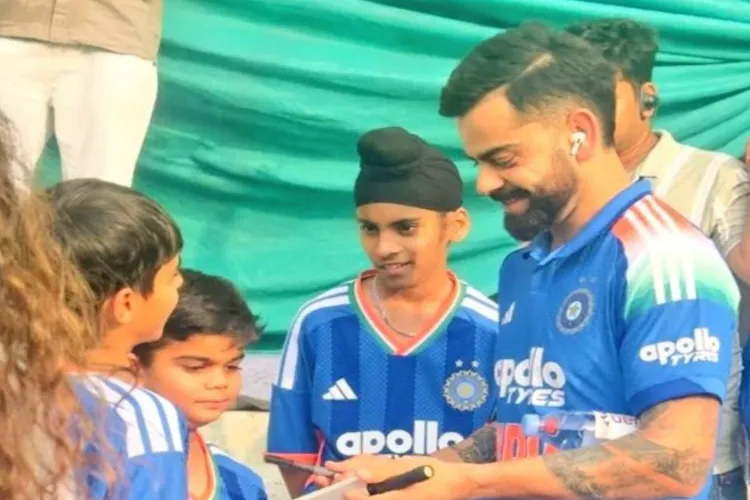
Virat Kohli had just finished a training session. Sweat clung to his jersey, and the familiar intensity that defined him on the field still lingered in his stride. As he walked toward the pavilion, he acknowledged the crowd with quick nods and half-smiles, a ritual he had repeated countless times in his career. Then, just as he was about to disappear from view, something caught his eye.
Standing behind the advertising boards was a young boy, no older than eight or nine, holding a cricket bat almost as tall as himself. What made him stand out wasn’t the bat or the hopeful grin, it was the resemblance. The neatly styled hair, the determined eyes, even the way he stood, shoulders squared as if already imagining a packed stadium chanting his name. He looked uncannily like a miniature version of Kohli himself.
The boy raised his hand, not waving wildly like others, but holding out a notebook and pen with quiet confidence. For a moment, it seemed like Kohli might walk past. The crowd noise surged, security nudged him forward, time pressed on. Then he stopped.
That pause, just a few seconds, changed everything.
Kohli turned back, smiled, and walked toward the boy. The child froze, disbelief written across his face. Kohli took the notebook, knelt slightly to meet the boy at eye level, and signed his name carefully, as if it mattered deeply that the autograph be perfect. When he handed it back, he ruffled the boy’s hair and shared a brief laugh with him, an exchange too small for scorecards, yet big enough to steal hearts.
Someone captured the moment on camera. Within minutes, it found its way onto social media. Within hours, it was everywhere.
The internet, as it often does, responded first with humor. Side-by-side photos appeared: Virat Kohli and his “future self,” Virat Kohli and his “next generation.” Memes joked about cloning labs and time travel, about cricketing legacies starting early. But beneath the jokes was something softer, something collective and emotional that people didn’t need words to recognize.
It wasn’t just about resemblance. It was about recognition.
For fans who had grown up watching Kohli evolve, from a fiery young cricketer to one of the most disciplined athletes in the world, the moment felt symbolic. Here was a man who had spent years chasing excellence, now pausing to acknowledge a child chasing a dream that looked a lot like his own past. In that brief interaction, the distance between icon and admirer dissolved.
Parents shared the video with captions about dreams and role models. Former players commented on the importance of humility. Young fans saw proof that their heroes could still see them in the crowd. The moment became a reminder that fame, when worn lightly, has the power to inspire without overwhelming.
For the boy, life would likely return to normal soon, school mornings, dusty nets, weekend matches with friends. But he would always carry that moment: the day his hero saw him, smiled at him, and treated him not as a fan, but as an equal in possibility. Perhaps years from now, when he stands at a crease somewhere, bat in hand, he’ll remember how it felt to be noticed.
For Kohli, it may have been just another autograph. Or maybe it was a mirror, a fleeting glimpse of himself as a child, standing behind barriers, believing fiercely in a future not yet written.
In a world where viral moments often burn fast and fade faster, this one lingered. Not because it was loud or dramatic, but because it was gentle. Because it reminded millions that greatness isn’t only measured in runs and records, but in the grace to pause, smile, and sign a dream into existence.
ALSO READ: Mahmud Akram: the boy who knows 400 languages
And somewhere between the memes and the applause, the internet agreed on one thing: some moments don’t need filters, hashtags, or punchlines. They just need heart.

_(1)_(1).webp "Jagannath Rath Yatra")








_(1)_(1).webp)

_(1).webp)