




New Delhi
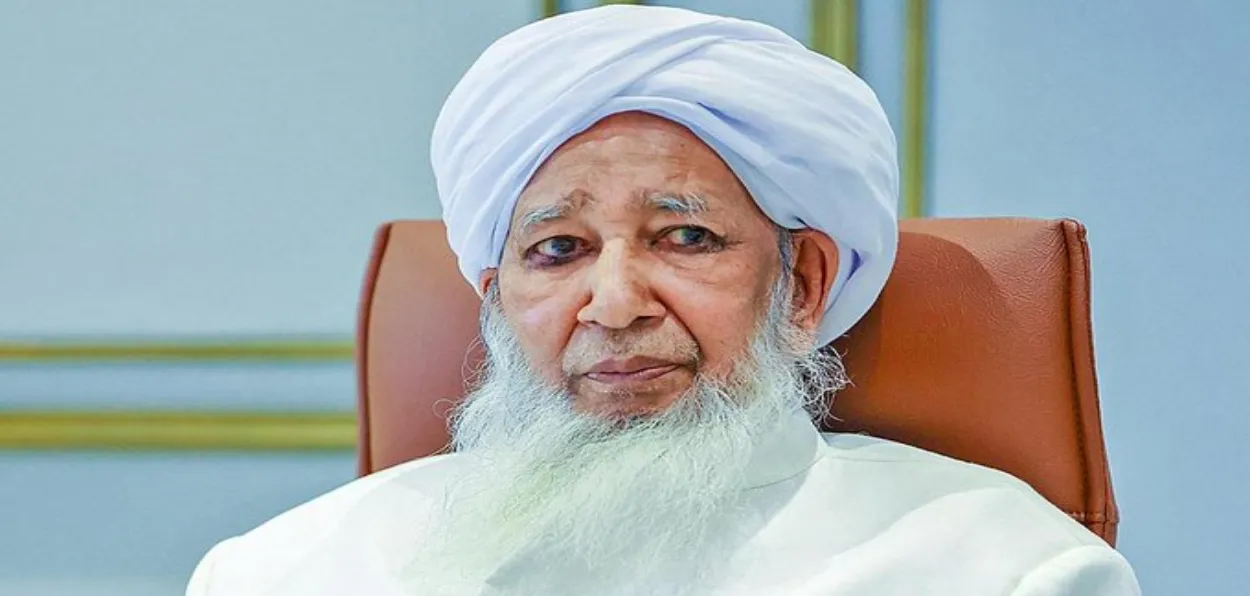
Women across India have reacted sharply to the fiat of the 95-year-old prominent Sunni scholar Kanthapuram A. P. Aboobacker Musliyar, also regarded as the Grand Mufti of India, over his assertion that women should be confined to home and his likening them to gold ornaments that lose value if left exposed in public.
His assertion comes within days of a circular issued by his organisation the Samastha Kerala Jem-iyyathul Ulama, which said women should stay off public platforms, which also drew criticism from several women political leaders.
Despite his advanced years, Kanthapuram A. P. Aboobacker Musliyar is regarded as a highly placed Islamic scholar.. He is also the General Secretary of both the All-India Sunni Jamiyyathul Ulama and the Samastha Kerala Jem-iyyathul Ulama. He was even hosted by Prime Minister Narendra Modi earlier this year.
Speaking at a religious function in Kochi, he said, “It is precisely recognising that bringing women onto public platforms in this manner causes great destruction that Islam mandated purdah for women,” Ahmad said at an Islamic Conference. “If the necklace has to retain its beauty, it has to be kept safely inside a box.”
He quoted a Quranic verse and reportedly said, “Women should remain confined within their homes. They should not enter the public sphere. The Holy Quran says so. ” He said such views had been taught by Islamic scholars for the past 100 years.
“We have studied the religion. Therefore, it is our duty to say this. We will say it,”
Journalist and a leading Muslim digital content creator Arfa Khanum Sherwani called it a textbook definition of ugly, regressive, patriarchal bullshit. arifa
Textbook definition of ugly, regressive, patriarchal bullshit. pic.twitter.com/WBCMjKW6e4
— Arfa Khanum Sherwani (@khanumarfa) August 31, 2026
Another leading columnist who writes on Muslim issues Amna Ansari has called out the head cleric:
I am angry. I am hurt. And I am exhausted by Muslim men speaking about Muslim women as though our lives belong to them.
— Amana Begam Ansari (@Amana_Ansari) August 31, 2026
I am a Muslim woman. My faith is mine too. My conscience is mine. My choices are mine. I live in India, and the Constitution gives me the right to practise my… pic.twitter.com/vTHNB6Cdxh
Content creator Raseena Noushad criticised the idea that women’s role should be restricted to the home. “They believe women should stay at home, deliver babies, and cook,” she said.
Turning the argument around, she asked men who oppose women entering public spaces to consider staying at home themselves. “To those who think women shouldn't go out, why don't you go to the Taliban? Why are you trying to make Kerala like the Taliban?” she asked.
Another content creator, Nadhiya Khadar, questioned whether those advocating that women stay at home were prepared to financially support them.
She pointed out the economic dependence such restrictions could create for women, particularly those from ordinary families. “If you are making statements based on religion, as a religious leader, you should find a solution for that,” she said.
Nadhiya pointed out that women may need an income even for basic personal and family needs. “If a woman wants to buy a burkha for her mother, she needs to ask her husband for money. What if he refuses to give her any? I am not talking about women in privileged families like yours, but rather the average Muslim family in Kerala,” she said.
Writer and content creator Shimna Zeenath also criticised the remarks, arguing that they were contrary to what she sees as Islam’s historical engagement with women.
“It is hard to understand what message the religious clergy is sending by keeping women away from all cultural and political discourse, truncating their thoughts and portraying them as mere reproductive tools,” she wrote on Facebook.
She argued that such restrictions were “the exact opposite of the enlightenment that Islam ignited during the time of the Prophet.”
Filmmaker Aisha Sultana responded with a historical question of her own: “Who led the Battle of Jamal?”
The Battle of Jamal, fought in 656 CE, involved several prominent figures from the early Islamic period, including Aisha bint Abu Bakr, the Prophet Muhammad’s widow, who was among the central figures in the conflict.
Interestingly Congress MP Imran Masood says the Grand Mufti of India Sheikh Abubakr Ahmad is not an Islamic scholar and doesn't have knowledge of Islam. He calls Grand Mufti of India a "govt agent". Do Muslims from Keralam agree with Congress MP's statement?
#WATCH | Delhi: On Keralam Grand Mufti Sheikh Abubakr's remarks on women, Congress MP Imran Masood says, "I do not agree with him at all. Who was Razia Sultan? Who is this Grand Mufti? What is this position? There is no post of Grand Mufti in Islam. What is this mockery of Islam?… pic.twitter.com/7Ema4oylwL
— ANI (@ANI) August 31, 2026
The backlash has not been confined to social media. Several political leaders in Kerala have also criticised Kanthapuram’s remarks and described them as anti-woman.
ALSO READ: Simab Khan's rise from a notorious slum to becoming a civil servant
Kerala Home Minister Ramesh Chennithala rejected Aboobacker’s (officially known as Sheikh Abubakr Ahmad) view that women should stay away from public life, saying women have every right to participate actively.






.webp "Dipika Pal shaping an idol")



_(1).jpg)
_(4).webp)