New Delhi
Australia on Tuesday pushed back against China’s criticism of the Quad grouping, asserting that the alliance is focused on promoting peace, stability and prosperity across the Indo-Pacific rather than engaging in bloc politics.
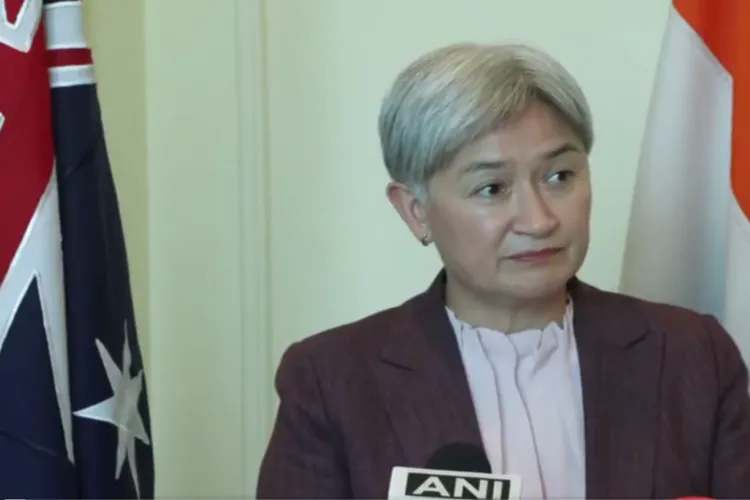
Speaking to reporters in New Delhi after the Quad Foreign Ministers’ Meeting, Australian Foreign Minister Penny Wong rejected Beijing’s allegations of “bloc confrontation” and stressed the grouping’s constructive agenda.
“I want to talk about what we are for. We are for peace, stability and prosperity in the Indo-Pacific, and that’s what we’re acting to deliver,” Wong said.
Her remarks came after Chinese Foreign Ministry spokesperson Mao Ning said in Beijing that cooperation among nations should contribute to regional peace and prosperity rather than target third countries. China also reiterated its opposition to exclusive groupings and bloc-based confrontations.
The Quad foreign ministers, in their joint statement issued after the meeting, expressed serious concern over developments in the East China Sea and South China Sea.
The statement reaffirmed opposition to destabilising or unilateral actions carried out through force or coercion that threaten regional peace and stability.
It also raised concerns over interference in offshore resource development, obstruction of freedom of navigation and overflight, and dangerous manoeuvres involving military aircraft, coast guard vessels and maritime militia ships. The ministers specifically highlighted unsafe actions such as the use of water cannons, flares, ramming incidents and blocking tactics in the South China Sea, while also expressing concern over the militarisation of disputed areas.
The Quad meeting, attended by India, Australia, Japan and the United States, focused heavily on strengthening cooperation for a free and open Indo-Pacific region. Discussions covered maritime security, energy resilience, supply chain stability and regional connectivity.
The four countries also announced initiatives aimed at improving energy security, reinforcing resilient supply chains and expanding maritime cooperation in response to disruptions in global energy markets.
A major outcome of the meeting was the announcement of a joint infrastructure initiative in Fiji, where the Quad partners will work together to modernise port infrastructure.
US Secretary of State Marco Rubio described the project as the first instance of all Quad members collaborating on a port infrastructure initiative in the Pacific Islands. He said the project would demonstrate the grouping’s ability to provide resilient and high-quality infrastructure support.
The move is considered significant because Fiji had previously explored port development cooperation with China under Beijing’s Belt and Road Initiative.
The Quad also reaffirmed its commitment to maintaining a “free and open Indo-Pacific” supported by secure maritime routes, reliable energy systems and stronger regional resilience.
In the joint statement, the ministers noted that disruptions in key maritime regions have exposed the vulnerability of critical sea lanes and threatened the uninterrupted flow of commerce. They warned that such disruptions carry serious implications for fuel, food and fertiliser security, particularly for Indo-Pacific nations and Pacific Island states.
The statement further stressed the importance of upholding international law, protecting sovereignty and territorial integrity, and resolving disputes peacefully. The ministers also opposed unilateral attempts to alter the status quo through force or coercion.
The Quad meeting in New Delhi was chaired by External Affairs Minister S. Jaishankar and attended by Rubio, Wong and Japanese Foreign Minister Motegi Toshimitsu.
READ MORE: Gurugram’s ‘Bulldozer Man’ RS Batth joins Muslims in Eid cleanliness drive
The Quadrilateral Security Dialogue, commonly known as the Quad, includes India, the United States, Japan and Australia. The grouping was first proposed in 2007 by former Japanese Prime Minister Shinzo Abe with support from leaders including former Indian Prime Minister Manmohan Singh, former Australian Prime Minister John Howard and former US Vice President Dick Cheney.