Barcelona
A deadly train collision in southern Spain has cast a shadow over what has long been regarded as one of the country’s biggest modern success stories — its high-speed rail network.
At least 40 people were killed and dozens injured when two high-speed trains collided on Sunday, officials said late Monday. The crash has stunned a nation that has taken pride in a rail system known for speed, safety and technological achievement.
Below is a snapshot of Spain’s high-speed rail journey and why the accident is being seen as a historic rupture.
A 34-year transformation
Spain launched its first high-speed AVE train — the name means “bird” in Spanish — 34 years ago, marking a turning point in national infrastructure. Successive governments invested heavily in the network using domestic funds and European Union development aid.
The debut of the AVE came just two months before the 1992 Barcelona Olympics, a period widely viewed as Spain’s re-entry onto the global stage after decades of isolation under the dictatorship of General Francisco Franco. Together, the Olympics and the rail expansion symbolised economic renewal and modernization.
3,900 kilometres of track
Over three decades, Spain has laid roughly 3,900 kilometres (2,400 miles) of high-speed rail, serving a population of around 49 million. Only China has built more, with about 45,000 kilometres of high-speed track for its much larger population, according to the International Union of Railways.
High-speed rail — defined as lines allowing trains to run at 250 kmph (155 mph) or more — helped Spain shed its reputation for lagging behind other major European economies in industrial development.
The domestic boom also helped Spanish firms expand abroad. A Spanish consortium built Saudi Arabia’s high-speed rail line linking Mecca and Medina, which began operations in 2018.
Madrid to Barcelona: 7 hours to 2.5
Before the arrival of high-speed rail, the 600-kilometre journey between Madrid and Barcelona could take around seven hours, making air travel the preferred option for many passengers.
That same trip now takes about two and a half hours. In November, Spain announced plans to upgrade the line so trains can reach speeds of 350 kmph (218 mph), potentially cutting travel time to under two hours — on par with the fastest services in China.
The AVE network has also played a unifying role, connecting coastal population centres with the capital through sparsely populated interior regions. However, critics argue that the drive to extend high-speed lines everywhere may have diverted funds from commuter and regional rail services, which experience far more delays.
For many provincial cities, missing out on an AVE stop has come to symbolise economic stagnation.
High-speed rail is also central to Spain’s climate strategy, encouraging a shift away from short-haul flights toward electrified transport.
A first deadly high-speed crash
Sunday’s collision marks the first fatal accident involving Spain’s high-speed rail services. One official described the wreckage as a “mass of twisted metal.”
Authorities say they are still investigating how one train derailed and collided with another travelling in the opposite direction. Álvaro Fernández, president of state-owned operator Renfe, said both trains were moving well below speed limits and that “human error could be ruled out” at this stage.
Spain’s deadliest train disaster this century occurred in 2013, when 80 people were killed after a train derailed in the northwest. That investigation found the train was travelling far above the speed limit on a non-high-speed section of track.
Three operators, new competition
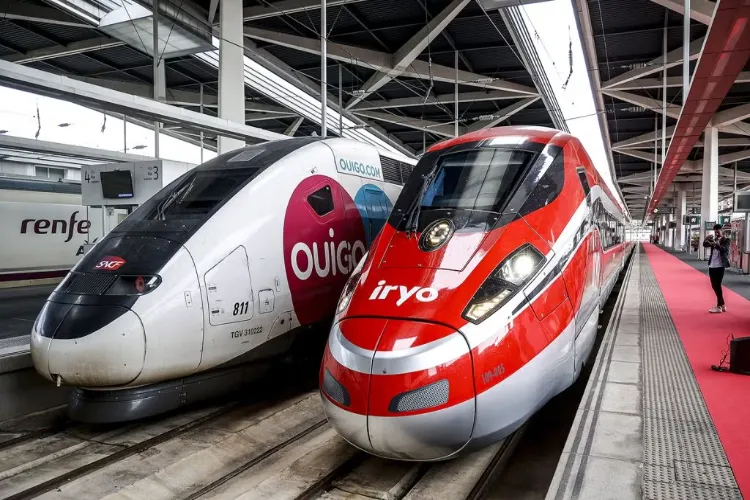
Spain’s high-speed rail market has three operators. Competition was introduced only in 2022, ending Renfe’s long-held monopoly.
Italian-owned Iryo was the first private operator, followed by France’s Ouigo. An Iryo train was involved in Sunday’s crash and was the first to derail, causing the Renfe train to leave its track. Iryo said it is cooperating fully with investigators to determine the cause.

















_(1).webp)