New Delhi
An India House will come up in Abu Dhabi, while the UAE will provide artefacts for the National Maritime Heritage Complex at Lothal, to honour the close cultural ties between the two nations. This is the soft power exchange deal signed between the two countries during the visit of the President of the United Arab Emirates, Sheikh Mohamed bin Zayed Al Nahyan, to India.
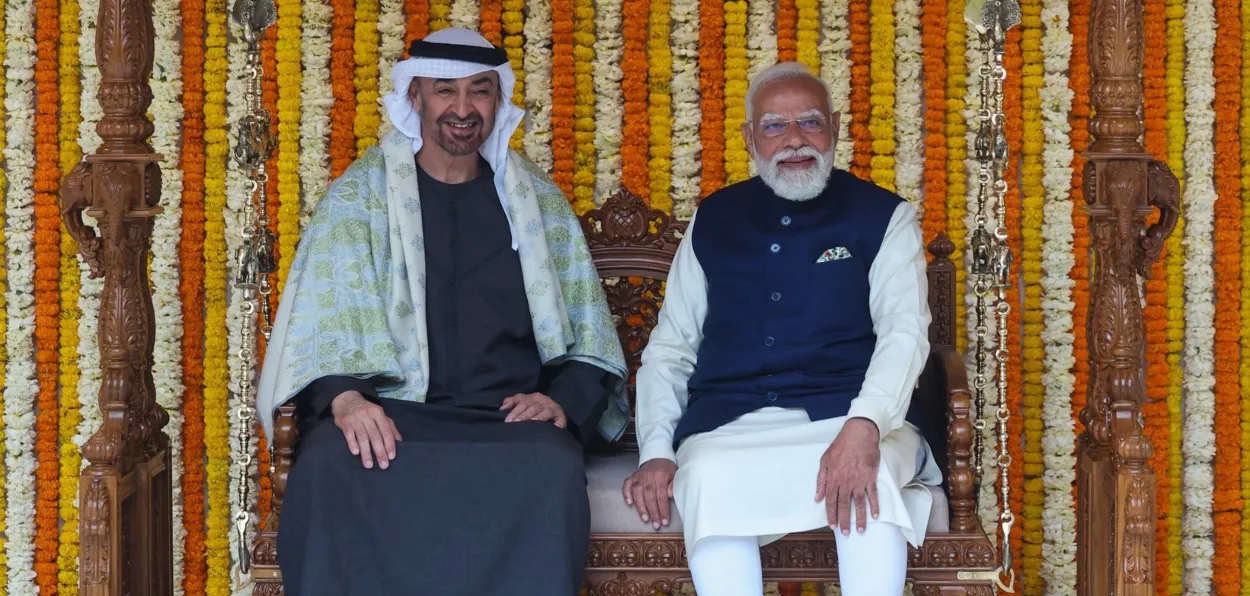
This was the fifth visit of Sheikh Mohamed bin Zayed Al Nahyan to India in the last ten years and his third official visit to India as the President of the UAE. Breaking protocol, Prime Minister Narendra Modi received ‘brother’ at the airport, and both the leaders drove in the same car and also discussed matters while sitting in a flower-decked swing.
While President Nahan was in Delhi for a few hours, the importance of his visit was demonstrated by the way the two sides signed a plethora of agreements on cooperation in various fields between them to elevate.
The UAE leader took to X to speak about his Delhi visit and post some pictures:
Today I was pleased to meet with Indian Prime Minister @narendramodi in New Delhi to discuss opportunities to further strengthen the deep-rooted and historical ties of cooperation between our countries. Committed to fostering sustainable development and economic growth, the UAE… pic.twitter.com/i46cgMh0iX
— محمد بن زايد (@MohamedBinZayed) January 19, 2026
According to the MEA, the two leaders have decided to double bilateral trade to target US$ 200 billion by 2032. They directed their teams to work towards connecting Micro, Small and Medium Sector Enterprises (MSMEs) on both sides.
They called for the expeditious implementation of key initiatives, such as the ‘Bharat Mart’, the ‘Virtual Trade Corridor’ and the ‘Bharat-Africa Setu’ to promote MSME products across the Middle East, West Asia, Africa and the Eurasia region.
They welcomed discussions on a potential UAE partnership for the development of the Special Investment Region in Dholera, Gujarat. The envisioned partnership would include the development of key strategic infrastructure, including an international airport, a pilot training school, a maintenance, repair and overhaul (MRO) facility, a greenfield port, a smart urban township, railway connectivity, and energy infrastructure. Highlighting the success of the first NIIF Infrastructure Fund, the Prime Minister of India invited UAE sovereign wealth funds to consider participation in the second Infrastructure Fund, scheduled for launch in 2026.
Modhd. Taqi, a political analysts of the UAE said the gesture of Modi Presenting a shawl to the UAE President was a huge gesture:
भारत में अतिथि को शॉल भेंट करना एक परंपरा है, जो सम्मान और स्वागत का प्रतीक मानी जाती है—चाहे वह आधिकारिक अवसर हों या जन-समारोह।
— Mohammed Taqi (@MohdTaqi11) January 19, 2026
इस भाव-भंगिमा का अर्थ है अतिथि के प्रति गहरा आदर, उसे सम्मानित व्यक्तित्व के रूप में मान्यता देना, तथा अवसर का स्वागत और उत्सव मनाना। साथ ही यह… pic.twitter.com/73N7D9KyWB
During the visit, the two countries agreed to deepen cooperation in the space sector. In this context, they welcomed the understanding reached to collaborate on a joint initiative aimed at driving the commercialisation of the sector through the advancement of space sciences and technologies.
It aims to enable India–UAE joint missions, expand global commercial services, create high-skilled employment and start-ups and strengthen bilateral investment through sustainable business models.
The two leaders decided to strengthen collaboration in science and technology and innovation, especially in the areas of artificial intelligence (AI) and emerging technologies. Welcoming the decision to collaborate on the establishment of a supercomputing cluster in India, they also agreed to explore cooperation in setting up data centres in India.
The two leaders directed their teams to explore the possibility of establishing ‘Digital Embassies’ between the UAE and India, under mutually recognised sovereignty arrangements. Sheikh Mohamed bin Zayed Al Nahyan expressed support for the AI Impact Summit to be hosted in India in February 2026.
They welcomed signing a 10-year LNG Supply Agreement between Hindustan Petroleum Corporation Limited (HPCL) and ADNOC Gas for the delivery of 0.5 million tonnes per year of liquefied natural gas, beginning in 2028. The two sides also explore partnership in advanced nuclear technologies, including development and deployment of large nuclear reactors and Small Modular Reactors (SMRs), as well as cooperation in advanced reactor systems, nuclear power plant operations and maintenance and nuclear safety.
Amjad Taha, a well known strategic analyst of the Gulf posted the image of two leaders in a car on X and wrote that the future of their partnership is bright:
India is a powerful eastern ally standing against backwardness, Islamist jihadist terrorism, antisemitism, and all forms of radicalisation. Strong in AI, technology, diversity, and tolerance just like the United Arab Emirates.
— Amjad Taha أمجد طه (@amjadt25) January 19, 2026
Together, we stand and thrive.
What’s coming will… pic.twitter.com/HJDpSGi4fv
The deals for cooperation were also signed in the financial sector, where India would give its UPI system to the UAE, and in education.
In the joint communiqué released by the Ministry of External Affairs, the two leaders reiterated their unequivocal condemnation of terrorism in all its forms and manifestations, including cross-border terrorism, and emphasised that no country should provide a haven to those who finance, plan, support or commit terrorist acts.
The two leaders recalled the launch of the India-Middle East-Europe Economic Corridor (IMEC) on the margins of the G20 summit in Delhi in September 2023.
ALSO READ: Kabir Khan's film on the Taj Mahal turns into India's soft power
Both sides highlighted their collaboration in polar science and noted the positive outcomes of joint expeditions and institutional cooperation. Both sides agreed to further advance this partnership through targeted scientific initiatives, coordinated research planning and strengthened collaboration between national polar research institutions. They emphasised that continued cooperation in the polar regions would support evidence-based climate action and contribute to global scientific efforts.

.webp "Representational Image")






.webp "Representational Image")
.webp "Prime Minister Balendra Shah")