New Delhi
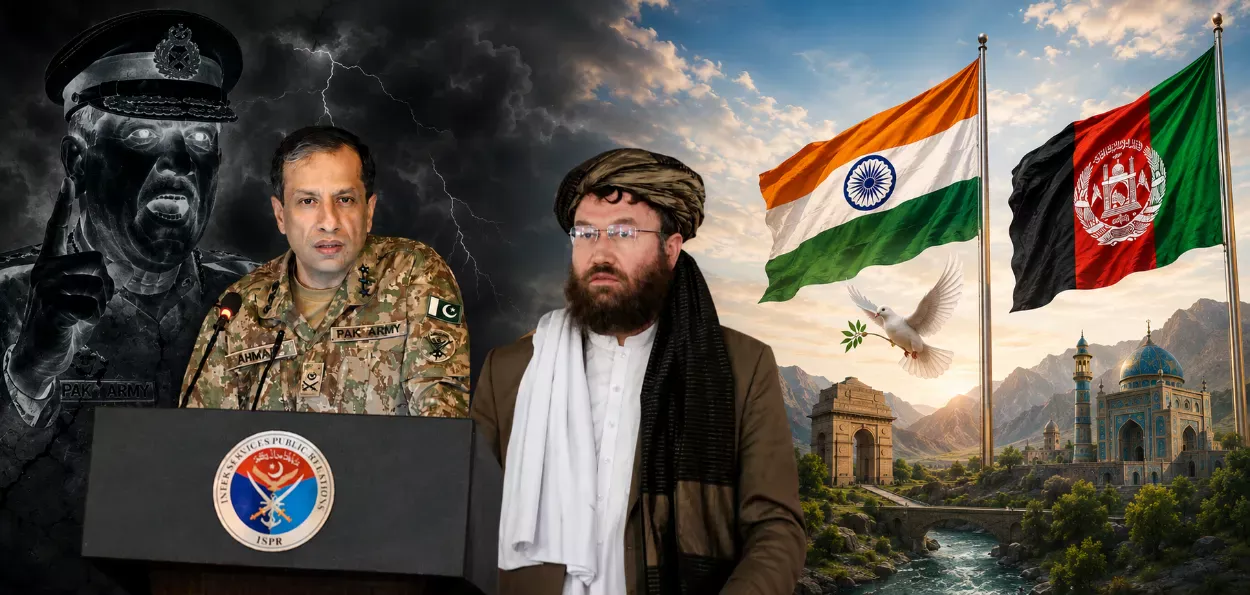
The DG of the Inter-Services Public Relations (ISPR) Lieutenant General Ahmed Sharif Chaudhry, sparked a controversy with referring to the Taliban authorities in Afghanistan as kafirs (infidels) for cultivating close ties with India and saying “their DNA matched with Indians’ DNA” is the latest example of how religion continues to be invoked to serve Pakistan's strategic objectives.
The statement came after the United Nations Assistance Mission in Afghanistan (UNAMA) reported that at least 499 civilians were killed and 1,216 injured between October 2025 and June 2026 in Pakistani air strikes, artillery attacks and border clashes with Taliban forces.
Pakistan is also irked by visits of the Afghan ministers to New Delhi for signing agreements for developmental push in Afghanistan.
"Hindus are Kafir. Afghans are Kafir because they befriend Hindus."
— Pakistan Untold (@pakistan_untold) August 1, 2026
- @OfficialDGISPR explains why Pak Hindus are killed and girls are abducted by state-sponsored Islamistspic.twitter.com/g6I7555b0Z
It also follows Pakistan Army chief General Asim Munir's controversial remark in 2025 that "Muslims are different from Hindus," a statement that reinforced Pakistan's long-standing religious narrative against India. The comment assumed greater significance after the Pahalgam terrorist attack, in which terrorists reportedly identified victims by their religion before killing 26 civilians, leading to India's military response under Operation Sindoor.
Some of the most significant milestones in Pakistani state’s use of religion for political and diplomatic purposes:
Zia-ul-Haq's Islamisation
After overthrowing Prime Minister Zulfikar Ali Bhutto in a military coup in 1977, General Zia-ul-Haq faced a legitimacy deficit. To justify his military regime, he launched an ambitious Islamisation programme.

Zia-ul-Haq
His government introduced the Hudood Ordinances in 1979, established Shariat courts, made Zakat collection compulsory and projected him as the guardian of Islam rather than merely a military ruler.
Perhaps his most enduring legacy was reshaping Pakistan's education system. School curricula were rewritten to promote an Islamic national identity, accelerating the country's religious radicalisation. Many scholars argue these policies created a powerful religious constituency that sustained his regime and permanently altered Pakistan's political landscape.
The Afghan Jihad (1979–1989)
The Soviet invasion of Afghanistan transformed Pakistan into the frontline state of the anti-Soviet jihad.
Working closely with the United States and Saudi Arabia, Pakistan mobilised thousands of Islamist volunteers from Afghan refugee camps under the banner of jihad. The Inter-Services Intelligence (ISI) used an extensive network of religious seminaries to recruit, indoctrinate and train fighters.
 Mujahideen trained by Pakistan to fight Soviet invasion in Afghanistan
Former ISI chief Lieutenant General Hamid Gul openly described the objective as achieving "strategic depth" in Afghanistan—a doctrine that envisaged a friendly Islamist government in Kabul serving Pakistan's strategic interests against India.
Pakistan believed the Taliban's return to power in 2021 would restore this strategic advantage. Instead, the Taliban leadership asserted its independence and refused to function as Pakistan's proxy. Tensions deepened as Kabul strengthened engagement with India, whose development projects had earned considerable goodwill across Afghanistan. This marked a significant reversal of Pakistan's long-standing Afghanistan policy.
Kashmir’s proxy war
Successive Pakistani governments and sections of the military establishment portrayed the Kashmir conflict not merely as a territorial dispute but also as a religious obligation.
 A Pakistani terrorist caught by villagers in Udhampur district of J&K
Pakistan supported militant organisations such as Hizbul Mujahideen, Lashkar-e-Taiba and Jaish-e-Mohammed, while religious rhetoric was used to recruit fighters, raise funds and justify cross-border terrorism.
India responded with sustained counter-terrorism operations alongside efforts to discourage local youth from joining militant groups. Over time, indigenous recruitment declined sharply, leaving only a small number of militants—many of them Pakistani nationals—active in Jammu and Kashmir.
Nawaz Sharif's Shariat Bill
Even civilian leaders resorted to religious symbolism for political purposes.
In 1998, Prime Minister Nawaz Sharif introduced the Fifteenth Constitutional Amendment, seeking to make the Quran and Sunnah the supreme law of Pakistan.
 Nawaz Sharif with daughter Maryman Sharif
The move was widely seen as an attempt to consolidate his authority, strengthen ties with religious parties and reinforce his Islamic credentials amid mounting political opposition. Although the bill passed the National Assembly, it failed to become law after stalling in the Senate.
Recognition of the Taliban Regime
Pakistan was among only three countries—along with Saudi Arabia and the United Arab Emirates—to recognise the Taliban government after it captured Kabul in 1996.
 The Taliban officials seen in front of Indian airplane hijacked by Terrorists at Kandahar airport
While the decision was presented in terms of Islamic solidarity, it was fundamentally driven by strategic considerations. Islamabad sought to secure influence in Afghanistan, obtain strategic depth against India and curb New Delhi's presence in the region.
ALSO READ: Fatima Sultana brought tigers back to forests of Rajasthan
The policy reflected Pakistan's recurring practice of combining religious rhetoric with geopolitical objectives.

_(1)_(1).webp "Jagannath Rath Yatra")