
Tokyo
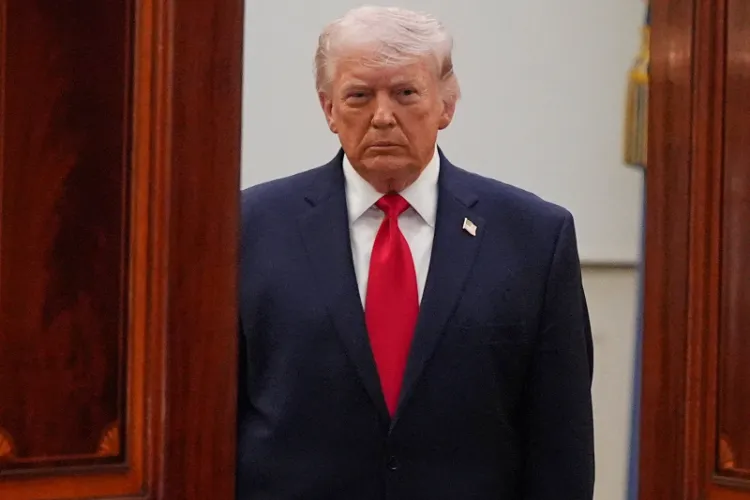
Equity markets across the globe came under pressure on Tuesday, with US futures tumbling and European stocks falling sharply amid rising tensions triggered by US President Donald Trump’s renewed tariff threats linked to Greenland.
Major European indices were deep in the red in early trade. France’s CAC 40 dropped 1.2 per cent to 8,014.42, Germany’s DAX fell 1.5 per cent to 24,581.44, and Britain’s FTSE 100 slid 1.3 per cent to 10,068.04.
US markets were also set for a weak opening, with futures for the S&P 500 down 1.8 per cent and Dow Jones Industrial Average futures lower by 1.6 per cent.
Market jitters followed Trump’s remarks over the weekend that the US would impose a 10 per cent import tariff from February on goods originating from Denmark, Norway, Sweden, France, Germany, the UK, the Netherlands and Finland. The proposed tariffs were framed as retaliation for opposition to American control over Greenland.
The comments sparked diplomatic unease across Europe, with governments weighing possible responses. Discussions reportedly include retaliatory trade measures and even the potential use of the European Union’s anti-coercion mechanism for the first time.
Seeking to calm markets, US Treasury Secretary Scott Bessent said on the sidelines of the World Economic Forum in Davos that ties between the US and Europe remain solid. He urged partners to remain patient and allow the situation surrounding the Greenland-linked tariff threats to unfold.
Asian markets also traded lower. Japan’s Nikkei 225 fell 1.1 per cent to 52,991.10 after Prime Minister Sanae Takaichi announced a snap election scheduled for February 8.
Bond markets in Japan reacted sharply, with yields on long-term government bonds surging. Takaichi’s move to seek a fresh mandate, combined with proposals to temporarily suspend food taxes, raised concerns over increased government spending and fiscal pressures.
The yield on Japan’s 40-year government bond climbed to a record 4 per cent, while other long-dated bond yields also jumped to levels not seen in decades, reflecting heavy selling by investors.
Chinese stocks ended mixed, with Hong Kong’s Hang Seng slipping 0.3 per cent to 26,487.51, while the Shanghai Composite closed nearly flat at 4,113.65.
Elsewhere in Asia, South Korea’s Kospi declined 0.4 per cent to 4,885.75, Australia’s S&P/ASX 200 lost 0.7 per cent to 8,815.90, while Taiwan’s Taiex edged up 0.4 per cent. India’s Sensex fell 0.8 per cent.
“Geopolitical developments remain the dominant driver for markets, particularly any discussions emerging from Davos,” said Michael Brown, senior research strategist at Pepperstone.
Investors are also watching closely for a busy week of US corporate earnings and key inflation data used by the Federal Reserve to guide monetary policy.
The Federal Reserve is expected to keep interest rates unchanged at its next meeting in two weeks as it balances easing labour market conditions against inflation that remains above its 2 per cent target. The Bank of Japan’s policy meeting concludes later this week.
In commodity markets, US crude oil slipped 49 cents to $58.95 a barrel, while Brent crude fell 33 cents to $63.61.
ALSO READ: India, UAE signs deals to deepen partnership during MBZ's short Delhi visit
In currency trading, the US dollar weakened to 157.83 yen, while the euro strengthened to $1.1716.
















_(1).webp)