Pallab Bhattacharya
Kunki Chowdhury has burst onto the Assam political scene as the Assam Jatiya Parishad (AJP) candidate for the newly carved Guwahati Central constituency in the 2026 Legislative Assembly elections, facing off against BJP veteran Vijay Kumar Gupta in what has quickly become one of the most talked-about generational contests in the state.
The seat, encompassing bustling areas from Fancy Bazar to GS Road, pits her youthful energy and reformist ideas against decades of established political machinery, turning the race into a litmus test for whether fresh voices can break through in urban Assam.
At 27, Chowdhury is unapologetically Gen Z — a first-time candidate with no prior party affiliation who entered the fray after an unexpected invitation from the AJP. Born and raised in Guwahati, she is enrolled as a voter in the New Guwahati area and represents a generation that grew up with smartphones, global exposure, and frustration over everyday urban woes.
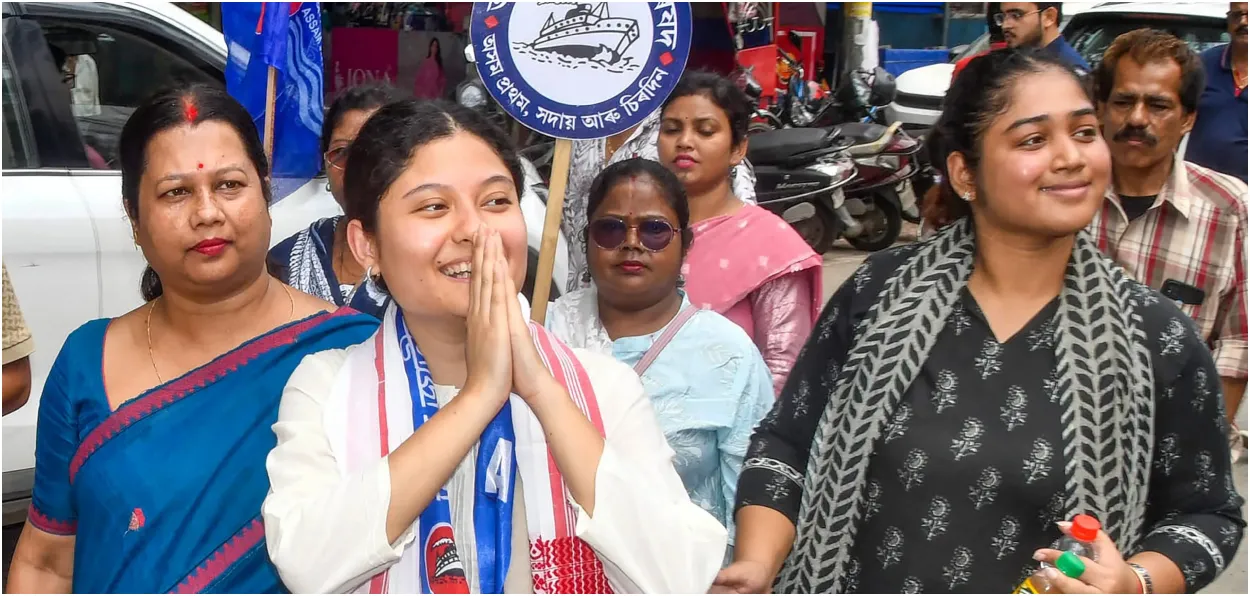
.jpg) Kunki Chowdhury in Guwahati
Kunki Chowdhury in Guwahati
Her rapid rise on social media, where she has built a strong following through short videos and direct appeals, has already made her a phenomenon among young voters who see in her a break from traditional politics.
Her educational journey reflects that global-local blend. After finishing school in Guwahati, she headed to Mumbai for studies at the Narsee Monjee Institute of Management Studies (NMIMS). She then earned a Master of Arts in Education Leadership from University College London in 2025, an achievement she financed largely through a ₹23.96 lakh education loan from the State Bank of India.
The Election Commission affidavit lists her qualification simply as “Post Graduate,” yet her UCL degree and the debt it carried underscore both ambition and the real financial struggles many young Indians face while chasing quality education.
Before politics came calling, Chowdhury spent around six years working with her family’s non-profit organisation in education and community service. She also gained professional experience at institutions such as Girijananda Chowdhury University in Assam. Her paternal side belongs to one of Guwahati’s long-standing business families, giving her deep roots in the city’s commercial and civic life, while she herself declares “private employment” as her profession with salary as her main income source.
 Assam Congress leader Gaurav Gogoi and AJP chief Lunrin Jyori Gogoi campaiging for Kunki Chowdhury in Guwahati
Her affidavit shows modest movable assets of just over ₹9 lakh, no immovable property, and no corporate directorship — painting the picture of a young professional rather than a business heir or career politician.
On her maternal side, Chowdhury carries a proud Gorkha lineage that has become central to her public identity. Her mother, Sujata Gurung Chowdhury, is the granddaughter of Barrister Ari Bahadur Gurung, who represented the Gorkha community in the Constituent Assembly and signed the Constitution of India in 1949.
The family has Gorkha-Assamese heritage as a symbol of constitutional patriotism rather than anything “outsider.”
The constituency itself, with nearly 1.9 lakh voters across more than 200 polling booths, mirrors the aspirations and frustrations of middle-class, business and students of Guwahati. Local problems like traffic snarls, waterlogging and parking shortages dominate conversations.
.webp) Kunki Chowdhury campaigning
Kunki Chowdhury campaigning
In just a few months, Kunki Chowdhury has gone from a young education professional with an overseas degree and a family non-profit background to Assam’s most visible Gen Z face in electoral politics.
Gyanashree Bora, affiliated to Raijor Dol, which is yet to be registered as a political party, from Mariani Constituency, is another young candidate with a PhD degree in Chemistry. Mariani is the home constituency of Raijor Dal chief Akhil Gogoi and Gyanashree is fighting against five-time MLA Rupjyoti Kurmi of the ruling BJP.
ALSO READ: Master Powerlifter Umaira lifts all social bars
Whether Kunki Chowdhury wins or not, her candidature has already injected fresh energy into the debate on generational change, regional identity, and the future of Guwahati’s governance. For many young Assamese, she is proof that global education and local roots can come together to challenge the status quo — one knock on every door at a time.
(The writer is a retired DGP of Assam Police)


_(1).jpg "Visitors gather at the Santosh Mitra Square Durga Puja pandal, themed on the 150th anniversary of Vande Mataram and its historic role in India's freedom movement, ahead of the festival, in Kolkata")

.jpg "Gujarat’s women entrepreneurs bring their craftsmanship to life during Navratri")









_(4).webp)
_(2).webp)