New Delhi
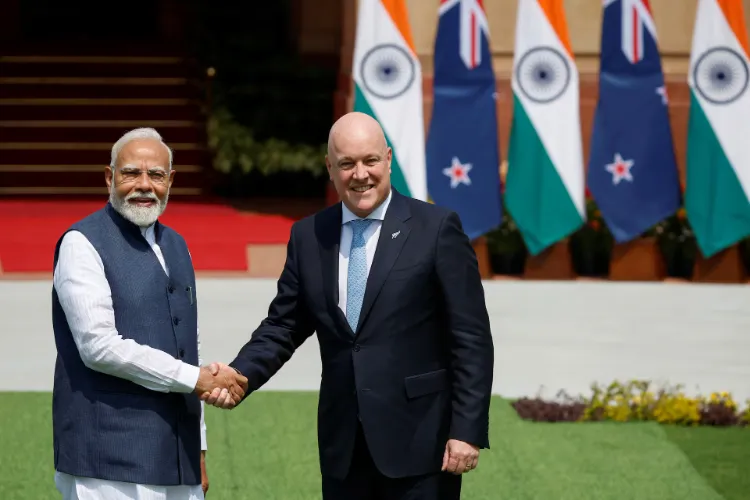
Prime Minister Narendra Modi and New Zealand Prime Minister Christopher Luxon on Monday announced the conclusion of a Free Trade Agreement (FTA), which they said would act as a catalyst for enhanced trade, investment and strategic cooperation between the two countries.
The two leaders spoke over the telephone and welcomed the conclusion of the agreement, negotiations for which were launched during Luxon’s visit to India in March 2025. They noted that the FTA was finalised in a record nine months, reflecting strong political commitment on both sides.
According to an official statement, the agreement is expected to significantly deepen bilateral economic engagement, improve market access, boost investment flows and create opportunities across sectors for businesses, farmers, MSMEs, students and professionals in both countries.
With the FTA as a foundation, the leaders expressed confidence in doubling bilateral trade over the next five years. New Zealand has also committed to invest USD 20 billion in India over a 15-year period, with the investment commitment backed by a rebalancing mechanism under which trade concessions may be suspended if targets are not met.
The agreement covers trade in goods and services, investment, mobility and trade facilitation. New Zealand has offered market access in 118 services sectors and MFN treatment in 139 services sectors, while India has extended market access in 106 services sectors and MFN treatment in 45 sectors.
A key feature of the agreement is enhanced mobility. New Zealand has agreed to provisions on student mobility and post-study work visas, including up to three years for STEM bachelor’s and master’s graduates and up to four years for doctorate holders. A temporary employment pathway allowing up to 5,000 Indian professionals in skilled occupations at any time has also been created.
In goods trade, India’s average MFN tariff of 16.2 per cent will reduce to 13.18 per cent upon entry into force of the FTA, to 10.30 per cent after five years and to 9.06 per cent by the tenth year. Market access has been provided on 70.03 per cent of tariff lines, while sensitive sectors such as dairy, sugar, select agricultural products, gems and jewellery, and metals have been excluded.
The leaders also welcomed progress in defence, education, sports and people-to-people ties, and reaffirmed their commitment to further strengthening the India–New Zealand partnership.
READ MORE: Young bride Mrs Yasim taught me differences can be celebrated
Bilateral merchandise trade stood at USD 1.3 billion in 2024-25, while total trade in goods and services was estimated at USD 2.4 billion in 2024.





.png)





.webp "Reserve Bank of India")

.webp "Representational image")