 Vidushi Gaur
Loreto Convent Intermediate College, Lucknow wasn’t just a school to me; it was my first lesson in how beautifully India could hold its differences without letting them turn into distances.
One memory, warm, colourful, and imposingly delicate, stays with me more than the rest. It belongs to my English teacher, Mrs Yasmin, who taught me far more than grammar, comprehension, and Shakespeare.
Unforgettable Experiences
I never questioned how natural it was to see girls of every religion, Hindu, Muslim, Christian, Sikh, stand together, sing in one voice, and bow their heads in prayer. It was routine, but it was also extraordinary.
.jpeg)
AI generated picture of a Muslim English teacher wearing Chooda, Sindoor and Mangalsootra
Mrs. Yasmin entered my life in Class 7, tall, graceful, with a voice that could make even the dullest poem sound like a secret being shared. She was Muslim, and everyone in school knew when she got married because for weeks, the staffroom was filled with congratulations and glowing compliments.
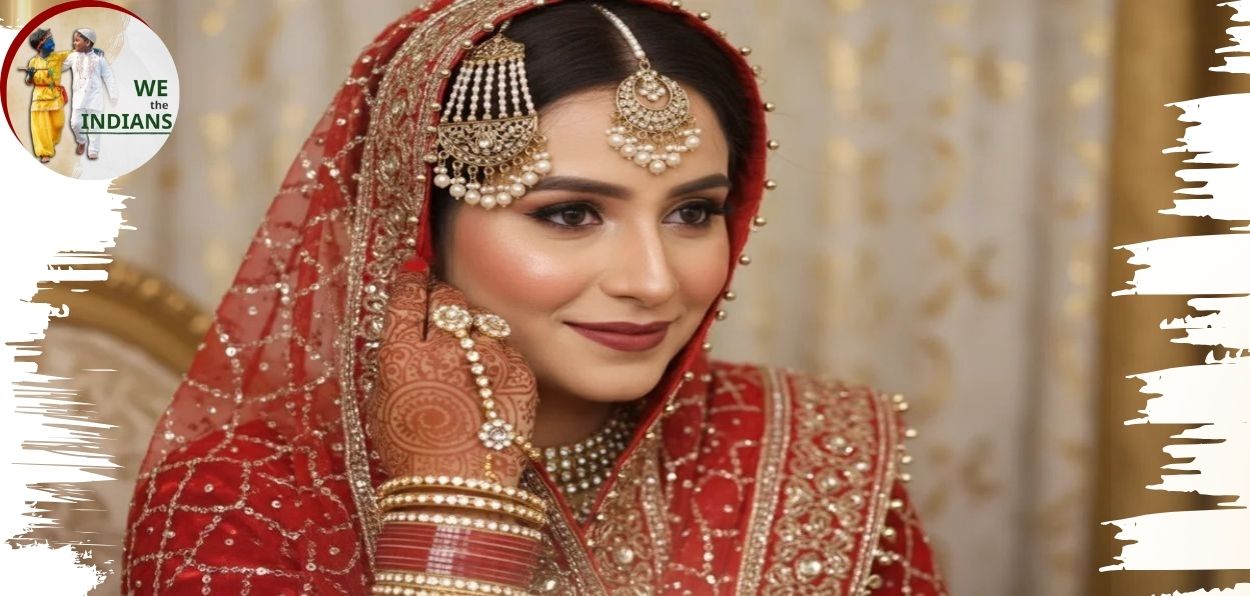
She had married in the traditional Muslim fashion, Nikah under a shimmering dupatta, hands adorned with beautiful henna. We had seen photographs of her wedding, she looked radiant, elegant, exactly as a Lucknawi bride should.
But what happened after her marriage is what left a mark on me.
A week after the wedding break, she returned to school. I remember sitting in the second row, swinging my legs under the desk when I saw her walk in. I noticed, the sindoor, a bright, confident streak of red down the middle of her hair. Red and white chooda, peeking from under her sleeves. And a mangalsutra, resting quietly against her pastel kurta.
It was a moment when the entire class blinked in unison. A sort of soft confusion floated in the air. We were too young to understand religious boundaries, but old enough to sense when something unusual had happened. One brave girl finally asked softly, “Ma’am… you… wore…?”
She smiled the kindest smile I have ever seen on a teacher. “Yes,” she said, touching the mangalsutra lightly. “I wore these because I find Hindu brides beautiful. The colours, the joy… I have always loved it.” There was no apology in her voice. No hesitation. Only affection. That day, she taught us Juliet’s balcony scene, but the real lesson was something else. She had married according to Muslim customs, as her family’s tradition. But she also embraced what she admired from another religion, not out of rebellion, but out of love. There was something profoundly simple and profoundly brave in that.
In a Catholic institution, here was a Muslim woman adorned like a Hindu bride and nobody stopped her, questioned her, or judged her. Not the Loreto Sisters who ran the school. Not the teachers. Not the students. In fact, I remember Sister Anne greeting her in the corridor with a warm, “You look lovely, dear.” That moment, that quiet acceptance, felt like Loreto itself was nodding approvingly.
.jpeg)
AI Generated picture of a Muslim bride wearing Chooda
As months passed, her bridal symbols stayed. She didn’t wear them every day, just when she felt like it. Some days she walked into class with her usual elegance; on others, she came in with a tiny dot of sindoor or a pair of red bangles that clicked gently when she turned the pages of our textbooks.
To me, those details became symbols of something bigger than ornaments. They were symbols of choice, admiration, and freedom. I remember asking her once, timidly, “Ma’am, doesn’t anyone mind?” She smiled and replied, “People mind when love is small. But when love is big, there’s room for everything.” I don’t know if she meant love between people, love between communities, or love for beauty, but I know that something inside me shifted that day.
Years later, when I read about divisions, arguments, or debates about what women should or shouldn’t wear, what belongs to one religion or another, I always return to her image, standing at the front of our class, chalk in hand, red bangles at her wrist, utterly unbothered by boundaries others imagined for her. She was proof that identity is not fragile. It doesn’t break when touched by colours from another culture. It grows.
Loreto Convent taught me English, mathematics, science, and discipline. But Mrs. Yasmin taught me how beautifully identities can mingle. She taught me that religions don’t clash, people do. Sometimes, a single person can show us how softly worlds can blend, how a streak of sindoor can sit peacefully beside the verses of the Quran, how bangles can chime in a school where hymns echo in the morning.
Even today, when someone asks me what communal harmony looks like, I don’t quote books or speeches.
ALSO READ: Cricket taught me to value human talent over caste and religion
I simply remember my English teacher, a Muslim woman in a Catholic school, wearing the adornments of a Hindu bride, standing tall, smiling, and teaching us not just literature, but the most colourful lesson of all--the beauty of coexistence.
Readers are welcome to share their experiences of communal harmony or interreligious friendship on [email protected] for publication - Editor

.jpg "Gujarat’s women entrepreneurs bring their craftsmanship to life during Navratri")









.webp)