




Thiruvananthapuram
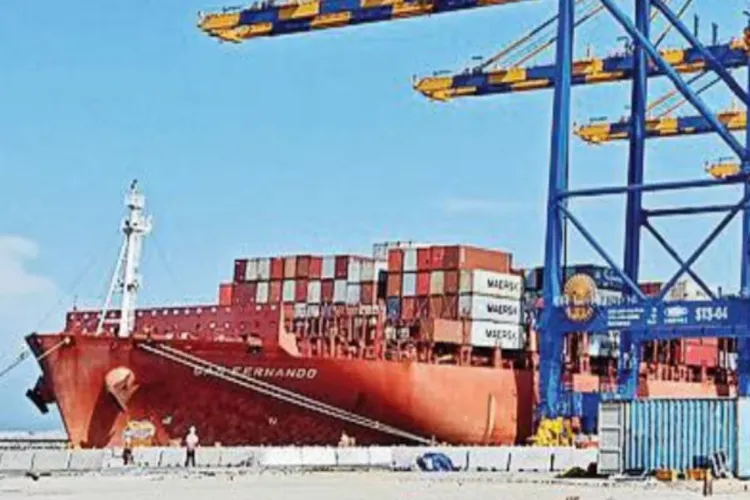
The commencement of full-fledged export-import (EXIM) operations at Vizhinjam International Seaport is expected to help India reduce its reliance on overseas transhipment hubs and retain a greater share of value from maritime trade.
More than 75 per cent of India's container transhipment cargo is currently handled through foreign ports, adding to logistics costs and transit time. Vizhinjam's EXIM operations are expected to help address this structural dependence and strengthen India's ability to retain greater value from its maritime trade.
The commencement of full-fledged Export-Import (EXIM) operations from Vizhinjam in Kerala is "a proud moment for us", Keralam Chief Minister VD Satheesan said on Tuesday and noted the state government will improve connectivity to the area.
EXIM operations mean handling cargo being exported from or imported into the country, in addition to transhipment between international shipping services.
"It is a proud moment for us and Vizhinjam is now a gateway to the world. The challenge before us is to make the most of this opportunity through Mission Samudra, with Vizhinjam as its base, stronger road and rail connectivity and greater private investment," he said.
"The government will allocate Rs 3,200 crore for land acquisition for the Ring Road, while discussions have already begun to bring in private investment," he added, according to a press note.
Ashwani Gupta, Chief Executive Officer (CEO) and whole-time Director, Adani Ports and Special Economic Zone Ltd. (APSEZ), India's largest integrated transport operator, said it is the opening of a "new gateway connecting Keralam's talent, India's enterprise and the aspirations of millions to global markets".
He said the port's purpose extends beyond cargo movement, serving India's aspirations for self-reliance, global competitiveness and maritime leadership. The Vizhinjam investment is part of the Adani Group's wider commitment to Keralam and its infrastructure-led growth, the note said.
With the Phase 2 investment, the Group's cumulative investment in the Vizhinjam project will reach Rs 30,000 crore, the largest investment committed by any business house in Keralam.
The investment reflects the Group's role in expanding critical infrastructure, strengthening connectivity and supporting a more conducive environment for business and investment in the state, the note said.
The shift to EXIM operations has wider implications for the efficiency of India's maritime trade. This arrangement can reduce reliance on overseas transshipment hubs, shorten transit time and improve supply chain efficiency.
The significance of Vizhinjam extends to India's maritime competitiveness. Located close to major East-West shipping routes, Vizhinjam has already demonstrated its ability to operate at global scale.
Commercial operations commenced on December 3, 2024 and the port has since handled more than 2.28 million twenty-foot equivalent units (TEUs) and 1,100 vessels, including over 80 Ultra Large Container Vessels (ULCVs). It crossed 1 million TEUs in just 10 months and 2 million TEUs in 18 months.
It also handled MSC Irina, a 399.99-metre vessel with a capacity of 24,346 TEUs, the largest container vessel to visit India.
The initial EXIM catchment covers Keralam, Tamil Nadu and Karnataka, giving businesses across South India more direct access to international shipping networks. The port is expected to support the competitiveness of manufacturing and commercial centres such as Bengaluru, Coimbatore and Tiruppur, while driving demand for logistics, warehousing, freight forwarding and related services.
The development is also expected to create more than 5,000 additional direct and indirect jobs, opening new opportunities across the wider maritime and logistics ecosystem.
READ MORE:Aisha Ayub's digital business hinges on peoples' power
The next phase will further expand Vizhinjam's capacity and supporting infrastructure. The Rs 16,000-crore Phase 2 expansion will raise annual capacity to 5.7 million TEUs, add 1,200 metres of container berth and bring permanent rail connectivity, enhanced road connectivity, logistics parks, warehousing and other supporting infrastructure. Accelerated full-phase development is targeted for December 2028.












.webp "US Ambassador to India Sergio Gor")
.webp "Representational Image")
_(1)_(1).webp)



.webp)
.webp)

_(1).webp)