Ashhar Alam/New Delhi
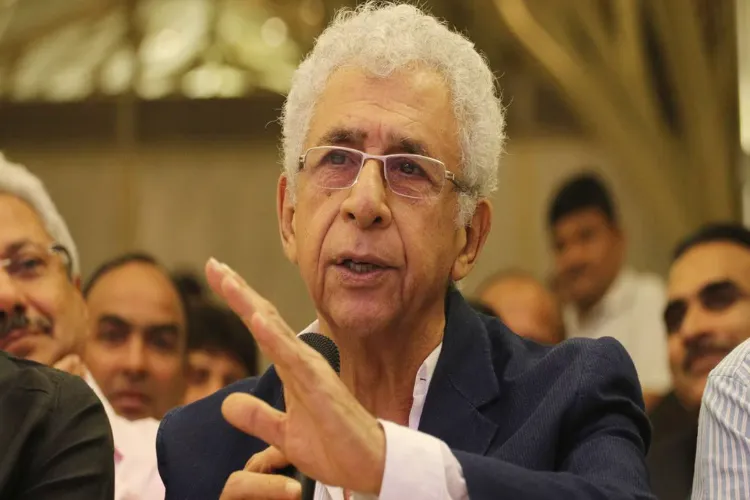
Veteran actor Naseeruddin Shah has sharply criticised Mumbai University after being dropped from a student event hours before it was to begin, calling the decision misleading, disrespectful and reflective of a deeper intolerance.
In a column published in a newspaper Shah said he was uninvited from the Jashn-e-Urdu programme organised by the university’s Urdu department on February 1, without any formal explanation or apology. He wrote that he was informed late on January 31 that his presence was no longer required.
What unsettled him further, Shah said, was the narrative presented to the audience. According to the actor, organisers announced that he had declined the invitation, a claim he flatly denied. “After telling me I needn’t attend, the university decided to add insult to injury by saying I had refused,” he wrote.
Shah, who has spent over four decades engaging with students across institutions, said the programme held special significance for him. Interacting with young people, he noted, has been among the most fulfilling aspects of his career, offering lessons that no formal acting classroom ever did.
The actor suggested that his removal had less to do with logistics and more with his public views. Referring to remarks allegedly made by a senior university official, Shah challenged the claim that he had made statements “against the country”, asking for a single instance where he had spoken ill of India.
He clarified that while he has never praised the self-styled idea of India as a “Vishwaguru”, he has consistently questioned the conduct of the Prime Minister and criticised the ruling establishment. Dissent, he argued, should not be equated with disloyalty.
In the article, Shah expressed unease over what he described as shrinking freedoms and a hostile environment for students and critics. Drawing a parallel with George Orwell’s 1984, he wrote that failing to glorify the “great leader” increasingly risks being branded as sedition, amid what he called constant surveillance and a climate of “round-the-clock hate”.
“This is not the country I grew up in and was taught to love,” Shah wrote, lamenting the rise of “thought policing” and doublespeak in public life.
The controversy comes amid a broader debate within the cultural sphere. Recently, composer A.R. Rahman sparked discussion after telling the BBC Asian Network that his reduced presence in Bollywood reflected growing corporate control and hinted at communal undertones in the industry.
Reactions were swift and divided. Lyricist Javed Akhtar suggested filmmakers might simply feel intimidated approaching a figure of Rahman’s stature, while director Subhash Ghai dismissed the remarks as overstated.
ALSO READ: Teacher Irfana Tabassum revives defunct schools in Kashmir
Following boycott calls, Rahman issued a clarification on Instagram, reiterating that India remains his inspiration and that his comments were misunderstood. “I feel blessed to be Indian,” he wrote, adding that the country allows him the freedom to create and celebrate its multicultural voices.
Together, the episodes have reignited conversations about artistic freedom, dissent, and the space for critical voices in today’s India.