.webp "Shrine of Bulbul Shah, Srinagar, J&K")
Ehsan Fazili/Srinagar
Tucked away in the narrow lanes of downtown Srinagar, about 50 yards from the historic Nawakadal bridge, stands the shrine of Syed Sharf-ud-Din Abdur Rahman, popularly known as Bulbul Shah, the first Sufi saint to introduce Islam in Kashmir. Situated on the right bank of the river Jhelum (Veath) at Bulbul Lankar, the shrine marks the site where the Valley's first langar was established in the early 14th century as part of the Sufi tradition of hospitality and service.
The locality derives its name from the saint, whose memory is preserved through what is regarded as Kashmir's first Khanqah. Today, the shrine remains an active centre of spiritual devotion, attracting devotees mainly from within the Valley. It stands diagonally opposite Government Women's College, Nawakadal, across the bridge from the site where the palace of the Buddhist ruler Renchan Shah once stood. A narrow lane passing the shrine leads to Maharaj Gunj, Srinagar's historic wholesale market established in 1871.
_(1).webp)
“It has been 59 years since Shah-e-Hamadan (Mir Sayyid Ali Hamadani) that Bulbul Shah arrived in Kashmir”, said a senior member of the Managing Committee at the shrine. Three prominent scholars and Sufis who arrived in Kashmir before Shah-e-Hamadan to spread Islam in the Valley included Bulbul Shah (Syed Sharf-ud-Din Abdur Rahman) of the Suhrawardy order, Syed Tajuddin, sent by Shah-e-Hamadan as a precursor to scout the region, and Mir Sayyid Hassan Semnani, another close companion and emissary of Shah-e-Hamadan.
A black marble plaque at the entrance to the shrine bears inscriptions in Urdu and English recounting the saint's arrival and his contribution to the spread of Islam in Kashmir. It states:
“Syed Sharf-ud-Din, commonly known as Bul Bul Shah Sahib, was the disciple of Shah Niamat-Ullah Farsi, who in turn was the disciple of Sheikh Shihab-Ud-Din Suharwardi. Syed Sharf-Ud-Din was originally from Turkistan. Following the wishes of his preceptor, Syed arrived in Kashmir during the reign of (Raja) Sahadeva (AD1301-1320). Syed Sharf-ud-Din is the first known Sufi saint of Kashmir. His most important contribution is that he converted the reigning Buddhist ruler of Kashmir, Rinchan Shah (AD 1320-1323) to Islam. To pay tribute to his memory, Rinchan (now Sadr-Ud-Din) constructed a Khanqah after his name and endowed it with a rent-free land grant. It is the first Khanqah in Kashmir, and its Langar became so famous that the Mohalla where it was built came to be known as Bul Bul Lankar.
_(1).webp)
The annual Urs of Bulbul Shah is observed on the 7th of Rajab in the Islamic calendar and draws large numbers of devotees, mostly from Kashmir. It includes special prayers followed by Moulud the next day. Similar prayers are held on the seventh day of every Islamic month, said Owais Kareem Kanue, President of the Managing Committee.
Hundreds of men and women visit the shrine during these occasions and on other important religious days. The Intizamia Committee manages the shrine's upkeep, organises sermons and food distribution, displays relics, and runs a Darasgah where around 40 children are currently enrolled.
Devotees offer prayers daily, with separate access for women to the Roza (mausoleum) of the saint. Beside Bulbul Shah's grave lies that of Mulla Mohammad Ahmad, the saint's maternal uncle and spiritual guide.
According to Javed Ahmad Mattoo, a senior member of the Organising Committee, a family from Saharanpur in Uttar Pradesh, tracing its lineage to the Suhrawardy order, visited the shrine last year. Followers of the order from different parts of India also visit the shrine from time to time.
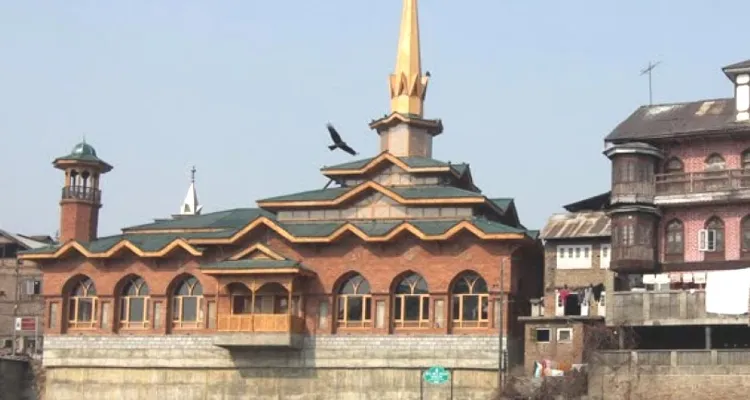
The Khanqah-e-Bulbul Shah consists of three main structures. The principal shrine, rebuilt with assistance from the Jammu and Kashmir government after work began in 2006, houses the mausoleums of Bulbul Shah and his spiritual guide. In the lawns overlooking the Jhelum stands the cenotaph of Renchan Shah, who embraced Islam and became Sadr-ud-Din. According to local residents, the cenotaph, now enclosed within a tomb structure, was rediscovered by the Department of Archives around 1990.
Adjacent to it stands Masjid-e-Hanfia, built at the site of the original Khanqah established during Renchan Shah's reign. The Khanqah underwent several reconstructions over the centuries and was reportedly destroyed in a fire during the 20th century.
“The Khanqah had been burnt in my early childhood….and we as children would play around the site”, recalls Ali Mohammad Wani, a senior member of the eight-member Intizamia Committee.
_(1).webp)
According to the epitaph, the original Khanqah was constructed in 720 Hijri (1320 AD), while the present mosque structure dates to 1399 Hijri (1979 AD).
Bulbul Shah was born into a Uyghur Muslim family in the 13th century. He studied Sufism under renowned scholars, including Shahabuddin Suhrawardi and Syed Shah Niamatullah, before undertaking missionary work to spread Islam through the Sufi path. Under what is believed to have been a spiritual command, he arrived in Kashmir around 1302 CE. He passed away in 1327 CE (726 AH) and was laid to rest beside his Khanqah at present-day Bulbul Lankar.
ALSO READ: Hari Parbat: Where temple, khanqah and Gurudwara coexist
A popular anecdote explains how he came to be known as Bulbul Shah. It is said that while performing ablution on the banks of the Jhelum, he saw a nightingale (Bulbul in Persian). His disciples interpreted the bird's flight and disappearance as a symbol of his soul's spiritual ascent. He is then believed to have demonstrated a mystical experience to one of his followers, after which he came to be popularly known as "Bulbul Shah."

.webp "Representational Image")







.webp)