 Saquib Salim
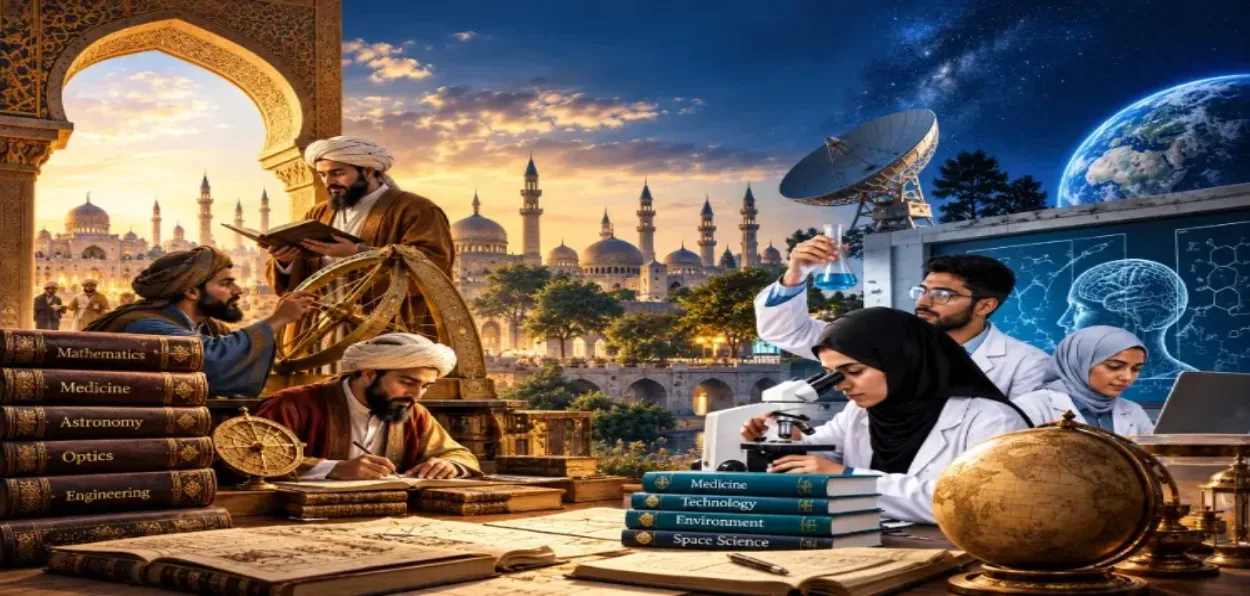
Popular discourse has often attempted to push Islam and reason into opposing camps. Yet, when we examine the intellectual heritage of Islam, we see that Islam and modern science have never been natural opponents.
Across historical accounts, theological inquiries, and contemporary studies, we find that science was not seen as a secular intruder threatening religious dogma, but as a direct extension of spiritual devotion.
Historian Ehsan Masood notes that in classical Arabic, there was no separate word for "science" as the term is used today. Scholars relied on the word ilm, meaning "knowledge," a concept that covered "knowledge of the natural world, as well as knowledge of religion and other things."
Writers who use the term in this classical sense treat it as proof that "science and faith are two sides of the same coin."
Professors Ali Ünal and M. G. El-Fandy both illustrate this through the enduring image of the "two books."
Drawing upon the Turkish thinker Said Nursi, Ünal calls the physical universe "the Qur'an of Creation" and the scripture the "Recorded Qur'an." He argues, "Just as there can be no conflict between a palace and the paper written to describe it, there can also be no conflict between the universe and the Qur'an."
El-Fandy independently reaches the same conclusion, identifying the universe as one of "the two books of Allah" alongside the Quran itself.
This perspective traces directly back to the first words revealed to the Prophet, commanding him to "Read" in Quran 96:1 to 3. At that moment, as Ünal observes, "there was nothing yet to read," making it a direct command to study the workings of creation.
The grammar of the Arabic language reinforces this. The word for a Quranic verse, ayah, is identical to the word used for "events taking place within the souls of men and phenomena in the world of nature." To observe nature is to read scripture in another form.
When this Islamic framework was translated into scientific practice, India provided much of its vital material. The classical Islamic scientific renaissance did not develop in a vacuum; it actively drew upon the rich knowledge of ancient Indian scholars.
In the eighth century, under Caliph al-Mansur, the astronomer al-Fazari translated an ancient Indian astronomical work by Brahmagupta known as the Sindhind. Masood records that this translation "brought Indian numerals into the Arabic world for the first time."
The ninth-century mathematician al-Khwarizmi, founder of algebra, built directly on this foundation. His treatise on Indian numerals established the positional system that centuries later reached Europe.
Masood reminds us that "What the Western world calls Arabic numerals are known as 'Indian numerals' in the Arabic language." The decisive breakthrough in this mathematical transmission was "the concept of zero," an element absent from Roman numerals and essential to every subsequent advancement in Islamic mathematics and astronomy. Al-Khwarizmi integrated the wisdom of mathematicians from India, such as Brahmagupta, and Greek thinkers like Euclid.
A century later, the scholar al-Biruni produced his famous study of Indian civilisation and science, titled India, alongside his Determination of the Coordinates of the Cities. For al-Biruni, studying the natural world and foreign civilisations was an act of worship.
Mehdi Golshani notes in Muzaffar Iqbal's volume that al-Biruni argued that anyone seeking to distinguish truth from falsehood "has to study the universe and find out whether it is eternal or created," because doing so "paves the way for knowing the Being Who directs and controls the universe."
In this environment, scientific discovery carried no inherent threat of heresy. As El-Fandy points out, while Western history recorded the 1615 trial and condemnation of Galileo for adopting Copernican astronomy, Islamic history saw no such persecution: "Nothing of the above-mentioned sort of accusation occurred in the Muslim countries."
If Islam and science shared such a harmonious past, why did friction appear in later periods? In India, historical records reveal that resistance to modern scientific institutions arose primarily from colonial politics rather than religious doctrine.
When British authorities phased out Persian and Arabic instruction in favour of English, Sir Syed Ahmad Khan established a scientific society and later a university modelled on Oxford and Cambridge at Aligarh. Sir Syed defended modern learning by pointing to early Islamic translators who adopted non-Muslim scholarship, remarking, "And the Greeks didn't even believe in God."
Where resistance occurred, it was intertwined with anti-colonial sentiment. When Nawab Aliuddin, a ruler of an Indian princely state, rejected the telescope, stating "there is much fallacy in a telescope… I would not hold the evidence of all the telescopes in the world as anything against one word uttered by the humblest of the prophets," his stance expressed deep distrust toward foreign authority.
Similarly, during plague epidemics, when Indian Muslims relied on Unani medicine "based on a combination of Ibn Sina's Canon of Medicine and the more faith-based Medicine of the Prophet," resistance to British vaccination drives was tied to political opposition rather than a blanket rejection of medicine. Masood observes, under colonial rule, the voice of science became tied "to the blade of a ruler's sword."
This synthesis of faith and intellect continued into the modern age. The Pakistani physicist Muhammad Abdus Salam, who shared the 1979 Nobel Prize in Physics with Steven Weinberg, stands as a prime example. Salam was a devout believer, while Weinberg was a devout atheist. Masood writes that "the individual beliefs of scientists have no bearing on the nature of what it is that they are investigating."
Salam questioned religious leaders who neglected scientific education, asking why sermons failed to encourage scientific study "considering that one eighth of the holy book speaks of science and technology," only to be told that preachers "only know the science of the age of Avicenna."
Today, this tradition remains active in India through scholars such as Mohammad Zaki Kirmani, Mohammad Riaz Kirmani, M. Kaleemur Rahman, and many others, who continue to explore the intersection of scientific methodology and ethics. Mohammad Zaki Kirmani asserts, "Islamic science is therefore simultaneously both science and ethics."
The dialogue between science and Islam shows a vibrant scholarly tradition rather than a rigid dogma. While scholars like El-Fandy highlight what they describe as the "scientific miracle" of the Quran, other contemporary thinkers like Ziauddin Sardar debate the philosophical assumptions underlying modern scientific neutrality.
ALSO READ: Indonesia: Ganesha atop Mount Bromo volcano is worshipped
All these historical and modern accounts demonstrate that across classical vocabulary, early Indian mathematical translations, the reforms of Sir Syed Ahmad Khan, and the work of modern Nobel laureates, science was never viewed as a rival to Islam. It was understood as a profound extension of religious duty, seeking truth across both books of creation.

.webp "Representational Image")









.webp)