Mansooruddin Faridi/New Delhi
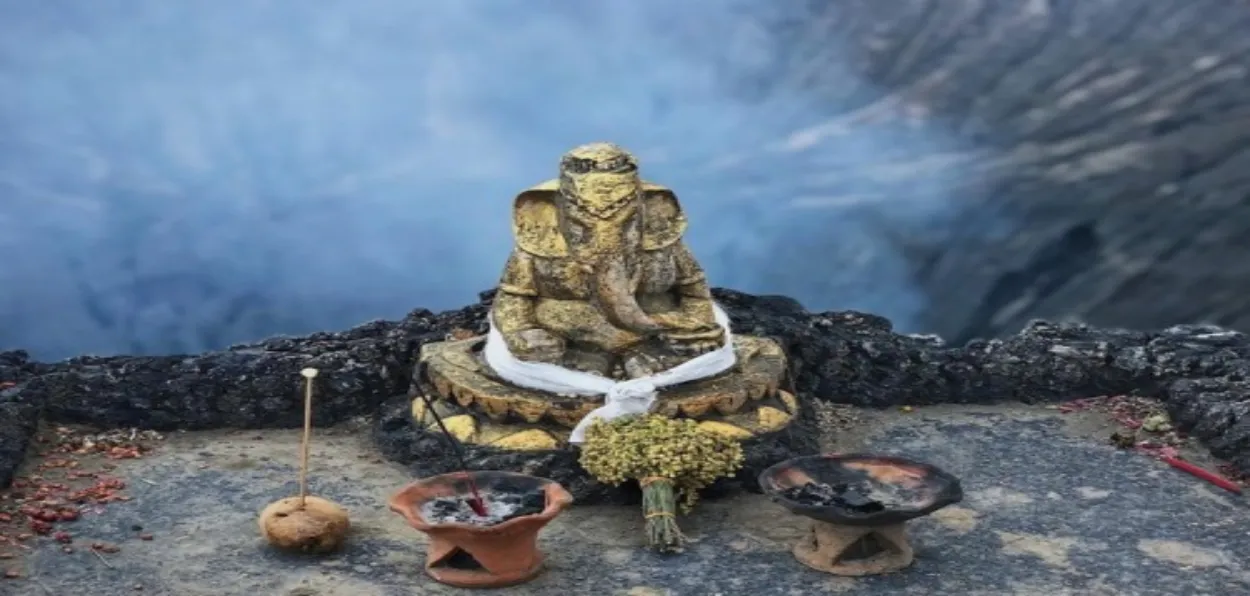
High above the volcanic landscape of East Java, Indonesia, where smoke can rise from the earth and the ground beneath one’s feet is part of an active volcano, stands an unlikely guardian: a centuries-old statue of Lord Ganesha.
The Hindu deity is worshipped on the slopes of Mount Bromo, one of Indonesia’s active volcanoes. At an altitude of around 2,329 metres (7,641 feet), the idol has become more than a religious symbol. For the Tenggerese people who live around the volcano, it is part of a living tradition that connects faith, ancestry, nature and survival.
According to local tradition, the Ganesha’s statue has stood here for about 700 years. Devotees continue to offer fruit, flowers and incense, seeking blessings and protection from the forces of the volcano. The belief that Ganesha, regarded in Hindu tradition as the remover of obstacles, can protect the community from volcanic destruction has given the statue a special place in local religious life.
The setting itself makes the tradition remarkable. Mount Bromo is not a dormant relic of the past. It is one of Indonesia's many active volcanoes and forms part of the Bromo Tengger Semeru National Park. The mountain's name is derived from Brahma, one of the principal deities of Hinduism, whose name is rendered locally as Bromo.
 Lord Ganesha atop Mount Bromo, Java, Indonesia
Yet the significance of the place goes beyond a single statue.
It opens a window into an older Indonesia, one in which Hinduism and Buddhism shaped kingdoms, languages, literature, architecture and popular traditions long before Islam became the dominant religion across much of the archipelago.
It also tells us a lot about Indonesia, the world's largest Muslim-majority country,where Islamisation did not erase the civilisation that preceded it.
The people most closely associated with Mount Bromo are the Tenggerese. They are an ethnic community whose traditions preserve elements of the Hindu-Buddhist culture associated with the old Majapahit world.
The Indonesian government's tourism authority describes the Tenggerese as descendants of the Majapahit era and notes that their religious traditions combine Hindu beliefs with elements of Buddhism and older local practices. They worship Ida Sang Hyang Widhi Wasa as the Supreme God and also revere the Hindu trinity of Shiva, Vishnu and Brahma.
This mixture is particularly visible during Yadnya Kasada, the community's best-known annual religious ceremony.
 The volcanic crater of Mount Bromo
On the 14th day of the Kasada month in the traditional Tengger calendar (coinciding with Ganesh Chaturthi), devotees gather at the foot of Bromo at Pura Luhur Poten, a temple built from dark volcanic stone.
The ceremony is rooted in a centuries-old legend concerning Roro Anteng and Joko Seger, the ancestral couple associated with the Tenggerese. According to the story, the couple prayed for children and were granted 25, on the condition that their youngest child would ultimately be offered to the mountain. The legend remains central to the ritual tradition of the community.
Modern offerings are, of course, different from the sacrifice described in the legend. Today, the ritual involves agricultural produce, flowers, money and livestock.
In 2016, for example, the ritual continued even when Bromo was erupting and volcanic ash was filling the air.
 Tenggerese.People
The scale of Indonesia's Hindu-Buddhist heritage is evident in its great monuments.
UNESCO describes Prambanan as the largest temple compound in Indonesia dedicated to Shiva. Built in the 9th and 10th centuries, its temples contain reliefs depicting the Ramayana and are dedicated to Shiva, Vishnu and Brahma.
UNESCO also notes that the wider Prambanan complex contains Hindu and Buddhist monuments, reflecting the religious and cultural complexity of ancient Java.
Across Java and other parts of the archipelago, traces of the Hindu and Buddhist past remain visible in temples, literature, performing arts, place names, rituals and popular culture. The Tenggerese are one particularly striking example of how an ancient religious tradition survived within a predominantly Muslim society.
Indonesia's story is therefore not one of one religion replacing another and the earlier culture disappearing. It is considerably more complex.
Islam became the dominant faith across much of the archipelago, but older Hindu-Buddhist traditions survived in particular regions and communities. The Tenggerese of East Java are one example; Bali, where Hinduism remains the majority religion, is another.
 A lake made with rainwater filling the crater atop Mount Bromo
Even within Tenggerese religious practice, the boundaries between traditions are historically fluid. Their beliefs incorporate Hindu concepts alongside elements associated with Mahayana Buddhism and older local practices. Indonesia's official tourism material itself describes this distinctive combination.
That layered history is important because it challenges the idea that civilisations exist in sealed compartments.
A Ganesha statue beside an active volcano in a Muslim-majority country may initially appear to be an oddity. In reality, it is a reminder of how cultures evolve: older traditions can survive, change and acquire new meanings without necessarily disappearing.
The Ganesha of Mount Bromo therefore tells several stories at once.
In Indonesia, where Islam, Hinduism, Buddhism and older indigenous traditions have left their marks on the same civilisation, the Ganesha statue is a small but powerful reminder that history does not always disappear.
ALSO READ: 'Khanqahs in Kashmir have been turned into pilgrimage centers'
Sometimes, it continues to live — in a ritual, a story, a language, a monument or a solitary deity watching over an active volcano.

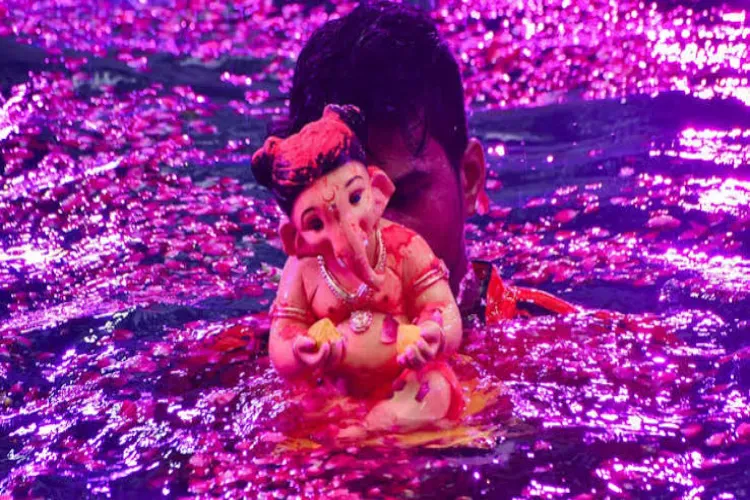
.webp "Representational Image")






.webp)