Kolkata (West Bengal)
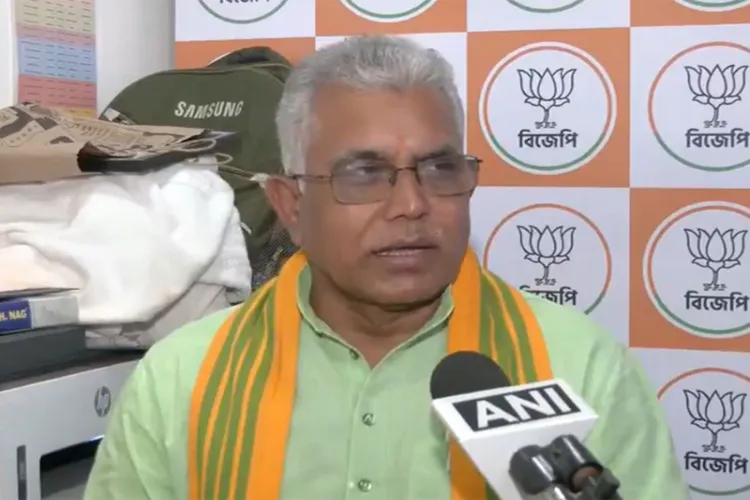
Following the BJP's stunning performance in the West Bengal Assembly Elections, senior BJP leader and MLA-elect from Kharagpur Sadar, Dilip Ghosh, stated that the party has an abundance of experienced leadership to take the role of Chief Minister, and the decision of the party leadership would be final.
BJP is set to form its first government in the state after securing more than 200 seats in the polls.
Speaking to ANI, Ghosh promised that the party would focus on administration and development in the state.
"We have 208 MLAs. Anyone among them can be the Chief Minister...There is no dearth of workers in the BJP. All of them are experienced. The decision by the party will be supreme. Everyone will work together towards providing good governance," he said.
Expressing gratitude to the people of West Bengal, he said that it was the result of 75 years of "Tapasya", recalling the efforts of Bhartiya Jana Sangh's founder, Syama Prasad Mookerjee and claimed that around 300 BJP workers were "sacrificed" in political violence in the last decade for this victory.
"Gratitude to the people of Bengal for their mandate. I had said that there has been tremendous voting, so the victory will be thumping too. People in Bengal make the victorious side get 200 plus seats. We did a 'tapasya' for 75 years for this to happen - from Dr Syama Prasad Mookerjee till date. In last 10 years, around 300 party workers have sacrificed themselves due to political violence. After this 'tapasya' and 'pariksha', people have accepted us and we will meet their expectations," he said.
Syama Prasad Mookerjee was a pivotal figure in the fight against the "United Bengal" plan, which was proposed by Huseyn Shaheed Suhrawardy, then Premier of Bengal. Mookerjee's opposition to this plan was rooted in his belief that it posed a significant threat to the Hindu-majority regions of Bengal, including Kolkata, and would lead to the erasure of Bengal's cultural and civilizational heritage. He mobilized public opinion, warned the Congress leadership, and argued forcefully for the partition of Bengal to ensure that its Hindu-majority regions remained part of India. His efforts were instrumental in derailing the "United Bengal" scheme and securing West Bengal's inclusion in the Indian Union.
The Indian Express
In 1947, Syama Prasad Mookerjee was the decisive voice against the "United Bengal" plan proposed by Huseyn Shaheed Suhrawardy, then Premier of Bengal. Mookerjee successfully argued forcefully for the partition of Bengal to ensure that its Hindu-majority regions remained part of India. His efforts were instrumental in derailing the "United Bengal" scheme and securing West Bengal's inclusion in the Indian Union. After resigning from Nehru's cabinet in 1950, Mookerjee collaborated with MS Golwalkar (RSS) to create a political alternative. In 1951, he founded the Bharatiya Jana Sangh, the direct organisational ancestor of the modern-day BJP.
Dilip Ghosh secured victory with a margin of 30,506 votes against Trinamool Congress' Pradip Sarkar, receiving a total of 89,885 votes. BJP's victory in West Bengal marks a significant moment for the party as it has been for long a marginal player in the state dominated for years by the Congress, Left parties and later Trinamool Congress.
According to ECI data, the BJP won 207 seats in West Bengal, performing way better than in the 2021 assembly elections, in which they won 77 seats.
READ MORE: Firdous Khan's journey is a blend of literature and journalism
Trinamool Congress, which swept the last assembly poll by winning 212 seats, finished a distant second with 80 seats.
Meanwhile, the repolling for the Fatla assembly constituency is scheduled for May 21, with counting of votes on May 24.








.webp "Uttar Pradesh Chief Minister Yogi Adityanath")



_(1).webp)