




Kochi
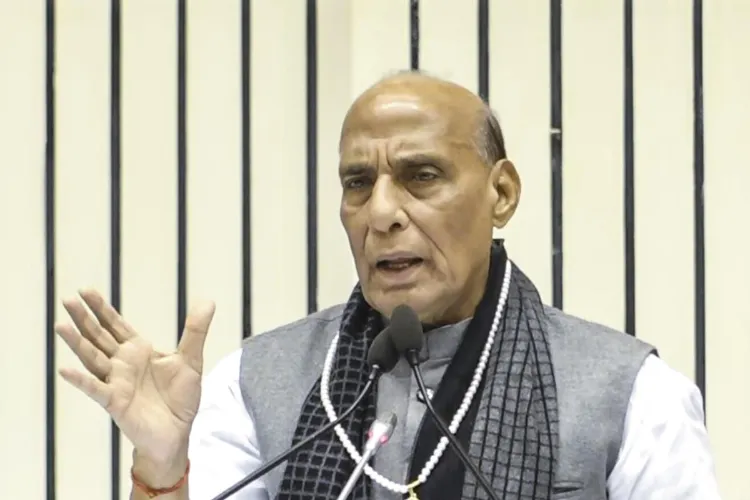
Defence Minister Rajnath Singh on Friday said India attained political independence in 1947, but its cultural and civilisational renaissance remained incomplete, alleging that some in power at the time considered Indian culture "inferior".
Addressing the national conclave, “One Epic, Many Stories: Ram Katha Across Bharat and Beyond”, organised by Malayalam daily Janmabhumi here, Singh said that even after Independence, there was opposition to then President Rajendra Prasad attending the inauguration of the rebuilt Somnath Temple.
“Imagine, on the occasion of the inauguration of the rebuilt Somnath Temple, the visit of the then President Dr Rajendra Prasad was opposed,” he said.
Singh said Independence was expected to allow the “soul” of a nation suppressed for a long time to find expression, and questioned why it took seven decades after Independence for the Ram temple to be built.
“Who is a greater symbol of India's soul than Shri Ram? No one. Then why did it take seven decades after independence for Lord Shri Ram's temple to be built? Why were questions raised about the very existence of Lord Ram?” he said.
He attributed this to what he described as “the politics of appeasement” and “a distorted concept of secularism imposed on India”.
Singh said the Indian civilisational principle was “Sarva Dharma Samabhava”, or equal respect for all faiths, and argued that a concept of secularism that viewed religion as an opponent of the state and politics was not suited to the Indian way of life.
He alleged that, under Western secularism, religion was presented as communalism, tradition as backwardness, faith as fanaticism and belief as superstition.
“This was never the vision of India's freedom fighters,” Singh said, citing freedom fighter K M Munshi and Constituent Assembly member H V Kamath in support of his argument that a secular state need not be anti-religious or Godless.
Singh said the country was now undergoing the cultural and civilisational renaissance that, according to him, had remained incomplete after Independence.
“Today, under the leadership of our Prime Minister Modi ji, India is witnessing a cultural and civilisational renaissance, and today we are shedding the colonial mindset and moving forward rapidly,” he said.
He said greater efforts were needed to make the younger generation aware of India's culture and civilisational heritage, claiming that such awareness would strengthen national consciousness and contribute to India's economic, social and political progress.
He then invoked nine qualities associated with Lord Ram as “Maryada Purushottam” and said adopting these virtues could help India become a developed and great nation.
“I have no doubt that these nine qualities will transform India into a great and developed nation,” Singh said.
Singh said India had faced despair and frustration before 2014 due to corruption and misgovernance, but the government under Modi had prepared a roadmap to overcome these challenges.
He said India had turned crises such as the Covid-19 pandemic and global wars into opportunities and continued moving towards self-reliance and development.
Singh cited Operation Sindoor and said India had demonstrated its ability to cross borders to eliminate threats. He also said Naxalism had “come to an end”.
He cited India's achievements in tackling climate change and its supply of more than 300 million vaccine doses to over 100 countries.
Singh said India's youth were building startups and unicorn companies and contributing to the country's development.
He said compassion was reflected in efforts to improve people's lives and claimed that more than 250 million people had been lifted out of poverty over the last 10 to 12 years.
Singh cited UPI as an example of India's ability to inspire the world, saying it had become the world's largest real-time payment system and had been adopted by more than 10 countries.
On India's growing capabilities, Singh said indigenous defence production had increased from around Rs 40,000 crore to Rs 1.80 lakh crore, while defence exports had risen from Rs 600 crore to Rs 40,000 crore, with Indian defence products being exported to nearly 100 countries.
He said India's prosperity was reflected in schemes such as Ayushman Bharat, Lakhpati Didi, Pradhan Mantri Awas Yojana, Jal Jeevan Mission and Ujjwala Yojana.
Singh spoke about Keralam's connection with Lord Ram and the Ramayana, saying the state was referred to as Parashurama Kshetra in the Puranas and that Parashurama and Lord Ram were considered avatars of Lord Vishnu.
“In this way, Keralam has a very deep connection with Lord Ram,” he said, adding that even today, families in Keralam traditionally gather in the evening, light the Nilavilakku and chant the name of Lord Ram.
READ MORE:Can Muslims flourish under non-Muslim rule?
Singh appreciated Janmabhumi and highlighted journalism's role in raising public awareness. He also referred to the 1975 Emergency, noting that journalists and publications had worked to defend democracy and the Constitution despite censorship.
BJP state president Rajeev Chandrasekhar and party leader P K Krishnadas were also present at the event.

.webp "Union Home Minister Amit Shah")





.webp "The Delhi High Court")

.webp)