New Delhi
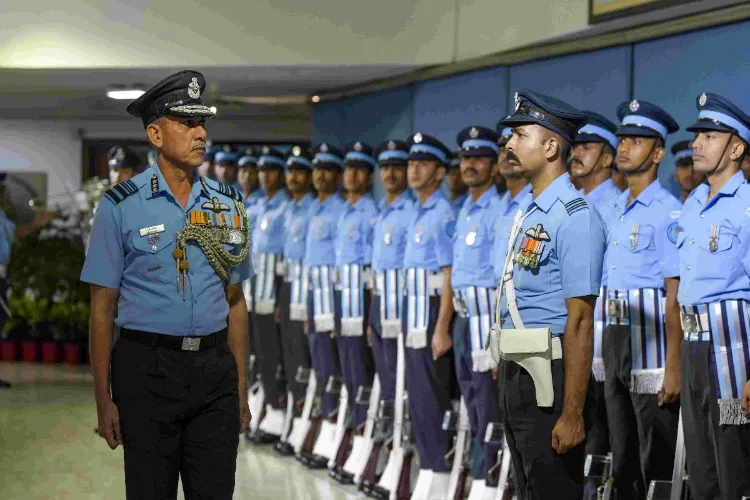
Vice Chief of Air Staff Air Marshal Narmdeshwar Tiwari on Monday urged private defence companies to concentrate on their core strengths rather than attempting to diversify excessively, stressing that India’s defence ecosystem will advance only when industry players become global specialists in their chosen domains.
Speaking at a seminar on defence partnerships at the Manekshaw Centre, organised by the Centre for Aerospace Power and Strategic Studies and Indian Military Review (IMR), Air Marshal Tiwari said major companies should evolve into “integration houses” and work in sync with MSMEs and niche suppliers rather than trying to build all technologies in-house.
“There is a tendency to dabble in too many things at the same time. It eventually makes you lose focus,” he cautioned. “Please focus on niche areas — preferably one or two — where you have strength, instead of spreading yourself too thin.”
Next-gen capability, man-unmanned teaming
Emphasising the need to future-proof platforms already in service, the Air Marshal highlighted that the next phase of capability enhancement will revolve around integrating next-generation weapons and systems across aircraft and platforms.
“We need to make our current platforms capable of taking next-generation weapons with interoperability, inter-linking and data-linking — so that you can have man-unmanned teaming functioning,” he said. Artificial intelligence-enabled systems and unmanned teaming, he added, will be “a big thing in the future”.
The VCAS pointed to Europe’s defence manufacturing model as an example worth emulating. “They make very niche equipment, but they are so good that major aerospace firms require them. That is the direction we need to move in,” he said.
Opportunities in engines, weapons and drones
Air Marshal Tiwari highlighted aero-engine components and precision-guided weapon systems as major areas where the private sector can expand without depending solely on government research bodies.
“Whether it is pumps, combustion chambers, fuel injectors — a lot of these can be developed from scratch. There is enough opportunity for the private sector,” he noted. He encouraged companies to invest in seekers, sensors, propellants, guidance systems and software — sectors in which, he said, Indian talent already has capacity and skill.
Calling the drone sector a major global opportunity, he remarked, “India is in a sweet spot. We have human capital, resources and geopolitical stability to go to the next level.”
‘Aatmanirbharta must go beyond domestic supply’
Reiterating the IAF’s commitment to indigenous capability, the Air Marshal said defence production in India must aim beyond domestic requirements. “Whatever we make here should not be restricted to our armed forces. It should have the quality and capacity to serve the world,” he said.
He later told reporters that true strategic independence is possible only when the country stops importing defence equipment. “Our industry should be able to produce everything that is needed for our defence forces — and also for the world,” he emphasised.
Innovation through academia and startups
Responding to questions, the VCAS said the IAF is deeply engaged with academia and startups through platforms such as iDEX, the Technology Development Fund and ‘Make’ projects. The Directorate of Aerospace Design, he said, has already delivered products that have reached the market through industry partnerships.
Academic collaboration is especially crucial in areas like artificial intelligence and machine learning, he added, noting that numerous MoUs have already been signed.
READ MORE: Unity Reel Challenge: Showcase India’s unity in 90 seconds and win a bumper prize
Events like the defence partnership seminar, the Air Marshal said, help the Air Force assess which private companies’ expertise can be leveraged for next-generation solutions, while also helping businesses understand the IAF’s requirements.



.png)











.webp)
.webp)