




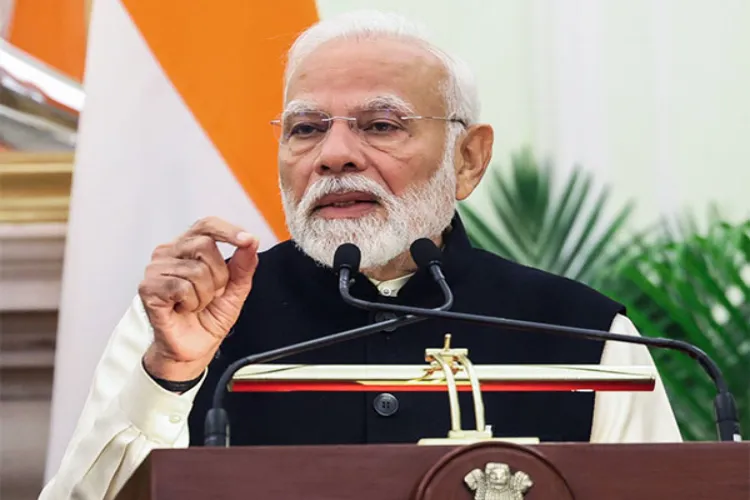
.webp "Union Information and Broadcasting Minister Ashwini Vaishnaw")
New Delhi
The Union cabinet on Wednesday approved two major manufacturing initiatives with a combined outlay of nearly Rs 1.9 lakh crore (USD 22 billion) to expand India's semiconductor ecosystem, scale up mobile phone production and strengthen its position as a global electronics manufacturing hub.
The government approved the Rs 1.27 lakh crore (USD 14.6 billion) Semicon 2.0 programme to accelerate semiconductor design and manufacturing capabilities, alongside the Rs 62,500 crore Mobile Phone Manufacturing Scheme (MPMS) aimed at increasing domestic production, boosting exports and deepening local value addition in the mobile phone industry.
The semiconductor programme builds on the first phase of the India Semiconductor Mission, and will focus on six key areas: chip design, semiconductor equipment and materials, fabrication facilities, advanced packaging and testing, research and development, and talent development.
"The Union cabinet under the leadership of Prime Minister Narendra Modi has approved Rs 1.27 lakh crore for Semicon 2.0," Minister for Electronics and Information Technology Ashwini Vaishnaw said at a news briefing.
The government expects the new scheme to attract investments of around Rs 4 lakh crore and lead to semiconductor production worth Rs 2 lakh crore during the scheme period.
India is also expected to export chips worth Rs 1 lakh crore.
"Guidelines of the schemes will be published in about 20 days," the minister said.
Vaishnaw said the scheme will support the indigenous production of chips designed in India with domestic ownership.
In contrast to the previous plan, the new scheme will provide incentives in the form of a grant against equity or link them to royalty-based funding.
"The government will mimic proposals of private investors in the chip firms," a Meity official said.
The government has cut incentives for setting up new chip plants from 50 per cent to 40 per cent for silicon fabs and 35 per cent for other fabs.
The Union Cabinet also approved a Rs 62,500 crore Mobile Phone Manufacturing Scheme to provide production-linked incentives to manufacturers over five years from fiscal year 2026-27 to 2030-31, Vaishnaw said.
"We expect to more than double the export of mobile phones to around Rs 15 lakh crore under the new scheme from around Rs 7.5 lakh crore under the previous scheme," the minister said.
Incentives will range from 2.25 per cent to 5 per cent on eligible mobile phone sales, with additional support for domestic sourcing of key components and for Indian companies investing in product design and research.
The government expects the mobile phone scheme to drive cumulative production of around Rs 39 lakh crore during its tenure, significantly increase exports and generate about 60,000 direct jobs.
India has emerged as the world’s second-largest mobile phone manufacturer by volume, with 99.2 per cent of mobile phones used domestically now manufactured within the country.
Mobile phones became India’s largest exported product category in 2025, overtaking traditional export segments such as diesel fuel and cut diamonds.
Semicon 2.0 aims to encourage the development of semiconductor intellectual property, commercial and strategic chip designs, and manufacturing capabilities for critical components required across sectors. The programme will provide support to companies involved in semiconductor machinery, materials, chemicals and gases while seeking to attract additional fabrication plants to India.
A government statement issued after the Cabinet meeting said the initiative would strengthen supply chain resilience and help establish India as a key semiconductor design and manufacturing destination. The country's first semiconductor fabrication unit is expected to begin operations in 2028.
The programme also seeks to expand Assembly, Testing, Marking and Packaging (ATMP) and Outsourced Semiconductor Assembly and Test (OSAT) capabilities, while advancing research into more sophisticated chip technologies.
India's semiconductor push has already resulted in approvals for 12 manufacturing projects with a combined investment of more than Rs 1.64 lakh crore.
These include a silicon fabrication plant, a silicon carbide facility, an integrated gallium nitride micro-LED display unit and nine packaging facilities, catering to sectors such as automobiles, telecommunications, consumer electronics, aerospace and industrial equipment.
Three approved projects by Micron, Kaynes and CG Semi have begun commercial production, while another facility is expected to start operations in 2026. The first phase has also supported 24 semiconductor design projects by startups and MSMEs, with 105 companies receiving access to industry-standard Electronic Design Automation tools.
Broadband gear-maker GX Group CEO Paritosh Prajapati said Semicon 2.0 is a transformative step towards building a globally competitive semiconductor ecosystem.
"While the policy strengthens India’s capabilities across advanced electronics manufacturing, it also creates a stronger foundation for enabling technologies, such as photonics and optical communications," he said.
Mobile phone makers' body India Cellular and Electronics Association (ICEA) Chairman Pankaj Mohindroo said the earlier PLI scheme helped India achieve scale, attract global companies, expand exports, and emerge as the world’s second-largest mobile phone manufacturer.
"MPMS now builds on this foundation by enabling large-scale mobile phone production with the deepening of the domestic value chain and a stronger component ecosystem. Our vision is to have India’s share of global mobile phone production to 35–40 per cent, and this policy will be a step towards that," he said.
Aisha Ali Hussaini, Semiconductor Tax Partner, EY India, "ISM 2.0 marks a pivotal step in India's semiconductor journey. With anchor investments secured in fabrication and packaging, and commercial production now underway, India has moved decisively from ambition to execution".
READ MORE: Magsaysay winner Safeena Husain wants to send 10 million girls back to school
"The programme's focus on strengthening the broader ecosystem, including equipment, materials, design IP, R&D, and supply chain capabilities, reflects the next stage of sector development. With significant incentives across key segments, ISM 2.0 has the potential to position India not just as a manufacturing destination, but as a globally competitive hub for semiconductor innovation."











.webp "Representational image")






.webp)