Jaisalmer
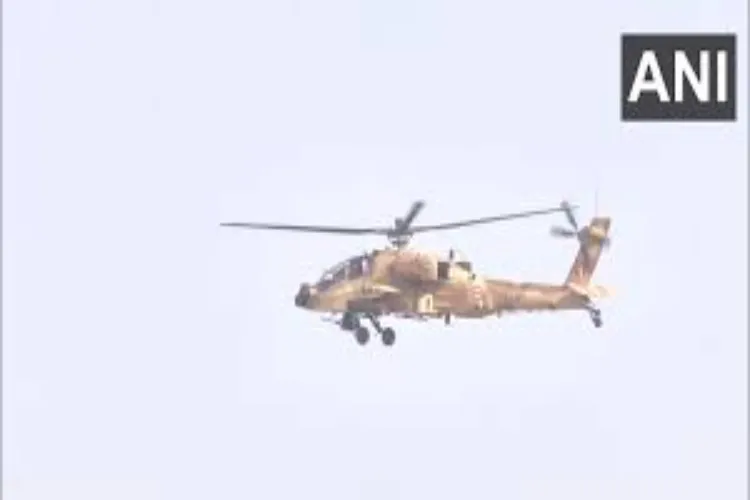
The Indian Army on Thursday showcased the operational capabilities of its newly inducted Boeing AH-64 Apache attack helicopters during a live-fire drill, ‘Brahmastra’, conducted at the Pokhran Firing Range.
The exercise highlighted the Army’s increasing emphasis on precision-strike capabilities and network-centric warfare. During the drill, Apache helicopters executed accurate strikes on designated targets in a simulated combat setting, deploying AGM-114 Hellfire missiles, rockets, and onboard gun systems.
The primary objective of the exercise was to assess combat preparedness and ensure seamless coordination between pilots and ground support teams.
The Boeing AH-64 Apache is considered one of the most advanced multi-role combat helicopters globally. It is equipped with a 30 mm chain gun, Hellfire anti-tank missiles, and Hydra rockets, along with sophisticated targeting technologies such as Longbow radar and night-vision systems. These helicopters are capable of operating in diverse conditions, including night and all-weather environments.
Colonel Vikrant Sharma, Commanding Officer of the Apache 451 Squadron, stated that the exercise focused on enhancing readiness for real-world combat through continuous training and system validation. He noted that pilots engaged in simulator-based training, mission planning, and target engagement, while technical teams ensured that the aircraft and weapon systems were fully operational. The successful execution of the firing drill demonstrated both the accuracy of the systems and the preparedness of the personnel.
He further emphasised the critical role of attack helicopters in modern warfare, particularly in providing immediate fire support to ground forces under the direct control of land commanders. He added that future battlefields would increasingly involve the integration of drones, loitering munitions, artillery, and counter-UAS systems, all coordinated within the tactical airspace controlled by land forces.
Colonel Sharma also pointed out that the induction of Apache helicopters, along with indigenous platforms such as the Light Combat Helicopter (LCH) Prachand and the weaponised Advanced Light Helicopter Rudra, has significantly strengthened the Army’s combat capabilities. He described Army pilots as a blend of courage, skill, and technical expertise, ready to meet future operational challenges.
He added that the Apache’s advanced sensors and precision-strike abilities enhance the Army’s capacity to detect and neutralise threats swiftly, contributing to better coordination in ground operations. According to him, the platform’s combination of firepower, situational awareness, and adaptability makes it a key component of modern battlefield strategy.
Calling the Brahmastra exercise a success, Colonel Sharma said it demonstrated the Army’s growing technological edge and combat readiness in an evolving threat environment. He highlighted the Apache’s ability to engage both ground targets and low-flying aerial threats, describing it as a significant force multiplier.
Lieutenant Colonel Kshitiz Goel, an Apache pilot, attributed the success of the exercise to close coordination between aircrew and maintenance teams. He said that pilots underwent rigorous training and rehearsals to refine targeting procedures, while technical teams carried out detailed inspections and ensured the helicopters and weapons systems were mission-ready.
He added that constant coordination between pilots and technicians helped maintain high levels of reliability and performance. The integrated efforts enabled precise and safe execution of operations, with successful firing of gun systems, rockets, and Hellfire missiles conducted during both day and night conditions.
READ MORE: From LoC to Bollywood: Naseem Mughal played Lulli Dakait in Dhurandhar
Overall, the exercise reaffirmed the Indian Army’s operational readiness and the effectiveness of its advanced aerial combat capabilities.