Srinagar
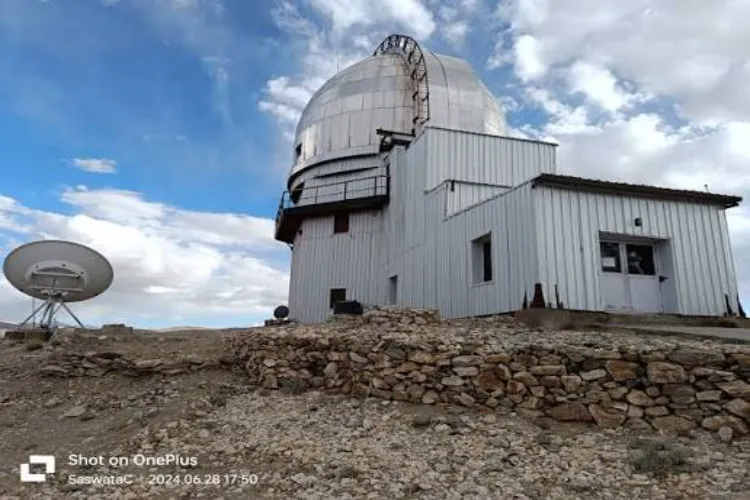
The National Institute of Technology (NIT) here is set to become the country's first NIT to have a dedicated campus-based observatory equipped with a high-performance 14-inch aplanatic Schmidt-Cassegrain telescope, officials said on Monday.
The telescope provides aberration-free flat-field images for advanced astrophotography and planetary observation. The Observatory for Astronomy and Astrophysics (NSOAA) will be inaugurated on Tuesday, marking a significant milestone in science education and research, they said.
"The facility will bring advanced observational astronomy to the campus and create a new platform for students, researchers and the wider community to engage directly with the night sky," an NIT-Srinagar spokesperson said.
The centrepiece of the observatory is a 14-inch Celestron C14 EdgeHD Schmidt-Cassegrain telescope, equipped with a computerised equatorial mount and supported by specialised astronomical imaging equipment, he said.
According to the spokesperson, the system includes planetary and cooled deep-sky cameras, LRGB filters, a 2.5x Barlow lens and high-speed imaging capabilities, allowing observations ranging from the Moon and planets to nebulae, star clusters and distant galaxies.
The facility is being developed with scientific guidance and collaboration involving the Indian Institute of Astrophysics (IIA), Bengaluru, one of India's premier institutions dedicated to astronomy and astrophysics, he said.
Dr Niruj Mohan Ramanujam, Scientist F and Head of the Science Communication, Public Outreach and Education (SCOPE) Section at IIA, is associated with the initiative as an advisor and collaborator, he said.
His expertise in astronomy education and large-scale public outreach adds an important dimension to the observatory's vision, the spokesperson said.
"With the establishment of NSOAA, NIT-Srinagar will become the first National Institute of Technology to establish a dedicated campus-based observatory of this kind, providing students with access to advanced observational astronomy and astronomical imaging facilities," the spokesperson said.
Speaking about the initiative, Professor and Head of the Department of Physics, NIT-Srinagar, Prince Ahmad Ganai, who is leading the project, said the observatory for Astronomy and Astrophysics is an effort to bring the excitement of observing and exploring the universe closer to our students.
"Our aim is to create a space where students can move beyond theoretical learning and engage directly with astronomical observations, data and scientific inquiry. We hope NSOAA will inspire curiosity, encourage research and help develop a stronger culture of astronomy and astrophysics in Jammu and Kashmir," he said.
Beyond being a telescope facility, NSOAA is envisioned as a centre for experiential science education, astrophotography, observational projects, student training and astronomy outreach, he added.
Ganai said the observatory can provide students with an opportunity to move beyond learning astronomy from books and simulations to actually acquiring and analysing astronomical data.
Its potential impact extends well beyond the NIT-Srinagar campus. The observatory could become a regional hub connecting schools, colleges, universities and science enthusiasts across Jammu and Kashmir with modern astronomy, Ganai said.
Regular sky-observation programmes, student workshops, teacher-training activities and public viewing sessions could help bring astronomy closer to young learners and encourage them to pursue physics, space science and astrophysics, he said.
Ganai said NIT-Srinagar is mulling to start its hands-on course on Astronomy and Astrophysics in the coming months, where special sessions will be allotted to schools, colleges and universities in the valley as part of its outreach programme.
The facility also places NIT-Srinagar among a relatively small number of Indian technical institutions with substantial campus-based astronomical observatories.
READ MORE:Mohammad Amaanullah built a fragrance empire against odds
IIT-Kanpur, for example, operates a 14-inch Schmidt-Cassegrain astronomical observatory with CCD imaging and remote-operation capabilities, the NIT spokesperson said.

.webp "Representational Image")








.webp "Activists Umar Khalid and Sharjeel Imam")


.webp)